

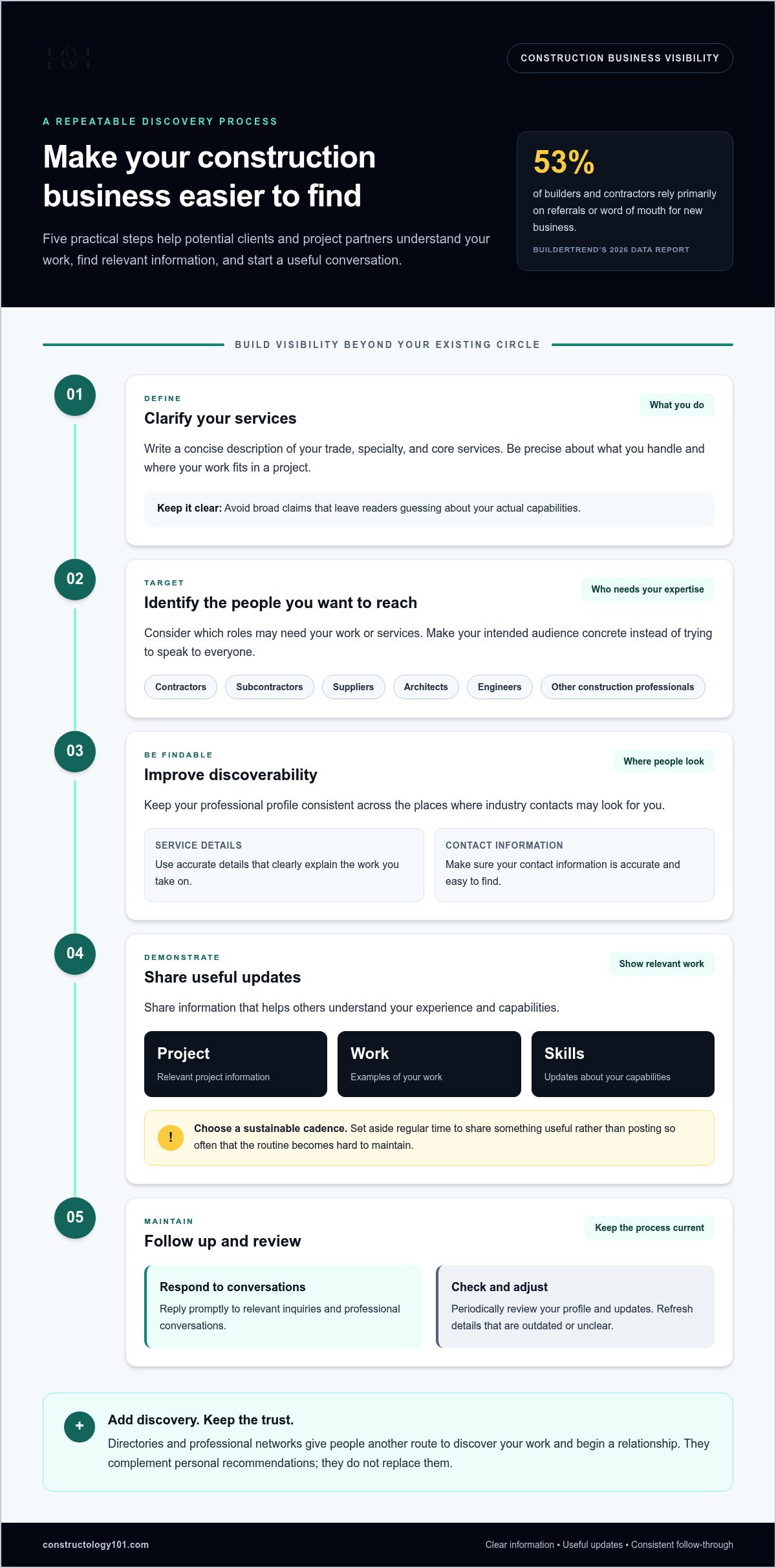
Buildertrend’s 2026 Data Report found that 53% of builders and contractors rely primarily on referrals or word of mouth for new business. Those trusted recommendations matter, but they can leave your next opportunity dependent on who remembers your name and when they need your services. Moving beyond word-of-mouth referrals in construction means adding repeatable ways to be seen, not turning away from relationships that already work.
Referrals can start strong conversations. But potential clients and project partners also need to understand what you do and how to find you when a recommendation isn’t already in motion. You can build that visibility while protecting the trust behind your existing connections.
This guide lays out practical steps to become more discoverable, strengthen relationships across construction roles, and create opportunities beyond your immediate circle. You’ll learn how to clarify your online presence, share your work, and use industry networking, including a construction directory like Constructology 101. The goal is a manageable plan that complements referrals with more consistent visibility and connection.
Key Takeaways
- Make your services, specialties, project types, and capabilities easy for the right construction professionals to understand.
- Build a simple discovery routine: share relevant work, keep your presence current, and follow up on professional conversations.
- Use referrals, directories, and professional networks for different strengths, from personal endorsement to structured discovery and relationship-building.
- Turn moving beyond word-of-mouth referrals in construction into a manageable four-week plan with clear, controllable goals.
- Explore Constructology 101 as a complementary industry directory and network, with profiles visible to all users and membership at $1/month.
Why construction businesses need more than word-of-mouth referrals
Referrals can open doors with something every construction professional values: trust. A satisfied client or respected colleague can explain the quality of your work in a way a short introduction can’t. But referrals often travel through existing relationships, so opportunity can depend on who knows your business, what they remember about it, and when someone in their circle needs your skills.
That’s the difference between being recommended and being discoverable. A contractor may earn repeat work from past clients while remaining unfamiliar to a new project team. A subcontractor could be the right fit for a trade package but outside the general contractor’s network. Suppliers, architects, engineers, landscapers, and laborers can face the same gap when potential collaborators don’t know their specialties or how they contribute to a project.
Referrals are valuable, but they do not make a business easy for everyone to find. The principles behind word-of-mouth marketing principles help explain why recommendations matter. The practical next step is to pair that trust with ways for people outside your current circle to learn what you do. That’s the focus of moving beyond word-of-mouth referrals in construction.
Where referral-only growth can leave gaps
A small network may generate steady introductions, yet still limit exposure to new project partners. If your work comes mostly through familiar clients or peers, professionals in other trades may not know to consider you. A quiet period can make that reliance more visible. It doesn’t mean past referrals have failed; it may simply show that your opportunities are closely tied to the activity of your existing contacts.
For example, an engineer who has collaborated with the same contractor for years might not hear about a new supplier through that circle. A landscaper could be well regarded but less visible to architects seeking a project partner. Additional visibility can help close these awareness gaps, but no single channel guarantees contracts. Treat each one as a way to create more chances for relevant conversations.
Keep trust while widening construction-industry visibility
Adding a directory presence or participating in a professional network doesn’t require replacing personal recommendations. These channels give people another route to discover your work, understand your role, and begin a relationship. Make that connection easier by naming your trade or specialty, explaining the project types you take on, and describing your capabilities in direct, accurate language.
Think about what a potential partner needs to know. A subcontractor can outline the work they handle; a supplier can describe the products or project information they share; an architect or engineer can make their expertise easier to recognize. Be specific without overstating what you do. Then follow through when someone responds. Reliable communication and clear expectations help turn initial visibility into professional trust. Strong construction business relationship management supports that process, from first contact to continued collaboration.
Keep referrals in your toolkit. Add repeatable ways to be found, explain your value, and connect with people beyond your usual circle. Together, these efforts make opportunity less dependent on chance while preserving the relationships that already support your business.
How to build a repeatable construction business discovery process
Make discovery a routine, not a one-time profile update. A clear process helps potential clients and project partners understand what you do, find relevant information, and start a useful conversation. Repeatable discovery means making your professional information easy to find and understand. Use these steps to build a system you can maintain alongside project work.
- Clarify your services. Write a concise description of your trade, specialty, and core services. Be precise about what you handle and where your work fits in a project. Avoid broad claims that could leave a reader guessing about your actual capabilities.
- Identify the people you want to reach. Consider which roles may need your expertise, such as contractors, subcontractors, suppliers, architects, engineers, or other construction professionals. The U.S. Small Business Administration guide on market research offers a framework for thinking about customer segments and demand.
- Improve discoverability. Keep your professional profile consistent across the places where industry contacts may look for you. Include accurate service details and contact information, and make sure your description clearly explains the work you take on.
- Share useful updates. Post relevant project information, work examples, or capability updates that help others understand your experience. Choose a sustainable cadence, such as setting aside regular time to share something useful, rather than posting so often that the routine becomes hard to maintain.
- Follow up and review. Respond to relevant inquiries and conversations promptly. Periodically check whether your profile and updates still reflect your work, then adjust details that are outdated or unclear.
Make your construction work easy to understand
Give people enough detail to recognize a fit without making them decode industry shorthand. A concise description might name your trade, a specific specialty, the types of projects you support, and the services you provide. Share project information that illustrates relevant experience, but don’t imply credentials, responsibilities, or results you can’t accurately claim. Keep the same details consistent across your professional profiles so a potential partner can quickly understand what you do.
Turn visibility into ongoing professional relationships
Discovery becomes more valuable when it leads to thoughtful contact. Introduce complementary professionals when there’s a clear reason to connect, and explain what makes the introduction relevant. After a useful conversation or project-related exchange, follow up with a specific detail or next step. Track actions you control, such as profile updates, relevant posts, and completed conversations. Treat contracts and lead volume as outcomes, not guaranteed measures of effort.
Constructology101 provides a construction-specific place to share your professional information through an interactive construction directory listing. Profiles are visible to all users, and membership is $1/month.
Referrals, directories, and professional networks: what each adds
These channels serve different purposes. A referral brings a personal introduction. A directory helps people search beyond the contacts they already know. A professional network creates space to build and maintain connections over time. Understanding the difference makes moving beyond word-of-mouth referrals in construction a matter of adding useful options, not choosing one channel and abandoning the others.
| Channel | Discovery | Trust | Relationship-building |
|---|---|---|---|
| Referrals | Usually reach people connected to the person making the recommendation. | Include a personal endorsement and context about the professional’s work. | Can open a conversation through an existing relationship. |
| Directories | Help people find professionals by role, specialty, or services, including beyond their current contacts. | Make service information available for review, but don’t replace a personal endorsement. | Give potential collaborators a starting point for an introduction. |
| Professional networks | Help members discover and keep up with other construction professionals. | Build familiarity through profiles, shared information, and continued interaction. | Support ongoing connections and project-related communication. |
What word-of-mouth does well, and what it cannot do alone
A recommendation can carry useful detail: someone may explain how a contractor handled a job, why a subcontractor suited a project, or how a supplier supported a team. That context helps a new contact approach the conversation with a degree of confidence. Referrals aren’t outdated or unnecessary. They work best when people in your network know what you do and recognize when to recommend you. If they don’t know your specialty or hear about a relevant need, they may not think to make the connection.
How directories and networks complement personal introductions
A directory adds structure. Instead of relying only on someone to remember your name, a potential project partner can look for professionals by construction role or service. An architect, for example, might use a directory to find a specialty trade; a contractor could discover a supplier or an engineering professional outside their usual circle. A clear profile helps make that first discovery meaningful.
A professional network can carry the conversation further. Members can share project information, see what others are working on, and communicate through network tools. Constructology101 connects construction professionals through its Directory and Industry Network & Trusted Connections. Profiles are visible to all users, supporting open discovery rather than limiting visibility to existing connections. For a deeper overview, explore the modern construction professional network.
Use each channel for what it does well: referrals for personal endorsement, directories for structured discovery, and professional networks for continued connection. Visibility creates an opportunity to be found, not a promise of project selection. A directory listing or network profile works alongside trusted introductions, giving people another way to learn about your work and decide whether to start a conversation.
A practical plan for moving beyond referrals in construction
Build visibility in manageable steps. This four-week starter plan turns a broad goal into actions you can fit around project work. Set targets you control, then give the routine time to support recognition and conversation. The aim isn’t to replace referrals or force a contract on a schedule. It’s to make your professional presence easier to find and maintain.
- Week one: clarify your positioning. Write a short description of your trade, specialty, project types, and capabilities. Make sure a potential project partner can quickly understand where your work fits and what you contribute. Update any professional descriptions that are unclear or out of date.
- Week two: establish a discoverable presence. Complete or refresh a professional profile in a directory or industry network. Check that your services and contact details are accurate, and include relevant project information that illustrates your work. Treat this as a useful reference for people who encounter your name through any channel.
- Week three: participate with purpose. Share one relevant project update or capability detail, then spend time engaging with construction professionals whose work connects to yours. A thoughtful comment or direct introduction can be more useful than a stream of generic promotional posts. Aim to start relevant conversations, not collect reactions.
- Week four: review and refine. Note which activities you completed and whether they led to useful exchanges. Identify unclear profile details, promising connections, or a follow-up you owe. Keep what fits your schedule and adjust what doesn’t. A steady routine is more sustainable than a burst of activity you can’t maintain.
Start with a manageable visibility routine
Choose a rhythm you can sustain, such as reviewing your profile and sharing a relevant update at regular intervals. Focus on information that helps construction peers understand your work: a project detail, a service clarification, or a practical observation from your role. Keep each update accurate and professional. Relevance builds a clearer picture of your capabilities than frequent posts that say little.
Review progress without expecting instant contracts
Track actions and conversations, not just attention. Record where a useful exchange began when you know. Don’t assume every opportunity came from one channel; people may discover you in one place and connect elsewhere. Review which activities lead to relevant discussions, then adapt the routine to your available time.
Online discovery doesn’t have to feel impersonal. Use a profile or update to make the introduction, then follow up directly with a specific, thoughtful message. That combination gives people context before you connect and keeps the relationship human. Constructology101’s construction-focused directory and network provide a place to put this plan into practice through your construction-industry presence.
Use Constructology 101 to extend your construction-industry connections
Referrals remain valuable, and they work best alongside ways for new people to discover your work. Constructology101 brings a construction-focused directory and professional network together, giving industry professionals another place to present their services, share project information, and connect. It’s a practical option for moving beyond word-of-mouth referrals in construction while keeping personal relationships central to how you build trust.
Showcase work and connect across construction roles
The Constructology101 Directory offers a membership-based listing where construction professionals can showcase their skills and services. A clear profile helps others understand your role and where you may fit into a project. Profiles are visible to all users, supporting discovery beyond your existing connections.
The Industry Network & Trusted Connections adds ways to keep professional conversations moving. Members can share project information and communicate through integrated messaging. For example, a contractor who finds a relevant subcontractor can use the profile as a starting point, then follow up directly to discuss the potential fit. These tools support connection and communication; they don’t guarantee a lead, contract, or project selection.
For added search visibility, Recommended Contractor appears at the top of the Find Members search page. Members can also use Maximizing My Reach to make a post go beyond their connections and show on the feeds of the entire network. These features offer additional ways to make work and capabilities visible to construction peers.
Understand membership and Pioneer Member benefits
Membership is $1/month. Pioneer Member benefits include early access to new features and a voice in platform development. Membership dues are tax-deductible. This gives members a clear understanding of the monthly fee and the ways Pioneer Members can participate as the platform develops.
Use your profile to explain what you do, share relevant work when it helps others understand your capabilities, and follow up thoughtfully when a connection develops. Those steady actions can complement referrals with more avenues for discovery and professional conversation. They don’t replace the trust built through reliable work and direct relationships.
Learn more about Constructology101’s construction directory and network through Build more connections with Constructology 101.
Make your next connection easier to find
Choose one practical step to take this week: refresh your professional profile, share a relevant project update, or follow up with someone whose work complements yours. Small, steady actions can make your expertise clearer to people beyond your current circle. That’s the momentum behind moving beyond word-of-mouth referrals in construction: build on trusted relationships while making it easier for new ones to begin.
Constructology101 offers construction professionals a place to showcase their work and connect through an open industry network. Profiles are visible to all users. Membership is $1/month, and dues are tax-deductible. Pioneer Members receive early access to new features and a voice in platform development.
Give industry peers another way to discover what you bring to a project. Build more connections with Constructology101. Keep showing up with clarity and purpose. The relationships you build today can create new possibilities over time.
Frequently Asked Questions
How can construction businesses get work beyond word-of-mouth referrals?
Build more ways for people to understand and find your work while continuing to nurture referral relationships. For example, a trade contractor can create a profile that explains the work they take on, share a relevant project update, and join conversations with professionals involved in related work. This is a practical starting point for moving beyond word-of-mouth referrals in construction. Track useful conversations and follow up, but don’t treat any channel as a guarantee of projects.
Are word-of-mouth referrals enough for a construction business?
They can be a strong source of trust, but they may not reach people outside the network making the recommendation. Imagine a project team needing a specialty trade while its members have no shared contacts in that field. Clear online information can help that team learn who you are and what you do. Keep nurturing referral relationships while also making your services visible to people who don’t already know your business.
How do construction professionals find new business connections online?
Start by finding online spaces where construction professionals share information about their work, then make your role and interests clear. If you’re a supplier, for instance, share project information that helps contractors understand what you provide and when it may be relevant. Respond to useful posts with specific, professional comments, and continue the conversation directly when there’s a clear reason. A directory or industry network can help you encounter professionals beyond your existing contact list.
Can a construction directory replace referrals?
No, a directory is best used alongside referrals. A personal introduction can provide context about a professional, while a directory gives someone a way to find and learn about businesses they weren’t already referred to. For example, a project partner could use a directory to identify a trade and then explore the professional’s profile before reaching out. Each channel contributes something different, and neither a directory listing nor a referral guarantees project selection.
What should a construction professional include in an online profile?
Make your role and services specific enough that a potential project partner can quickly recognize a fit. A useful profile might state your trade, the specialty work you handle, the project types you support, and the professional roles you typically collaborate with. Add accurate project details that illustrate your work, without implying experience or credentials you don’t have. Review the profile after your services or capabilities change so people aren’t relying on outdated information.
How does Constructology101 help construction professionals connect?
Constructology101 combines the Constructology101 Directory with Industry Network & Trusted Connections. Members can showcase skills and services, share project information, and communicate through integrated messaging. Profiles are visible to all users, giving construction professionals a way to find and learn about one another beyond existing contacts. Membership is $1/month. Use the profile and network to support discovery and communication, while recognizing that participation doesn’t guarantee referrals, conversations, or contracts.
What does Maximizing My Reach do on Constructology101?
Maximizing My Reach makes a post go beyond your connections and show on the feeds of the entire network. It can be useful when an update is relevant to construction professionals outside your direct connections, such as sharing project information or describing a capability. Keep the post accurate and useful to its broader audience. Wider distribution creates another opportunity for people to see your information, but it doesn’t guarantee replies, project opportunities, or a contract.


