

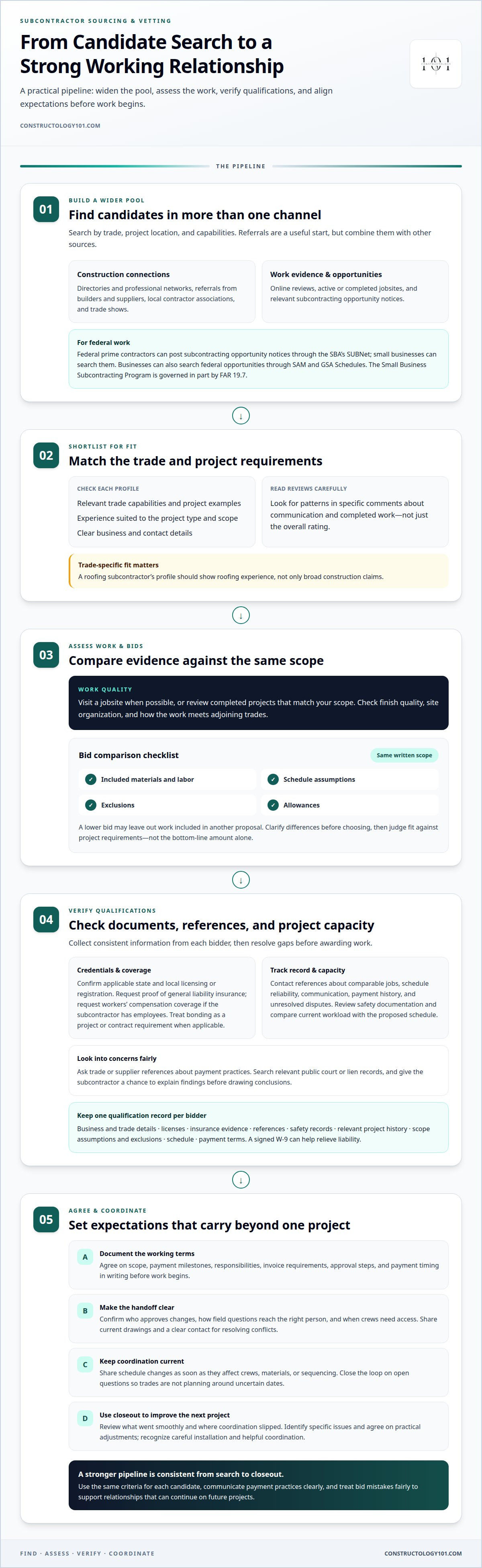
The strongest subcontractor pipeline uses more than one channel. To understand how general contractors find new subcontractors, combine referrals, construction-focused networks, and reviews of work at active or completed jobsites. For federal work, prime contractors can post subcontracting opportunity notices through the U.S. Small Business Administration’s SUBNet, where small businesses can search them.
A referral is a useful starting point, but it does not tell the whole story. Look for trade partners, assess their profiles, references, work quality, and payment practices, then set expectations that can sustain the relationship beyond one project. A sound process moves from finding candidates to vetting them carefully and agreeing on how you will work together.
Key Takeaways
- Build a wider candidate pool through referrals, construction networks, jobsites, and relevant subcontracting opportunities.
- Review each candidate’s profile, references, work history, insurance, and payment documentation before awarding work.
- Set clear expectations and handle bid mistakes fairly to create relationships that can carry into future projects.
- Match trade-specific experience to the project, then assess work quality and ask references about warranty and punch-list performance.
1. Finding subcontractors through construction websites and networks
Start with construction-focused directories and professional networks. Search by trade, project location, and capabilities, then compare profiles for relevant work examples and clear contact details. For example, a roofing subcontractor’s profile should show roofing experience, not just broad construction claims. Referrals from builders and suppliers can add candidates to your shortlist, while online reviews offer another perspective on communication and completed work. Look for patterns in specific comments rather than relying on an overall rating alone.
Assess the work itself. Visit a jobsite when possible, or ask to see completed projects that match your scope. Check finish quality, site organization, and how the work meets adjoining trades. A polished portfolio can help identify candidates, but seeing an installation in person gives you more context. Apply the same criteria to each candidate for a fair comparison.
How do general contractors compare subcontractor bids and pricing? Compare proposals against the same written scope, not just the bottom-line amount. Check included materials and labor, schedule assumptions, exclusions, and allowances. A lower bid may leave out work included in another proposal. Clarify differences before choosing, then assess how well each bid fits the project requirements.
Local contractor associations and trade shows can help you meet specialists and learn about their work. Use conversations to identify trades that fit your project, then follow up by reviewing profiles, references, and job examples. For example, an introduction to an electrical subcontractor at a trade show can lead to a focused discussion about experience with your project type.
For federal work, use the right opportunity channels. The U.S. Small Business Administration’s SUBNet database lets federal prime contractors post subcontracting opportunity notices and small businesses search them. Businesses can also search federal opportunities through SAM and GSA Schedules. The Small Business Subcontracting Program is governed in part by FAR 19.7, according to the Federal Acquisition Regulatory Council. Use these resources to find potential partners, then assess their relevant capabilities and project fit before shortlisting.
2. Checking contractor profiles, payment practices, disputes, and liens
Start with the subcontractor’s profile and qualification documents. Compare listed trade capabilities with the project scope, then review similar work examples and business history. Check licensing and registration requirements for the project location. Requirements vary by state, and some states fine general contractors or homeowners for hiring unlicensed contractors. Keep the review specific to the project location and trade.
What licenses, insurance, and bonding should subcontractors have in the US? Confirm applicable state and local licensing or registration, and request proof of general liability insurance. If the subcontractor has employees, request workers’ compensation coverage. Treat bonding as a project or contract requirement, and include it in your qualification criteria when the work calls for it.
Check references, safety records, and financial stability with focused questions. Ask past clients about schedule reliability, communication, and unresolved disputes. Review available safety documentation and ask how incidents were handled. To assess financial capacity, compare the subcontractor’s current workload with the proposed schedule, and ask trade or supplier references about payment practices. Search relevant public court or lien records, then give the subcontractor a chance to explain any findings before drawing conclusions.
How do general contractors check subcontractor references, safety records, and financial stability? Contact references directly, ask about comparable jobs and payment history, and review safety documentation alongside the subcontractor’s ability to staff the project. Record responses consistently so every candidate is assessed against the same criteria.
Use a qualification form or bid package to collect the same core information from each bidder: business and trade details, licenses, insurance evidence, references, safety records, relevant project history, scope assumptions, exclusions, schedule, and payment terms. What steps do general contractors use to vet and onboard new subcontractors? Review those documents, resolve gaps, agree on scope and payment milestones, then document responsibilities before work begins. Contractors generally don’t have to withhold taxes from subcontractor payments, but requesting a signed W-9 can help relieve liability.
Payment practices affect referrals: builders may hesitate to recommend a subcontractor if they’re unsure the hiring contractor will pay. Set clear invoice requirements, approval steps, and payment timing in writing. For an organized way to connect through construction-focused profiles, explore a construction professional network.
3. Building long-term relationships with subcontractors
Begin each project with a clear handoff. Confirm who approves changes, how field questions reach the right person, and when crews need access. For example, give the framing lead a current drawing set and one contact for resolving layout conflicts. Clear communication channels reduce avoidable rework and help trades coordinate their work.
Keep communication consistent after kickoff. Share schedule changes as soon as they affect a subcontractor’s crew, materials, or sequencing. If inspections delay a drywall start, explain the revised sequence and confirm the next handoff. Close the loop on open questions so a trade is not left planning around uncertain dates.
Build feedback into closeout. Review what went smoothly, where coordination slipped, and what to improve on the next project. Be specific: identify a late material decision or drawing conflict, then agree on a practical adjustment. Recognition matters too. Let a trade lead know when careful installation or quick coordination helped protect the schedule.
Handle bid mistakes fairly and communicate directly. Matt Risinger says he tries to make subcontractors whole when they make bid mistakes, helping keep them available for future jobs. That is his approach, not a universal pricing rule. For your projects, discuss the error, its impact, and a workable resolution before deciding how to proceed.
Think beyond one closeout. Matt Risinger says he has worked with some construction trades for more than a decade. Repeat partnerships grow through dependable coordination, respect for each trade’s expertise, and honest conversations when plans change. After a successful project, note what made the collaboration work, such as timely submittals or clean handoffs. Apply those lessons to the next job while accounting for its specific conditions.
4. How do contractors find qualified subcontractors for a specific trade or project?
How general contractors find new subcontractors for a specific project begins with translating drawings and specifications into clear trade requirements. Define work boundaries, coordination needs, access conditions, and finish expectations. For example, a masonry package may need to address wall assemblies, opening details, and coordination with structural work. Clear requirements help you find specialists whose experience matches the actual scope.
Next, compare each candidate’s experience with the project’s constraints. Ask what similar work they handled, which tasks their crew completed, and what coordination challenges arose. A subcontractor experienced with occupied buildings may suit a renovation better than one whose examples focus on new construction. How general contractors find new subcontractors should depend on project conditions, not just trade labels. Include crew availability and proposed sequencing in your assessment.
Request at least three builder references, then ask about comparable scopes and outcomes. Focus on warranty follow-through and punch-list completion: Were callbacks addressed? Did closeout items remain unresolved? These details show how the subcontractor handles obligations after installation, not only during production.
Ask candidates to show current or completed work that reflects your project’s requirements. A site visit can help you assess workmanship in context, including transitions between trades and finished details. If a visit is not practical, request project examples and discuss the specific elements your team needs to evaluate.
Base the final comparison on documented criteria. Note relevant experience, reference feedback, observed quality, coordination approach, and outstanding scope questions. For a renovation that requires careful protection of existing finishes, weigh that condition alongside trade skill. This gives you a clear basis for selecting a partner and aligning expectations before work begins. It also helps explain the decision to the project team and connect the choice to the work’s actual demands.
Constructology 101: Interactive Directory Listing
Constructology 101’s Interactive Directory Listing gives construction professionals a place to present their business and be discovered by others in the industry. Use it to extend your search beyond existing referrals and make your trade, capabilities, and project experience easier for potential collaborators to find. It complements your vetting process; review each prospective partner’s fit for the specific scope before moving forward.
For professionals who want to build industry connections over time, Pioneer membership is available at a lifetime price. Choose the directory when you’re ready to broaden your visibility and professional network, then continue assessing candidates through project examples, references, and clear scope discussions.
Explore the construction industry directory or contact Constructology 101 to take the next step.
Make Your Next Partnership a Deliberate Step
How general contractors find new subcontractors also reflects how they want future projects to run. Each new connection can strengthen your trade network, uncover skills your usual circle may miss, and provide options as project needs change. Build that network intentionally: keep priorities clear, make room for professionals with different strengths, and stay connected between active jobs.
A useful next step is to make your own capabilities and professional interests easier for construction peers to discover. Constructology 101 supports industry connections through its directory, helping professionals build visibility within the construction community. Use that visibility as a starting point for conversations and potential working relationships, then keep applying your project-specific evaluation process.
Explore Constructology 101 and grow your construction network. Take the next step with confidence, one well-matched connection at a time.
Frequently Asked Questions
Where do general contractors find new subcontractors?
General contractors find subcontractors through referrals, construction directories, trade associations, supplier relationships, jobsite visits, and online reviews. The best channel depends on the trade and project needs. For example, a contractor seeking a specialist for federal work can explore federal subcontracting notices, while one filling a local trade gap might start with industry contacts and construction-focused networks.
How do general contractors find subcontractors through referrals and industry networks?
Ask trusted builders, suppliers, and trade contacts to introduce you to subcontractors with relevant project experience. Be specific about the trade, scope, schedule needs, and type of job. A supplier familiar with a subcontractor’s work may point you toward a useful candidate, but treat the referral as a starting point. Follow up with project-specific questions before deciding.
What online platforms help general contractors find subcontractors in the US?
Construction-focused directories and professional networks help contractors discover businesses by trade and capabilities. For federal subcontracting opportunities, the U.S. Small Business Administration’s SUBNet allows prime contractors to post notices and small businesses to search them. SAM and GSA Schedules are also channels for searching federal opportunities. Choose a platform based on the project, since each serves a different purpose.
What risks should general contractors watch for when hiring a new subcontractor?
Watch for a mismatch between the proposed scope and the subcontractor’s experience, gaps in required licensing or insurance, unclear payment terms, and unresolved disputes. Missing details in a bid can cause confusion once work starts. Compare the written scope with project requirements, document agreed changes, and keep payment records organized. State licensing rules vary, so requirements depend on the project location.


