

What if your next reliable project pipeline starts before the bid is posted? Construction business relationship management turns networking into a practical way to strengthen partnerships, manage risk, and create opportunities beyond one-off bids. Instead of competing for every low-margin RFP, you can invest in relationships that support more predictable future work.
That shift matters when projects are hard to secure, subcontractor and supplier reliability is uncertain, and job-site friction slows progress. A low bid might win today’s job, but clear expectations, dependable communication, and trust help keep partners aligned when plans change. Strong relationships aren’t just a soft skill. They’re part of a resilient business strategy.
This guide explains how to move from transactional bidding to a relationship model that supports steady project flow and smoother collaboration. You’ll learn how to identify potential partners, build trust before work begins, and keep communication moving. We’ll also cover how an Interactive Directory Listing can make your capabilities easier to find and how integrated messaging can help partners connect directly.
Key Takeaways
- Use construction business relationship management to shift from one-off bids toward partnerships built for ongoing collaboration.
- Make your specialties, capabilities, and relevant project experience easy for the right industry professionals to find.
- Review your network for gaps in trades and suppliers, then prioritize connections your upcoming projects may need.
- Use digital networking to expand professional connections beyond your existing contact list and in-person events.
- Consider how an Interactive Directory Listing, integrated messaging, and Pioneer Membership can support a more connected construction network.
Why Transactional Construction Models Are Failing in 2026
Construction business relationship management is the deliberate cultivation of partnerships across a project network, including general contractors, specialty trades, suppliers, architects, and engineers. It applies the broader Business Relationship Management discipline to construction’s fragmented supply chain, where separate firms must coordinate their work.
The transactional model is straightforward: issue a bid, choose a price, complete the job, and move on. A relationship-first approach adds continuity. Partners become familiar with one another’s capabilities, communicate expectations earlier, and have a reason to work through problems together. This doesn’t eliminate risk, but it can make coordination more dependable than starting from scratch on every project.
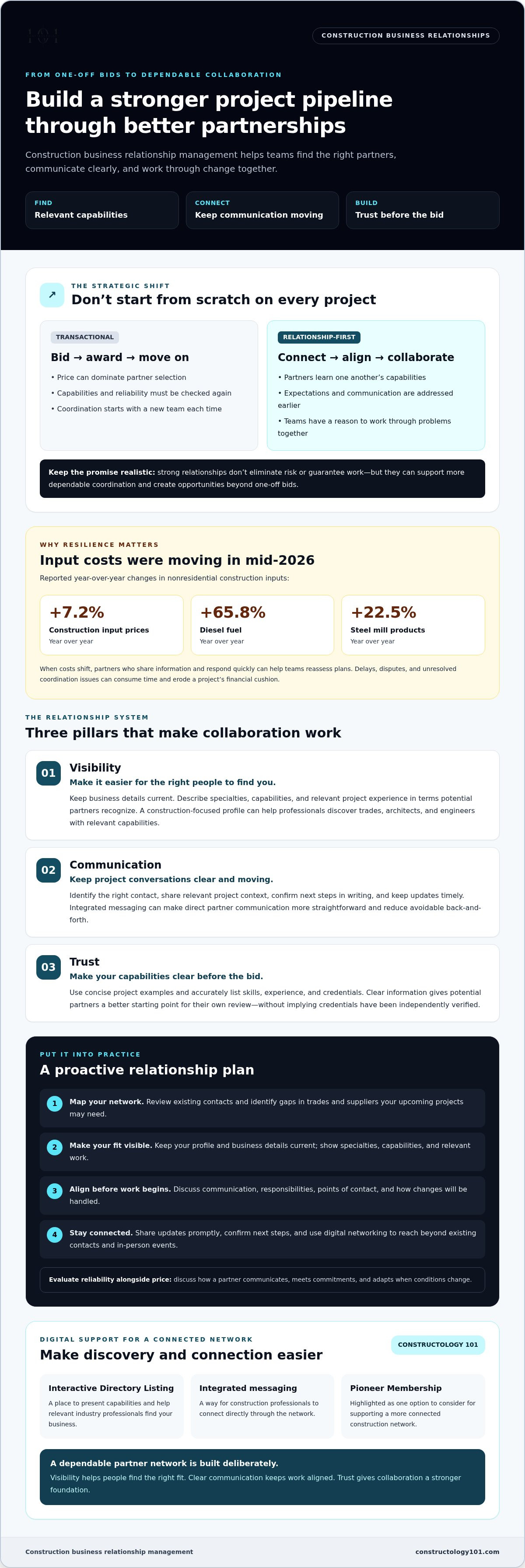
In 2026, that resilience matters. Assemble Pro Blog reported that nonresidential construction input prices were up 7.2% year over year in mid-2026, with diesel fuel up 65.8% and steel mill products up 22.5%. When costs move, a network that shares information and responds quickly can help teams reassess plans. Poor relationships can add pressure through delays, disputes, and thin margins. Rework and unresolved coordination issues consume time and erode a project’s financial cushion.
The Transactional Trap: Why Low Bids Cost More
Chasing the lowest price can look efficient, but price alone doesn’t show whether a partner communicates clearly, meets commitments, or adapts when conditions change. A one-and-done contract may also leave little incentive to invest in coordination beyond the immediate scope. Checking references, comparing capabilities, and aligning a new team for every job creates more work and uncertainty. Evaluate reliability alongside the bid by discussing communication, responsibilities, and how changes will be handled.
The Relationship Advantage: Predictability and Profit
Trusted partners can create a referral loop. A specialty subcontractor who values a GC’s planning and communication may recommend that GC to owners or other trade partners. Strong working relationships can also lead to earlier conversations or invitations to bid, though they don’t guarantee work. Agree on points of contact, share updates promptly, and confirm responsibilities. That consistency can reduce on-site friction and give teams more room to address issues before they disrupt progress.
The 3 Pillars of Construction Business Relationship Management
Construction business relationship management works best when partners can find one another, communicate clearly, and assess each other’s capabilities. These pillars matter on the ground: a foreman needs to identify a suitable trade, know who to contact, and understand what experience that partner brings. A national construction directory can support this process by organizing professional profiles across the broader construction community.
Visibility: The Foundation of Discovery
Visibility means making it easier for the right people to find you for work that fits your skills. Broad social networks can help professionals connect, but specialty trades may be harder to discover when profiles and conversations span many industries. A construction-focused digital profile gives you a place to explain what work you do and helps you find architects, engineers, and trades with relevant capabilities. Keep your business details current and describe your specialties using terms potential partners will recognize.
Communication: Keep Project Conversations Moving
Email remains useful, but scattered threads can make it difficult to track who said what or where a question stands. Set clear communication habits: identify the right contact, share relevant project context, and confirm next steps in writing. Integrated messaging can make direct partner communication more straightforward. Constructology 101 includes an integrated messaging system, giving construction professionals a way to connect through the network and reduce avoidable back-and-forth.
Trust: Make Your Capabilities Clear
Trust starts before the bid. A complete digital profile can help a potential partner understand your skills, experience, and fit without relying on a vague introduction. Use concise project examples to show the type of work you’ve completed, and list credentials or capabilities accurately. Don’t imply that a credential has been independently verified unless you know it has. Clear information gives partners a better starting point for their own review and can reduce repetitive pre-qualification questions.
These pillars reinforce one another. Visibility helps the right people discover your business, communication turns discovery into a useful conversation, and a credible profile gives that conversation a foundation. An Interactive Directory Listing can bring key business details together in one place. To see how this approach fits a modern construction network, explore how to choose a national construction directory, or learn more about Constructology 101 at Constructology 101.
Construction BRM vs. Traditional Networking: What Works Now?
A Rolodex, a stack of business cards, or a contact list can preserve names. They don’t show whether a firm’s capabilities match a project, keep a profile current, or make it easy to restart a conversation with context. Construction business relationship management uses ongoing connections and useful business information to turn introductions into a network you can actively maintain.
Trade shows still have value. In-person conversations can build rapport quickly, but they depend on who attends, when you meet, and whether you follow up. Online construction networking can extend your reach beyond a single event. A digital directory can help professionals discover one another across the national construction community, while detailed profiles give them a starting point for assessing fit before making contact.
The Scalability of Digital Directories
In-person networking is limited to the event and the people in the room. A digital profile can remain available while you’re focused on a job site, so potential partners can review your listed capabilities without waiting for the next event. Generalist platforms serve broad industries, which can make specialty trade expertise harder to find among unrelated profiles. A directory focused on construction professionals offers a more relevant place to present those skills.
Search and filtering options can make discovery more precise, but confirm what a directory actually supports before relying on it. If a project calls for a particular specialty or certification, check whether the profile fields and search tools help you identify it. Don’t assume a listing verifies credentials unless the platform clearly explains its verification process.
Moving Beyond the Business Card
A business card captures contact details at one moment. An interactive profile can provide more context, such as a firm’s specialties and project experience, and can be updated as its capabilities change. Constructology 101’s Interactive Directory Listing is designed to help construction professionals showcase their skills through detailed listings. Its integrated messaging supports direct communication, giving partners a way to connect beyond a handshake or introduction.
Use profile information as a starting point, not a substitute for due diligence. Review relevant experience, confirm credentials directly, and discuss scope, availability, and expectations before committing. This helps you assess potential construction partners using more than a good first impression. The strongest network combines human judgment with clear, accessible information and keeps connections active between projects.
How to Implement a Proactive Relationship Management Plan
Strong construction business relationship management doesn’t require an enterprise team or a complicated rollout. Start with a practical routine: keep your information current, stay in touch with important partners, and review whether your connections are contributing to better-fit opportunities.
- Audit your network. List the trades and suppliers you rely on. Note gaps, single points of failure, and contacts you haven’t kept in touch with. Identify which upcoming project needs could be difficult to cover.
- Update your profile. Describe your specialties, capabilities, and relevant project work clearly. Keep claims specific and accurate, and remove details that are no longer current.
- Centralize partner communication. Choose an industry-relevant channel for introductions and project conversations. Confirm who owns each follow-up and make key details and next steps easy to find.
- Give before you ask. Share useful project context or practical knowledge with your community. Build familiarity before a bid is urgent instead of reaching out only when you need a quote.
- Measure what matters. Track referrals, repeat collaborations, and bid-win ratios over time. Look for patterns in which relationships lead to well-matched work, not just more conversations.
Optimizing for Discovery
Write your profile for the people you want to reach. Use clear terms for your specialty, capabilities, and project experience, including language general contractors and architects may use when searching for a partner. Avoid vague claims such as “full service.” Name the work you actually do. A complete Interactive Directory Listing can give potential partners a clearer view of your business and support discovery, though no profile can guarantee search placement or contracts.
Make project examples useful by stating your role, the type of work, and the capabilities you brought to it. Keep details current so prospective partners aren’t relying on an outdated snapshot. Constructology 101’s specialized directory serves architects, engineers, and trades, while detailed listings give professionals a place to present their skills.
The “Give First” Strategy in Networking
Share relevant project information early when appropriate, such as the trade expertise you’re exploring or the kind of collaboration you need. That can help potential subcontractors assess whether a conversation makes sense before a formal RFP. Use direct messaging to clarify scope, responsibilities, and open questions, while keeping formal bid requirements and decisions clear and consistent.
Build a preferred-partner reputation through reliable follow-up, useful knowledge exchange, and respectful communication. Then review your referral and bid data regularly. If referrals rise but wins don’t, revisit your fit, proposal process, or how clearly you explain your capabilities. To put your skills in front of construction professionals, explore an Interactive Directory Listing.
Scaling Your Network with Constructology 101
Construction business relationship management needs more than a contact list. Constructology 101 is an interactive online directory and professional social network for the U.S. construction community, connecting architects, engineers, specialty trades, and suppliers. It gives professionals a focused place to present their capabilities and discover potential partners.
An Interactive Directory Listing can serve as a hub for your professional presence. Instead of relying on disconnected introductions and scattered contact details, you can bring key business information together in a detailed profile. Treat it as a relationship-building resource, not an automatic relationship manager: keep your listing current, respond to inquiries, and follow up directly to build trust.
Why an Interactive Directory Listing Is Vital
A useful listing supports three essentials: visibility, so relevant professionals can find you; credibility, through clear information about your skills; and connectivity, through direct communication. Describe your trade and capabilities specifically, and include accurate project experience that helps potential partners assess fit. A construction-focused directory makes these details more relevant than a general contact list, while integrated messaging can help move an introduction into a conversation.
Want to make your capabilities easier to discover? Learn how to list your trade business with an Interactive Directory Listing. A complete profile won’t guarantee inquiries or contracts, but it gives prospective partners a clearer starting point.
The Pioneer Membership: A Lifetime of Growth
Constructology 101’s Pioneer Membership is offered at a lifetime price, giving early adopters a way to participate in the network. Consider whether it fits your goals, such as showcasing your trade, connecting with professionals in related fields, or building a broader pool of potential partners. Membership alone can’t guarantee a return. Consistent participation, a clear profile, and thoughtful follow-up are what turn visibility into working relationships.
Build your presence, make relevant connections, and keep the conversation moving. Explore the Pioneer Membership and start building better relationships today.
Turn Stronger Relationships Into Your Next Growth Opportunity
Reliable growth comes from more than winning the next bid. Construction business relationship management helps you build a network you can return to, supported by clear business profiles, useful communication, and consistent follow-through. Start by strengthening the connections that matter to your work, then make it easier for the right partners to understand what you bring to a project.
Put that approach into action with Constructology 101. Its national directory brings together architects, engineers, specialty trades, and suppliers, while integrated messaging supports direct connection. An Interactive Directory Listing gives your capabilities a dedicated place to be discovered, and the Pioneer Membership offers early adopters a lifetime membership option.
Join Constructology 101 and explore the Pioneer Membership. Build your presence, grow your network, and take a practical step toward stronger partnerships.
Frequently Asked Questions
What is business relationship management in construction?
Business relationship management in construction is the deliberate work of building and maintaining productive connections among contractors, specialty trades, suppliers, architects, and engineers. It goes beyond exchanging contact details: partners share relevant information, communicate expectations, and follow through consistently. Strong construction business relationship management can help firms find suitable collaborators, reduce avoidable misunderstandings, and develop connections that may support future projects.
How does relationship management improve project ROI?
Relationship management can support project ROI by helping teams coordinate work, resolve questions sooner, and avoid repeated searches for new partners. Familiarity with a subcontractor’s capabilities and communication style can make planning more efficient, while clear scope discussions help limit mismatched expectations. These practices don’t guarantee higher returns, but they can reduce preventable friction and help protect time and margin. Track outcomes such as repeat work, referrals, and bid-win ratios to see what’s improving.
Why is a specialized directory better than LinkedIn for contractors?
A specialized construction directory organizes profiles around the industry’s professionals and services, making it a focused option for discovering relevant trades, suppliers, architects, and engineers. LinkedIn connects people across many industries, so construction-specific capabilities may be less central to how users browse. A directory can complement, not replace, general social networks. Review its profile details and search features to confirm they fit your needs, and verify qualifications directly before hiring.
How can I find reliable subcontractors nationally?
Start with a national construction directory to discover subcontractors by the services and skills they describe, then assess each candidate before making a commitment. Review relevant project experience, ask for references, confirm credentials directly, and discuss availability, scope, communication, and expectations. A detailed profile or introduction can help you build an initial shortlist, but it isn’t proof of reliability. Compare candidates’ responses and follow-through as carefully as their stated capabilities.
What should be included in a construction professional profile?
A construction professional profile should clearly explain your trade or discipline, services, capabilities, and the types of projects you’ve worked on. Add concise examples that describe your role and relevant experience, plus accurate credentials or certifications where applicable. Include current business contact details and respond to messages consistently. Specific, verifiable information helps potential partners assess fit more easily than broad claims such as “best in the business.” Update the profile as your work changes.
How do I manage difficult relationships with suppliers or subs?
Address problems early and discuss the specific issue, its project impact, and the action needed to move forward. Refer to agreed scope, dates, and responsibilities rather than relying on assumptions. Keep communication factual, document decisions, and confirm who owns each next step. If expectations no longer align, discuss practical options directly and professionally. Consistent follow-up can help restore clarity, while repeated problems may signal a need to reassess the working relationship.
What are the benefits of a lifetime construction network membership?
A lifetime construction network membership can provide ongoing participation under the membership’s stated terms. Constructology 101’s Pioneer Membership is a lifetime-price option for early participants and includes access to networking tools such as messaging and project sharing. Consider whether the directory and community match your business goals before joining. Membership doesn’t guarantee projects, referrals, or a financial return; active participation and a clear profile still matter.
How do I get my business discovered by architects and engineers?
Make your capabilities easy for architects and engineers to understand in a construction-focused directory. Use specific service descriptions, accurate project examples, and relevant skills rather than vague promotional language. Keep your listing current and make it easy for interested professionals to contact you. Constructology 101’s Interactive Directory Listing is designed to help construction businesses showcase their services to industry peers. Clear information can support discovery, but it can’t guarantee inquiries or work.


