

The best project connection often starts before anyone needs a crew. That’s the value of effective electrical contractor networking: build familiarity and trust early, rather than reaching out only when you’re looking for work. Networking can feel like one more demand on a packed schedule, especially when an event or online profile doesn’t lead to a useful conversation.
This guide shows how to make each connection serve a clear purpose. Learn how to choose channels based on your goals, start relevant conversations with peers, suppliers, and project partners, and follow up without turning networking into a full-time job.
We’ll cover practical ways to turn a brief introduction into an ongoing professional connection, from industry events to online directories and project-sharing spaces. Constructology 101 is one option for discovering construction peers, showcasing your services, and continuing conversations through messaging and project sharing. The goal is to create a repeatable habit that keeps relationships active, so collaboration can develop before the next opportunity arrives.
Key Takeaways
- Match your electrical contractor networking approach to a clear goal, such as finding project partners, learning from peers, or improving visibility.
- Use specific conversation starters and thoughtful follow-ups to turn introductions into relationships that can develop over time.
- Compare networking channels by audience fit, interaction style, time commitment, and the follow-up they require.
- Build a repeatable routine: set an objective, identify relevant people, make contact, offer value, and track next steps.
- Decide whether a professional network, interactive directory, or lead-generation service suits your needs by checking what each actually provides.
Electrical Contractor Networking: What It Is and What It Can Help You Build
Electrical contractor networking is the practice of building and maintaining useful professional relationships with people across the construction industry. Those connections can support knowledge-sharing, referrals, collaboration, and awareness of project needs, but they don’t guarantee contracts or work. The value comes from relevant conversations and trust built over time, not from collecting the most contacts.
A useful connection grows through two-way communication. Instead of sending an unsolicited pitch, learn what the other person does, share relevant experience, and look for a way to be helpful. An electrical contractor works within a wider construction network, so relationships with professionals in related roles can provide different perspectives and help with coordination.
Who electrical contractors can network with
Choose people based on the work you want to do and the knowledge you need. A general contractor may be a potential project partner; specialty trades can help coordinate related scopes; architects and engineers can share design context; suppliers can provide product information; and fellow electrical contractors can exchange practical lessons. Each relationship has a different purpose. Relevance and trust matter more than a long contact list.
For example, an electrician interested in larger renovation projects might get to know general contractors and other trades involved in similar work. A contractor who wants to strengthen technical knowledge might connect with peers or suppliers and ask focused questions about materials, installation considerations, or common coordination challenges. Start with curiosity, not an immediate request for business.
What makes a connection useful over time
A lasting professional connection offers mutual value. That could mean communicating reliably, sharing useful knowledge, making an appropriate introduction, or following through on something you agreed to send. Small actions count. After meeting an engineer at an industry event, for instance, you might send a brief note referencing a detail from your conversation and suggest staying in touch about related work.
Keep the relationship active before a project need appears. Check in when you have something relevant to share, respond thoughtfully to their updates, or reconnect after a reasonable interval. If a project opportunity later comes up, you’ll have some familiarity to build on, making it easier to discuss scope, timing, and fit. The connection may lead to collaboration, but the project still depends on its requirements and the people involved.
That’s the practical purpose of electrical contractor networking: creating a foundation for informed conversations, professional trust, and possible collaboration. Focus on a few relevant relationships, contribute where you can, and follow through consistently.
Electrical Contractor Networking Examples for Common Business Goals
Make each networking effort serve a purpose. The examples below are illustrative scenarios, not customer outcomes or guarantees. Each starts with a business goal, then identifies a relevant conversation and a manageable next step.
Find project partners and complementary trades
Situation: You want to meet general contractors or specialty trades whose work may align with your electrical capabilities. At an industry event, ask what kinds of projects they typically work on. Then give a brief, specific introduction: “I handle electrical work for commercial renovations and am interested in learning how your team coordinates trade partners.”
Follow-up: If there’s a natural fit, suggest a short conversation to compare project requirements and working practices. Send a note afterward that refers to something you discussed and confirms any agreed next step. Treat the exchange as an introduction, not an assumption that a contract will follow. For more on building trust and maintaining professional connections, see this guide to building strong construction business relationships.
Build peer knowledge through practical exchange
Situation: You’re looking for ideas on handling a recurring coordination challenge. In a peer group or industry discussion, describe the issue clearly, then ask how others approach it. Share a lesson from your own experience, too. A useful exchange is specific and reciprocal, not just a request for free advice.
Follow-up: Thank the person who contributed, try any relevant suggestion that fits your situation, and reconnect with a brief update. If the discussion raised a topic worth exploring, ask whether they’d be open to continuing the conversation.
Improve visibility and make your capabilities clear
Situation: You want other construction professionals to understand what your business does. Create a concise directory profile that describes your services and the project types that fit your experience. If you share a project example, explain your team’s role and the work involved, while respecting any client confidentiality obligations.
Follow-up: When someone engages with your profile or project example, respond with a relevant question instead of a generic pitch. For broader ideas on choosing digital channels and starting conversations online, read this guide to online construction networking.
Across these goals, effective electrical contractor networking means connecting with relevant people, exchanging something useful, and following through appropriately. An interactive directory and professional network such as Constructology 101 offers one way to showcase your services, discover construction peers, and continue conversations through messaging and project sharing.
Compare Electrical Contractor Networking Channels Before You Commit Your Time
The right channel depends on who you want to meet and how you prefer to build relationships. Associations, events, peer introductions, online networks, and specialized directories can all support electrical contractor networking, but none creates value automatically. Consider audience relevance, opportunities to participate, and the follow-up each channel requires. For a broader look at how professional networks work, read this modern construction professional network guide.
| Channel | Best-fit goals | Interaction style | Time commitment | Follow-up needs |
|---|---|---|---|---|
| Associations | Industry participation, learning, and professional community | Member activities, discussions, and organized resources | Ongoing; depends on participation | Reconnect with relevant members and continue useful conversations |
| Industry events | Meeting several potential peers or partners around a shared topic | In-person conversations and group sessions | Focused around event dates, plus travel or preparation | Send a personal note that refers to the conversation |
| Peer introductions | Building trust with a specific professional or trade | One-to-one, often through a mutual contact | Focused and flexible | Thank the introducer and agree on a relevant next step |
| Online networks | Discovering peers and staying connected between in-person meetings | Profiles, messaging, and project sharing | Flexible; works best with consistent participation | Respond to messages and keep conversations relevant |
| Specialized directories | Making services and capabilities easier for industry peers to find | Searchable listings and profile-based discovery | Initial profile setup, then periodic updates | Reply to relevant inquiries and continue suitable conversations |
Choose in-person channels for focused interaction
Associations can connect contractors with professional communities, education, and ways to participate in the industry. Events create a setting for direct conversation, but attending alone doesn’t build a relationship. Before you go, prepare a concise introduction about your work and one thoughtful question, such as how another trade coordinates its scope with electrical work. Peer introductions can be especially useful when you have a clear reason to meet a specific person.
Use online channels to stay discoverable and connected
Searchable profiles help other professionals understand your trade, services, and relevant experience. Messaging and project sharing can extend a conversation beyond an event or make it easier to reconnect later. An interactive directory and professional network such as Constructology 101 combines service listings with tools for professional connections, messaging, and project sharing. In-person contact offers immediate conversation; online participation provides flexible ways to discover people and follow up. Choose based on your goals, then maintain the relationships you begin.
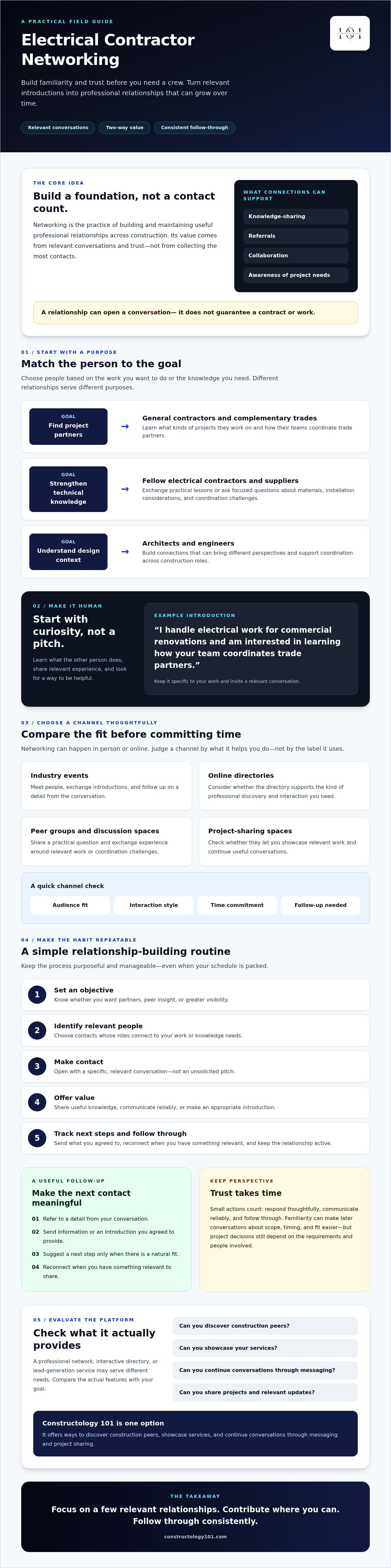
Build an Electrical Contractor Networking Routine That Leads to Better Conversations
A simple process makes electrical contractor networking easier to maintain, even during busy periods. Set a goal, identify relevant people, make a tailored introduction, offer something useful, and follow up with context. Treat the routine as relationship-building, not a promise of project work.
Start with a clear networking goal and a relevant introduction
Choose one purpose for each conversation. You might want to learn about a project type, meet a trade with complementary expertise, or make your company’s capabilities easier for peers to understand. A focused goal helps you choose whom to contact and what to ask.
Keep your introduction brief and specific. Include your electrical specialty, the kinds of projects that fit your experience, and why you’re reaching out. For example: “I focus on electrical work for building renovations. I’m interested in how your team coordinates electrical scopes with other trades.” Tailor the message to the recipient, and make it easy to respond without creating pressure.
Follow up with context, value, and a clear next step
After a conversation, refer to something you discussed so your note feels personal. If it genuinely helps, share a relevant resource, answer a question, or offer an introduction. Avoid generic check-ins sent only to stay visible. A useful follow-up respects the other person’s time and gives the conversation a reason to continue.
Track contacts in a simple spreadsheet, notes app, or another tool you already use. Record:
- Name and role: Include their company or trade so you can recall the context.
- Conversation details: Note where you connected, what you discussed, and any shared interests.
- Agreed next step: Capture what you promised to send or what you both discussed doing next.
- Reconnect reminder: Set a practical reminder based on the conversation, not an arbitrary schedule.
Fit the routine to your workload. You might review your notes during an existing office planning session or reconnect when you have a relevant update. Consistency matters more than volume. If a conversation has no clear next step, leave the door open without forcing one.
For an online option, explore the construction professional network to showcase your services and continue relevant conversations through messaging and project sharing.
Choose a Construction Networking Platform That Supports Electrical Contractor Connections
A platform should make it easier to find relevant construction professionals and continue worthwhile conversations. Before joining, check who uses it, what a profile communicates, and whether its features match how you prefer to connect. For electrical contractor networking, clarity matters: a directory, a professional network, and a lead-generation service serve different purposes.
What to assess in a construction professional network
Look beyond a platform’s feature list. Check whether its audience includes electrical contractors and the other construction roles you want to meet. Review how profiles present specialties, services, and project information. Then assess whether search and discovery help you find relevant people, and whether messaging makes it practical to contact them. Project-sharing tools can add useful context, but use them only when you’re comfortable sharing examples and have permission to do so.
- Audience relevance: Are the trades and project partners you want to connect with represented?
- Profile clarity: Can another professional quickly understand your work and the projects that fit your experience?
- Communication: Can you continue a conversation directly and in a way that suits your habits?
- Participation: Does the platform support useful connections, or does it mainly display listings?
An interactive directory helps people discover and review professional listings. A professional network supports connections and ongoing interaction among members. A lead-generation service focuses on delivering prospective customer inquiries. These categories can overlap, so check what the service actually provides. Don’t assume a directory or network guarantees leads, projects, or business results.
How Constructology 101 fits into an electrical contractor’s networking mix
Constructology 101 brings an interactive construction directory together with a professional social network for people across multiple specialties. Its directory listings let professionals showcase their services, while profiles, messaging, and project-sharing features support discovery and continued interaction. These tools can complement in-person relationships and direct introductions; they don’t replace the trust built through reliable communication and follow-through.
Professionals considering early participation can review the Pioneer Membership, which offers a lifetime deal and access to the platform’s networking tools. Check the platform for current membership details and decide whether its audience and features fit your goals.
Use your criteria to assess whether it belongs in your networking mix. Explore Constructology 101 as one option for connecting with construction peers online.
Build Relationships Before the Next Project Need
Strong electrical contractor networking isn’t about collecting names or pitching at every opportunity. It’s about choosing people and channels that fit your goals, sharing useful knowledge, and following up with care. Start with one relevant conversation, keep track of what you discussed, and make the next step feel natural.
Online tools can support that work by helping you stay discoverable and continue conversations between in-person meetings. Constructology 101 is a construction-focused directory and professional social network, with interactive listings, messaging, and project-sharing features. These tools can help you present your capabilities and connect with construction professionals, while trust still grows through consistent, professional interaction.
Ready to make your next connection more purposeful? Explore Constructology 101 and connect with construction professionals. Take one clear step today, then build from there. Good relationships start with a conversation and grow through follow-through.
Frequently Asked Questions
How can electrical contractors find networking opportunities?
Electrical contractors can find networking opportunities through industry associations, construction events, peer introductions, online professional networks, and specialized directories. Start with your goal: meeting potential project partners, learning from peers, or making your services easier to discover. Then choose a channel where those people are likely to participate. For electrical contractor networking, relevant conversations and thoughtful follow-through matter more than joining every group or attending every event.
What is the best way for an electrical contractor to meet general contractors?
Look for a natural introduction through a shared industry contact, an association, or a construction event where general contractors are likely to participate. Be ready to explain your electrical specialty and the project types that fit your experience. Ask about their work and how they coordinate trades. If there’s a potential fit, suggest a brief follow-up conversation to learn about each other’s approach, without assuming it will lead to a contract.
Can networking help electrical contractors find project partners?
Networking can help contractors discover professionals whose skills may complement their own, such as general contractors or specialty trades. A conversation can reveal whether your experience, working practices, and project interests align. Before discussing collaboration, clarify each party’s role, scope, and expectations for communication. A strong connection may create a path to explore working together, but networking doesn’t guarantee a project or replace evaluating each opportunity on its own merits.
Is online networking effective for electrical contractors?
Online networking can help electrical contractors discover construction peers and continue conversations between in-person meetings. A clear profile, relevant messages, and useful project information make it easier for others to understand your work. For example, Constructology 101 combines an interactive construction directory with professional networking, messaging, and project-sharing features. Online participation works best when it supports genuine interaction and follow-through. It complements in-person connections rather than replacing them.
How should electrical contractors introduce themselves to potential project partners?
Keep your introduction brief, specific, and tailored to the person you’re meeting. State your trade specialty, describe the project types that fit your experience, and explain why you’re reaching out. For example: “I focus on electrical work for renovations and wanted to learn how your team coordinates trade partners.” Then ask a relevant question and listen. Avoid leading with a broad sales pitch or asking for work before you understand their needs.
What should an electrical contractor include in a professional networking profile?
Include your business name, electrical specialty, services, and the kinds of projects that match your experience. Use straightforward language that helps general contractors, peers, suppliers, and other construction professionals quickly understand your capabilities. Add project examples when appropriate, describing your role and the work clearly. Share only information you’re authorized to publish. Keep the profile current so people who discover it can start a relevant conversation based on accurate details.
How often should electrical contractors follow up after making a new connection?
There’s no single schedule that suits every relationship. Follow up after the conversation while its details are fresh, especially if you promised information or agreed on a next step. Mention what you discussed and keep the message useful. If the person doesn’t respond, one polite follow-up can be reasonable; then give them room. Set a reminder to reconnect when you have a relevant reason, rather than sending repeated messages just to stay visible.


