

What if the best networking platform isn’t the one promising the most leads, but the one that helps you find relevant professionals and follow up consistently? If your contacts are scattered across referrals, email, and general social networks, choosing a general contractor networking platform can feel like another project to manage. The right fit should make it easier to discover construction professionals, share work, and start useful conversations, without treating membership as a guarantee of business.
It pays to look beyond a platform’s marketing claims. Some tools focus on project intelligence or bid management; others are built to help construction professionals connect. This guide explains the main platform types and how to assess directories, messaging, and project-sharing features against your goals. You’ll also find a practical way to introduce yourself, build relevant connections, and keep in touch. For example, Constructology 101 is a construction-focused directory and professional social network with stated features for listings, project sharing, and messaging. The aim is simple: choose a platform that fits your work, then use it with a clear, repeatable approach.
Key Takeaways
- Choose a general contractor networking platform based on the connections and work you want to support, not promises of guaranteed leads.
- Compare construction relevance, profile detail, search, messaging, and project-sharing features against your goals.
- Turn discovery into a professional connection by checking fit, reaching out with context, and following up clearly.
- Build a repeatable routine: set a goal, update your profile, search selectively, and track agreed next steps.
- Assess whether Constructology 101’s construction-focused directory and stated networking features fit the way you want to connect.
What Is a General Contractor Networking Platform and What Can It Help You Do?
A general contractor networking platform gives construction professionals a digital place to find peers, present their work, and make contact. Think of it as a professional meeting point: a general contractor might look for a specialty trade partner, while a supplier could introduce its business to contractors and other industry professionals. The goal is to make relevant people easier to discover and contact.
That can support practical steps: finding professionals whose capabilities fit a project, sharing work or project information, and starting a direct conversation. These tools apply the basic idea of business networking in a construction-focused setting. But a platform is a way to make connections, not a guarantee of projects, leads, contracts, or business growth. Results depend on who participates, the information they share, and the follow-through after an introduction.
It’s also useful to know what a networking platform isn’t. A general social network serves a broad range of interests, so construction contacts may be harder to find among unrelated content. A vendor procurement system supports purchasing or sourcing workflows. Project management software helps teams coordinate project work, while lead-generation tools focus on identifying or supplying prospective customers. Some features may overlap, but these tools have different primary purposes.
Who Uses a Construction Networking Platform?
General contractors may use one to identify specialty trades, suppliers, or professional collaborators. Architects and engineers can present their expertise and connect with construction teams; specialty trades can describe their capabilities; suppliers can introduce relevant products or services. A platform’s value depends on whether the right kinds of professionals participate and whether their profiles clearly explain what they do. A large directory is less useful if you can’t tell who fits your needs.
How Is a Networking Platform Different from a Directory?
A directory helps users find and assess listed professionals. Profiles can make it easier to compare roles, capabilities, and project interests before reaching out. A networking platform may add interaction features, such as direct messaging or project sharing, so users can move from discovery to conversation. Those features aren’t automatic: some directories are primarily listings, while some platforms support broader interaction. Check which tools are available rather than assuming every service works the same way.
Use your goal to judge the fit. If you mainly need to identify potential collaborators, relevant listings and clear profiles may be enough to start. If you also want to share project information or contact people within the platform, confirm those features are active and accessible to you. Focus on practical support for discovery and communication, not broad promises of business outcomes.
How Does a General Contractor Networking Platform Turn Discovery into a Connection?
Finding a profile is only the first step. Use a clear process to move from a broad search to a relevant professional conversation:
- Define the need: Identify the capability, collaboration, or professional perspective you’re looking for.
- Search relevant profiles: Use available categories and profile details to narrow your options.
- Review fit: Look for information related to your work, then verify experience and suitability independently.
- Make contact: Explain why you’re reaching out and ask a specific question.
- Follow up: If the person responds, agree on a practical next step and keep track of it.
Discovery finds a possibility. Review checks the fit. A thoughtful message and follow-up create an opening for a professional connection.
A profile can help someone decide whether to start a conversation. Make your role, capabilities, and project interests easy to understand, without asking readers to guess what you do. Treat profile information as an introduction, not proof of qualifications. Confirm relevant experience, references, and project requirements through your normal evaluation process before making a business decision.
What Makes a Construction Profile Useful to Other Professionals?
Write a clear business description, select accurate service categories, and keep contact details current. Share project information only when you’re authorized to do so and it’s appropriate for the audience. Keep every claim specific and factual: describe the work you perform and the capabilities you can support, not services you can’t substantiate. A focused profile gives peers useful context and a reason to reach out.
How Should a General Contractor Start a Professional Conversation?
Keep the first message brief and personal. Mention the project context or shared professional interest, then ask one specific question, such as whether the person has experience with a relevant type of work. Avoid generic pitches that could be sent to anyone. If you don’t hear back, follow up respectfully and with restraint. A message can invite a conversation, but it can’t guarantee a response.
Online tools can complement, not replace, other ways professionals meet. For example, Associated General Contractors of America (AGC) offers an association-based route to industry connections through resources and events. Whether you connect online or in person, the same habits help: be clear, be relevant, and follow through on what you agree.
To see how a construction-focused directory can support profile discovery and contact, explore the interactive construction directory from Constructology 101.
How to Compare General Contractor Networking Platforms Before Joining
Compare what a platform lets you do, not what its marketing suggests might happen. A directory, messaging tool, or project-sharing feature can support professional discovery and communication. None guarantees active prospects, leads, contracts, or business growth. Use your recurring needs as the benchmark, then check whether the platform’s current features and member activity fit.
Use this checklist to assess a general contractor networking platform before creating a profile or paying for membership:
| Area | What to check | Why it matters |
|---|---|---|
| Construction relevance | Are the professional roles and specialties relevant to your work? | The right audience matters more than broad membership claims. |
| Directory search | Can you find people by useful categories or other available profile details? | Search should help narrow discovery to relevant contacts. |
| Profile detail | Can members explain their services, capabilities, and project interests? | Useful information helps you judge whether to make contact. |
| Messaging | Is there a way to contact members, and what controls are available? | Discovery is more actionable when communication is clear and appropriate. |
| Project sharing | Can members share project information, and does that support your purpose? | Relevant examples may add context to a professional introduction. |
Which Features Matter Most to a General Contractor?
Start with the work you regularly need to coordinate. If you often seek specialty trades, check whether those categories are easy to find and whether listed profiles contain enough detail to guide outreach. If you want to introduce your own capabilities, look for profile fields that let you describe them accurately. Messaging and project sharing are useful only if they support how you intend to connect and communicate. A feature list is a starting point; test how the tools work in practice.
Check current participation, too. A platform may have relevant categories, but that doesn’t tell you whether enough suitable professionals are active there now. Review available profiles and recent activity where possible. Don’t assume that a large stated audience means your target contacts are reachable.
What Should You Check Before Paying for Membership?
Read the current membership terms directly. Confirm which features are included, whether any access is limited, and what renewal or lifetime conditions apply. If the terms aren’t clear, ask for clarification before paying. Don’t rely on an old description or assume every member can use every feature.
Review privacy, profile visibility, and communication controls as well. Understand what information other users can see and how you can manage contact. Then compare the platform’s actual functions with your goals. Treat membership as access to tools and opportunities to connect, not as a guaranteed business investment or promise of results.
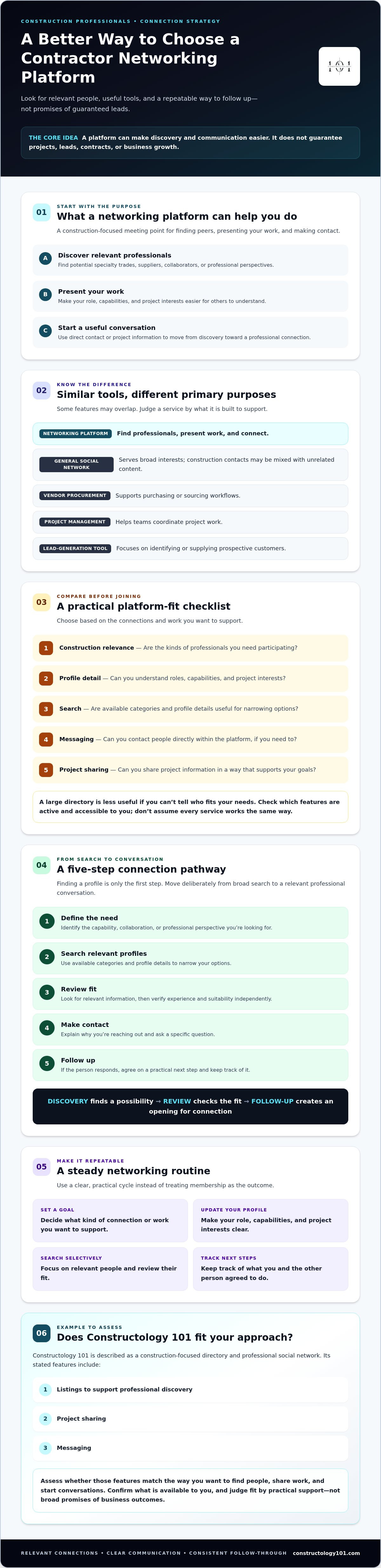
How to Build a Repeatable Networking Routine on a Construction Platform
A profile alone won’t build a professional relationship. Make networking a small, deliberate part of your business routine: decide who you want to connect with, show what you do clearly, and follow through when a conversation starts. A general contractor networking platform can support that process, but useful connections come from relevant participation, not simply signing up and waiting.
Use this cycle as a practical starting point:
- Set a goal: Choose a clear focus, such as finding a trade partner with a particular capability or connecting with professionals who share a project interest.
- Refine your profile: Make your services, capabilities, and contact information current and easy to understand.
- Search deliberately: Look for profiles related to your goal rather than browsing without a purpose.
- Contact selectively: Reach out when you can explain why the connection makes sense.
- Review progress: Note which conversations were relevant and what follow-up, if any, you agreed to.
Keep a simple record in a business system you already use, such as a contact manager or another appropriate tracking tool. Capture the person’s name, the context of your conversation, and the next step. This makes it easier to follow through without relying on memory, while keeping networking separate from any project management workflow.
How Can Contractors Network Without Sending Generic Pitches?
Start with a specific trade, capability, project need, or shared professional interest. Use information the other person has chosen to share to personalize your opening. For example, mention a relevant service category or project type in their profile, then ask one focused question about their experience or interest. Keep the message concise and courteous. The aim is to begin a useful conversation, not to send a broad sales pitch or assume the recipient is looking for work.
How Should You Assess Whether Your Networking Effort Is Working?
Look beyond profile views or the number of contacts added. Track whether you’re starting relevant conversations, making useful introductions, and completing agreed follow-ups. Then compare those interactions with your goals: are you connecting with the kinds of professionals and collaborators you set out to find? If not, adjust your search criteria, profile description, or message based on actual responses rather than guessing. A lack of replies doesn’t prove that a platform guarantees or fails to deliver business results.
Consistency helps you learn what works. If a construction-focused directory with messaging and project-sharing features fits your routine, explore Constructology 101’s construction networking platform and review its current features and membership terms before joining.
Is Constructology 101 the Right General Contractor Networking Platform for You?
Constructology 101 is a construction-focused directory and professional social network. Its stated features include professional profiles, directory listings, messaging, and project sharing. Those tools may suit contractors and other construction professionals who want a dedicated place to present their work and discover industry peers. Check which features are currently available and accessible to your membership type before deciding whether they fit your needs.
A directory listing can support discoverability, but it can’t guarantee leads, contracts, or revenue. Connections still depend on relevant participants, clear profiles, and the effort users put into making and maintaining professional contact. Treat the platform as a place to support networking, not a substitute for evaluating potential collaborators or a promise of business results.
Who May Benefit from a Construction-Focused Network?
A construction-focused network may be useful if you want to describe your services and connect with peers across the industry, including specialty trades, suppliers, architects, and engineers. Its value depends on whether available profiles align with your goals and whether you keep your own information clear and current. Thoughtful follow-through matters, too. If you’re looking for project management software or a standalone lead-generation tool, you’ll need a different solution.
What Is a Practical Next Step Before Joining?
First, define what you want the platform to help you do. Then compare that goal with its current features and terms:
- Write down your main networking goal: Be specific about the kinds of professionals or conversations you’re seeking.
- Review the listing and communication options: Check what profile information you can share and whether messaging or project sharing is available to you.
- Read current membership terms: Confirm included features, access conditions, and any renewal or lifetime terms directly before joining. Don’t rely on outdated descriptions.
That check is especially important if you’re considering Pioneer Membership. Verify its current availability, lifetime conditions, and included features before making a decision.
If its construction focus and current features match your goals, explore Constructology 101 and decide whether it fits the way you want to build professional connections.
Make Your Next Industry Connection Count
The right general contractor networking platform should help you find relevant professionals and start conversations, not promise business results. Compare construction relevance, profile details, messaging, and project-sharing features against your goals. Then make networking a habit: reach out selectively, follow up professionally, and keep track of useful next steps.
Constructology 101 is a construction-focused directory and professional social network. Its stated features include professional listings, project sharing, and integrated messaging. Review which features are currently available to you and decide whether they fit the way you want to connect with the construction community.
Explore Constructology 101 and see whether its current directory and networking features match your needs. Start with a clear goal, take the next step, and build industry connections one thoughtful conversation at a time.
Frequently Asked Questions
What is a general contractor networking platform?
A general contractor networking platform is an online environment where contractors and other construction professionals can present their work, discover relevant peers, and communicate. Depending on the platform, features may include searchable profiles, directory listings, messaging, or project sharing. These tools can make it easier to find people and begin a conversation, but they don’t confirm someone’s qualifications or guarantee qualified leads, projects, or lasting business relationships.
Can a networking platform help general contractors find subcontractors?
Yes, searchable professional profiles and trade categories may help contractors identify potential subcontractors. Use the information as a starting point, not as a qualification decision. Check whether a candidate’s services fit the project, then independently review relevant experience, references, availability, and project requirements. A platform can support discovery and initial communication, but it doesn’t replace due diligence, qualification, or agreeing on a clear scope of work.
How do I choose a networking platform for my construction business?
Start with a specific goal, such as finding professionals in a trade you regularly work with. Then compare construction relevance, searchable specialties, profile detail, communication tools, privacy controls, and membership terms. Verify which features are currently available to you and whether the participating community fits your needs. Choose based on practical tools and fit, not broad claims about audience reach or promised business results.
Is a construction networking platform the same as a contractor directory?
Not always. A directory primarily organizes professional listings to help users discover and assess people or businesses. A networking platform may also offer messaging or project-sharing features. The terms can overlap, so the label alone doesn’t tell you what the service does. Check its current features and access terms directly. Don’t assume every directory supports messaging or that every platform has an active community.
What should a general contractor include in an online professional profile?
Include a clear business description, accurate service categories, current contact information, and factual examples of relevant capabilities. Keep details specific so other professionals can quickly assess whether a conversation makes sense. Share project information only when you’re authorized to do so, and leave out confidential client details. Avoid unsupported claims; a clear, accurate profile helps set expectations without overstating what your business can provide.
Do construction networking platforms guarantee leads or projects?
No. A construction networking platform doesn’t guarantee leads, contracts, or revenue unless verified terms explicitly state otherwise. Results can depend on how well members match your needs, the accuracy of your profile, your participation, and how you communicate and qualify potential collaborators. Assess the platform’s features and terms separately from the results you hope to achieve. Treat it as a connection tool, not a promise of business.
What is a Pioneer Membership on Constructology 101?
Pioneer Membership is described as Constructology 101’s early-adopter membership and is associated with lifetime access to networking tools. Before joining, check directly whether it’s currently available, which features it includes, and what its lifetime terms mean. Don’t rely on older descriptions or assume every platform feature is included. Confirm the current details so you can decide whether the membership fits your goals.


