

A long plumbing subcontractor list can still leave you with the wrong fit. A useful list is built around your project scope, not just a collection of names. Referrals and online searches are good places to start, but they rarely make it easy to compare credentials, insurance, relevant experience, and crew capacity. Plumbing work can also overlap with other trades, so unclear responsibilities may create coordination gaps.
This guide shows you how to build a practical plumbing subcontractor list: match specialties to the work, screen candidates consistently, and narrow your options to a useful shortlist. You’ll also find questions to ask when you start conversations, so you can compare project fit and availability before moving forward.
Start by defining the plumbing work your project requires. Then look for specialists with relevant experience and verify their qualifications, coverage, references, and capacity. A construction-focused directory such as Constructology 101 can help you discover plumbing professionals and review how they describe their services. Use it as a discovery channel, not a substitute for due diligence. A consistent process helps you create a shortlist that supports clearer trade coordination and more productive conversations.
Key Takeaways
- Keep your working list distinct from a directory, bid list, or prequalified bidder roster, so each serves a clear purpose.
- Group firms by the plumbing scopes they perform, from underground work to hydronic or process piping.
- Use the same screening steps for every candidate, and check licensing or registration rules with the relevant authority.
- Build a plumbing subcontractor list using several discovery channels, then confirm each firm serves the project location.
- Compare candidates in one shortlist with consistent status labels, schedule details, and communication notes.
What belongs on a plumbing subcontractor list for a construction project?
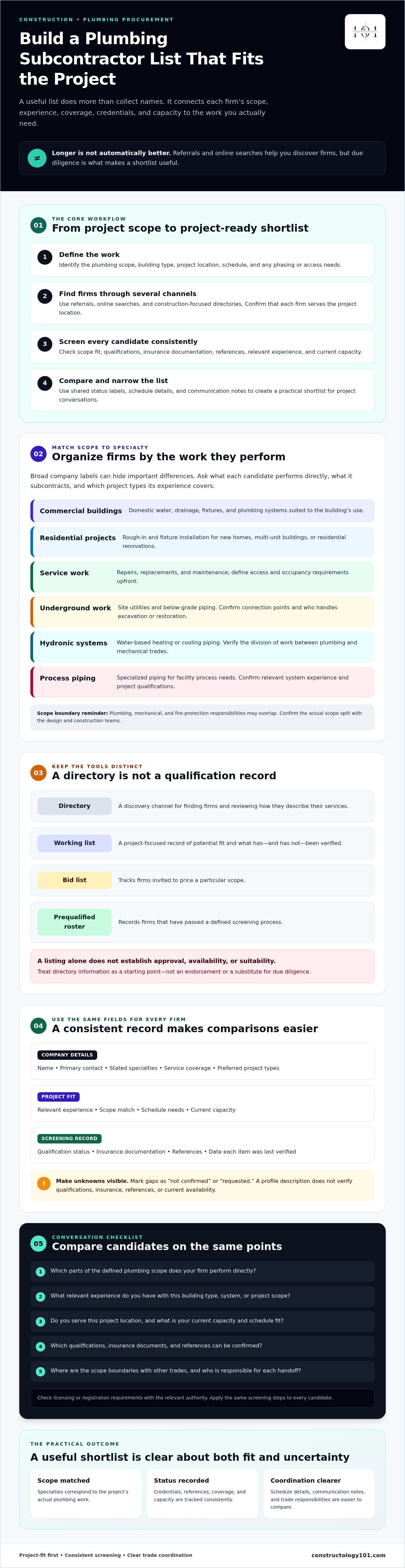
A project-ready list is more than a set of company names. It connects each firm’s specialties and service coverage to the work your team needs done. The right candidates depend on the project scope, schedule, building type, and location. A firm suited to residential fixture installation, for example, may not be the right fit for a commercial system or a tightly phased construction schedule.
A subcontractor performs part of a larger project under an agreement with another contractor. For foundational context, see Subcontractor. A directory helps you discover firms; a subcontractor list records which firms may fit a defined project and what you’ve verified about them.
Be clear about the list’s purpose. A directory is a discovery channel. A bid list tracks firms invited to price a particular scope. A prequalified bidder roster records firms that have passed a defined screening process. These tools can overlap, but they are not interchangeable. Inclusion on a list does not establish a firm’s approval, availability, or suitability for your project.
What information should each plumbing subcontractor entry include?
Use the same fields for every firm so you can compare candidates without relying on memory or scattered emails. Capture the basics, then mark what’s confirmed and what still needs checking:
- Company details: Name, primary contact, stated specialties, service coverage, and preferred project types.
- Project fit: Relevant experience, scope match, schedule needs, and current capacity.
- Screening record: Qualification status, insurance documentation, references, and the date each item was last verified.
Label gaps as “not confirmed” or “requested.” A directory profile can describe a firm’s services, but it does not verify insurance, qualifications, references, or current availability.
How does a plumbing subcontractor list differ from a directory?
Directories help you find potential firms. For example, Constructology 101 is a construction-focused directory where plumbing professionals can present their services and connect with construction peers. Treat a listing as a starting point for research, not an endorsement or qualification check.
Next, organize potential firms around a defined scope and procurement process, and record what you’ve confirmed for the project. This turns broad discovery into a practical reference for deciding whom to contact, invite to bid, or screen further.
Which plumbing subcontractor specialties should your list cover?
Build your plumbing subcontractor list around the work package, not broad company labels. A firm may handle general building plumbing but not underground utility piping, hydronic systems, or process piping. Ask what each candidate performs directly, what it subcontracts, and which project types its experience covers. Separate plumbing from adjacent mechanical or fire-protection scopes instead of assuming one firm covers them all.
Use this scope-to-specialty guide to shape your search, then confirm the details with each firm:
- Commercial buildings: Domestic water, drainage, fixtures, and plumbing systems suited to the building’s use.
- Residential projects: Rough-in and fixture installation for new homes, multi-unit buildings, or residential renovations.
- Service work: Repairs, replacements, and maintenance, with access and occupancy requirements defined upfront.
- Underground work: Site utilities and below-grade piping. Confirm connection points and who handles excavation or restoration.
- Hydronic systems: Water-based heating or cooling piping. Verify the intended division of work between plumbing and mechanical trades.
- Process piping: Specialized piping for a facility’s process needs. Confirm relevant system experience and project qualifications.
This is a starting framework, not a universal definition of trade boundaries. The Mechanical Contractors Association of America (MCAA) offers industry resources relevant to mechanical contracting. Use them for context, then confirm the actual scope split with your design and construction teams.
How do plumbing scopes change across project types?
New construction may involve full-system installation, while renovation and tenant improvement work can require tie-ins, selective replacement, and phased access. Service work has a different focus: diagnosing existing conditions and coordinating around ongoing building use. Before searching, define the fixtures and piping systems involved, the project phases, and any occupied-building constraints. For specialized systems, confirm relevant experience and qualifications separately.
When should plumbing work be coordinated with other trades?
Coordinate early whenever systems share space, sequence, or building connections. Plumbing routes may need to align with HVAC ductwork, electrical pathways, structural openings, and fire-protection systems. Use the project documents to identify who provides openings, sleeves, supports, connections, and inspections. Clarifying these responsibilities before installation can help prevent gaps and rework.
Code requirements depend on the project jurisdiction and the codes it has adopted. Confirm applicable plumbing requirements with the project’s design professionals and relevant authority rather than treating a general code reference as universal advice. For discovery, Constructology 101’s construction directory can help plumbing professionals present their services and connect with construction peers. Use directory information as a starting point, then verify each firm’s scope fit directly.
How can you vet plumbing subcontractors beyond online reviews?
A listing is a lead for research, not proof of qualification. Reviews may reveal patterns, but they do not confirm a firm’s fit for your scope, current documentation, or crew availability. Apply the same screening steps to every candidate on your plumbing subcontractor list, and record what you’ve verified as well as what remains unknown.
Work through this sequence:
- Scope fit: Ask whether the firm has completed comparable work and can cover the specific plumbing package. Don’t rely on a broad service description alone.
- Credentials: Identify the licenses, registrations, or other qualifications relevant to the work. Requirements vary by state and locality, so check current rules with the applicable authority.
- Insurance: Request current insurance documents and confirm that the stated coverage aligns with project requirements.
- References: Speak with project contacts who can discuss comparable work, performance, and coordination.
- Capacity: Ask about schedule availability, supervision, workforce, and any planned subcontracting.
- Communication: Discuss how the firm handles questions, schedule changes, and coordination with other trades.
Which documents and qualifications should you verify?
Request applicable licenses or registrations, insurance documents, safety information, and any prequalification materials required for the project. Check dates, named business entities, and stated scope. Where practical, confirm validity with the issuing source. A document in a profile or an earlier project file may no longer be current. Record its status and the date checked, and follow up on gaps before treating a candidate as qualified.
What should you ask about experience, capacity, and safety?
Ask for references from comparable projects and clarify what work the proposed team performed, not just what the company does overall. Confirm who will supervise, whether the crew can meet the schedule, and whether any work will be subcontracted. Discuss safety practices and how the firm identifies and addresses applicable OSHA requirements. The questions and documents needed may differ with project scope and site conditions.
End each conversation with clear next steps: what information is still needed, who will provide it, and when you’ll review it. Consistent notes make candidates easier to compare and help your team distinguish verified fit from a promising first impression.
Where can you find plumbing subcontractors and organize your search?
Build a wider candidate pool by using more than one channel, then tie every name to the project requirements. Professional directories and networks can surface firms by specialty. Trade associations and referrals can introduce industry contacts. Prior project teams may know subcontractors with relevant delivery experience, while public procurement sources can help identify firms that participate in similar work.
Start with search terms drawn from the scope, such as “commercial plumbing,” “underground utilities,” or “hydronic piping.” Add the project type and delivery needs to narrow the results. Then confirm that each firm serves the project location and is interested in the work being considered. For a broader approach to comparing discovery channels, see this guide to national construction directories.
How should you search directories and professional networks?
Compare each firm’s stated services and project examples with your defined scope. A construction-focused network such as Constructology 101 gives plumbing professionals a place to present their services and connect with industry peers. Treat profiles as discovery information, not automatic prequalification. Follow up directly to clarify project fit and details relevant to your search. A guide to finding reliable construction partners can also help you structure the broader search.
Add a source field to your working list. Note whether each firm came from a directory, an association, a referral, a prior project, or a public procurement source. This makes it easier to see which channels are producing relevant candidates and where you may need to expand your search.
How can referrals and trade groups expand your candidate pool?
Ask trusted project partners for referrals tied to comparable scope and delivery conditions. A useful referral explains why a firm may fit, rather than simply saying someone knows the company. Trade associations can help you discover firms and understand industry networks, but membership alone is not an endorsement of a specific subcontractor.
Use the same review process for every candidate, regardless of how you found them. If you’re a plumbing professional looking to present your services to construction peers, an interactive construction directory listing is one way to support discovery. A directory can broaden connections, but project teams still determine fit through their own procurement process.
How do you turn a plumbing subcontractor list into a project-ready shortlist?
Discovery gives you names. A shortlist shows which firms merit the next procurement step and why. Compare each candidate against the same project requirements, document open questions, and make the review process visible to everyone involved. Your plumbing subcontractor list becomes useful when it supports a decision, not just a search.
Use a simple comparison table and update it as you confirm information:
| Review area | What to record |
|---|---|
| Scope match | Required work covered, exclusions, and remaining scope questions |
| Relevant experience | Comparable projects and the proposed team’s role |
| Documentation | Items received, verified, or still pending |
| Capacity and schedule | Workforce availability, supervision, and schedule fit |
| Communication | Responsiveness, coordination approach, and next contact |
Use consistent status labels such as identified, contacted, under review, and qualified for this project. Define each label so the team applies it consistently. For every unanswered question, record who will resolve it, who will review the answer, and the next follow-up date. This prevents a candidate from appearing ready simply because a conversation has started.
What makes a candidate ready for the next procurement step?
Move a firm forward only when its documented experience aligns with the project scope and the checks required for that stage are complete. Separate verified documents and references from self-reported profile details and pending items. “Qualified for this project” should reflect your review criteria, not a general claim about the company. Final selection still follows the project’s procurement rules and review process.
How can plumbing professionals become easier to find?
Firms can make discovery more relevant by accurately describing their specialties, project experience, and service coverage. A construction-focused directory such as Constructology 101 gives plumbing professionals a place to present their services and connect with construction peers. Directory information can help teams find potential matches, but it does not confirm qualifications, availability, or project fit.
For plumbing professionals interested in presenting their services and connecting with industry peers, Explore Constructology 101 and review its current directory and networking options.
Build a Shortlist That Moves Your Project Forward
A useful plumbing subcontractor list starts with the work your project needs, then narrows candidates through consistent checks. Match specialties to scope, verify qualifications and documentation, and compare experience, capacity, schedule, and communication. Keep open questions visible so your team knows what still needs confirmation.
Directories and referrals can broaden your search, but discovery is only the first step. Treat profiles and recommendations as starting points, then assess each firm against your project requirements and procurement process.
For plumbing professionals, Constructology 101 offers interactive directory listings to showcase skills and services, along with networking features for project sharing and integrated messaging. Use the platform to connect with construction peers, while evaluating project fit through your own review process.
Explore Constructology 101 and review its current directory and networking options. Start with a clear scope and a practical shortlist to make your next procurement conversations more focused.
Frequently Asked Questions
What should be included in a plumbing subcontractor list?
Include each firm’s name and contact, specialties, service coverage, preferred project types, and relevant project examples. Add project-specific scope fit, qualification status, insurance documentation, references, capacity, schedule notes, and communication details. Record when information was last checked, and label each item as verified, self-reported, pending, or unknown. This gives your plumbing subcontractor list practical value: your team can compare firms against a defined project instead of treating names as proof of approval.
How do I find plumbing subcontractors for a construction project?
Search professional directories, trade associations, trusted referrals, prior project contacts, and public procurement sources. Use terms that reflect the package, such as commercial plumbing or underground piping, then confirm that a firm serves the project location and is interested in the work. Treat profiles and recommendations as discovery leads. Apply consistent scope and qualification checks before moving candidates onto a project-ready shortlist.
What types of plumbing subcontractors are there?
Plumbing subcontractors may focus on commercial buildings, residential projects, service work, underground piping, hydronic systems, or process piping. Some firms handle several scopes, while others specialize in one. Match the specialty to the building, systems, project phase, and installation needs. Confirm trade boundaries too, since mechanical or fire-protection work may be coordinated separately. Ask firms to clarify what they perform directly and what they subcontract.
How can I verify a plumbing subcontractor’s license and insurance?
Request applicable license or registration details and current insurance documents, then check requirements with the relevant state or local authority. Licensing rules vary by jurisdiction and work type, so don’t rely on a general online profile or an old project file. Review document dates, named business entities, and stated scope. Where practical, confirm validity with the issuing source and record what you checked and when.
Are online reviews enough to choose a plumbing subcontractor?
No. Reviews can help identify patterns in customer or client feedback, but they don’t establish fit for your project, current insurance, crew capacity, or relevant experience. Use them alongside references from comparable projects, qualification documents, and direct conversations about the proposed team’s role. Ask references about work similar to your scope and delivery conditions. Then compare each candidate against the same criteria instead of letting ratings alone determine the shortlist.
How many plumbing subcontractors should be on a shortlist?
There’s no fixed number that suits every project. Keep enough candidates to support your procurement process and compare viable options, while ensuring each one matches the scope and can be reviewed properly. The project schedule, complexity, procurement rules, and available firms all affect shortlist size. Track candidates by status, such as identified, contacted, under review, or qualified for this project, so the list stays useful instead of simply growing.
Can a construction directory confirm that a plumbing subcontractor is qualified?
No. A directory can help you discover professionals and review how they describe their services, but a profile alone doesn’t confirm credentials, insurance, availability, or project suitability. Constructology 101 is a construction-focused directory and professional network where firms can present services and connect with industry peers. Use that information as a starting point, then verify documents, references, scope fit, and capacity through your own project review.


