

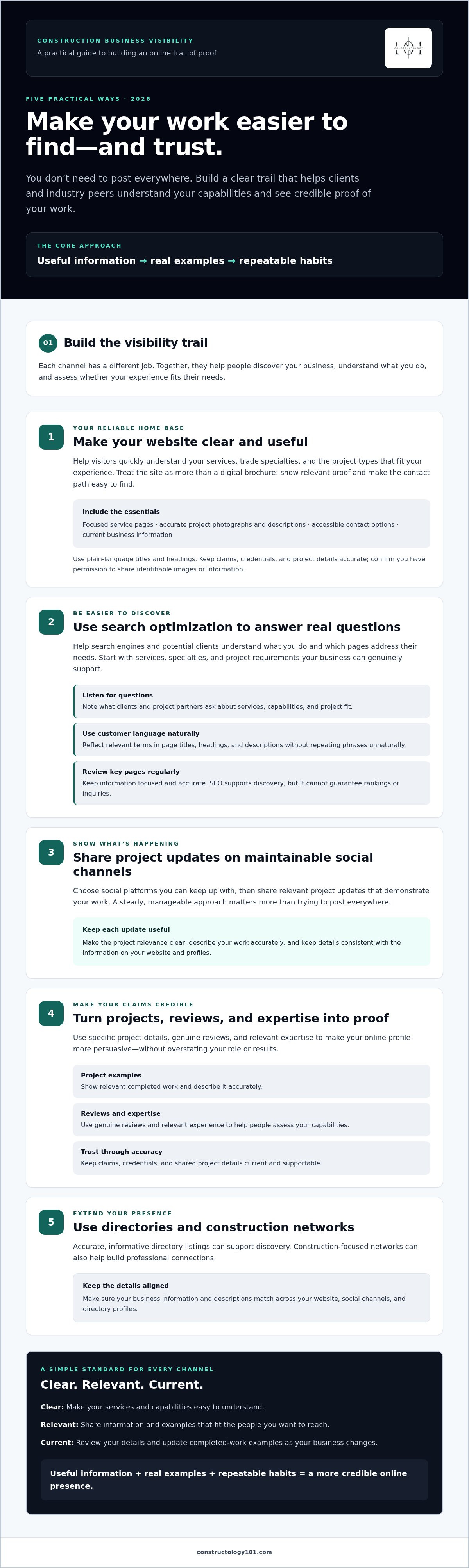
The best way to promote construction business online isn’t to post everywhere. It’s to build a clear trail of proof that helps clients and industry peers find your business, understand your capabilities, and trust what you share.
Choosing the right channels can feel difficult, especially when project experience is hard to present online or marketing seems like a full-time job. You don’t need specialist skills or a constant stream of content to make progress. Start with useful information, real examples of completed work, and a few repeatable habits.
This guide covers five practical ways to build visibility in 2026, from strengthening your website and sharing project updates to using directories and industry networks. You’ll learn how to showcase your services credibly, make your business easier to discover, and support stronger professional relationships. Choose the approaches that fit your business, then keep the information current.
Key Takeaways
- Build a clear website that helps visitors understand your construction services and see relevant examples of your work.
- Promote construction business online by answering customer questions with useful pages and reviewing how people find them.
- Choose social platforms you can maintain, then share relevant project updates to demonstrate your work.
- Use specific project details, genuine reviews, and relevant expertise to make your online profile more persuasive without overstating results.
- Keep directory listings accurate and informative, and use construction-focused networks to support discovery and professional connections.
1. Build a Construction Business Website That Turns Visits into Trust
Visibility only helps if prospective clients can quickly tell what your business does and whether your experience fits their needs. If your website is vague, outdated, or difficult to use, visitors may leave without understanding your services. A clear website gives your other online activity a reliable home and supports search, social media, referrals, and directory profiles.
A construction business website is a central online resource that explains your services, demonstrates your experience, and gives prospective clients a clear way to contact you. To promote construction business online, treat it as more than a digital brochure. Make it easy for the right people to understand what you do, see relevant proof, and decide what to do next.
Build around questions clients are likely to ask: What work do you take on? Which project types are a good fit? What capabilities can you demonstrate? Keep every claim, credential, and project description accurate and current. Your site should make a strong case without overstating your role or results.
What should a construction business website include?
Help visitors identify your services, trade specialties, and ideal project types without having to dig through several pages. Show real project photographs and describe them accurately. Confirm you have permission to share images and project details, especially when clients or other businesses are identifiable.
Make the next step obvious. Provide accessible contact options and tell visitors what information to include when they reach out. A simple contact path reduces friction and helps prospective clients share the details you need to assess whether a project is a fit.
How can a website support construction business visibility?
Give distinct services their own focused pages instead of squeezing everything into one broad overview. Use plain-language titles and headings that reflect how customers describe their needs. For example, explain a specific service directly rather than relying on internal trade terms visitors may not recognize. This structure also helps search engines understand what each page covers.
Connect your site to wider digital marketing strategies. Link to relevant project examples from service pages, and make sure your business information matches the details on your social channels and directory profiles. These channels serve different purposes, but consistent descriptions make your business easier to understand wherever someone finds it.
Your website can also support a strong professional presence beyond your own pages. For practical guidance on presenting your skills and experience, see this guide to building a construction professional profile. Review your site regularly, update completed-work examples, and remove details that no longer reflect your business.
2. Use Search Engine Optimization to Help Clients Find Your Construction Services
Search engine optimization (SEO) helps search engines and potential clients understand what your business does and which pages answer their questions. It’s a practical way to promote construction business online, but it works best as a steady improvement process, not a quick fix. SEO can support discovery, but it can’t guarantee rankings or inquiries.
Useful search optimization makes relevant business information easier to find and understand. Keyword stuffing repeats search phrases unnaturally without helping the reader. Focus on real questions, clear answers, and accurate descriptions of the work you take on.
Which search terms should construction businesses target?
Start with services, specialties, and project needs your business can genuinely support. Consider how different audiences describe their requirements: an owner may search for a particular type of work, while a general contractor or trade partner may look for a specific capability or subcontracting specialty.
Use those terms naturally in relevant page titles, headings, and descriptions. Don’t claim expertise, credentials, or service coverage you can’t substantiate. A focused, accurate page is more useful than a broad page trying to appeal to every possible search.
What should a simple SEO routine cover?
Keep the process manageable. Review key pages regularly and follow a simple sequence:
- Identify questions: Note recurring questions clients and project partners ask about services, capabilities, and project fit.
- Create relevant pages: Answer each topic with clear, specific information grounded in your experience.
- Improve page details: Check that titles, headings, service descriptions, and contact details are accurate and easy to understand.
- Review performance: See which pages people find and use, then refine any information that is unclear or incomplete.
Publish an answer only when your business has credible expertise to share. For example, explain what information helps you assess whether a project fits your services rather than making unsupported promises about outcomes. The Chartered Institute of Building also outlines ways to grow your construction business through practical marketing channels.
Search visibility is only one part of your online reputation. For more context on building a consistent presence, read the guide to a contractor’s digital footprint. You can also consider a construction-focused interactive directory listing as another place to showcase your skills and services alongside your website.
3. Promote Your Construction Business on Social Media with Useful Project Updates
Social media can help keep your business visible and show how your team works. Treat it as a place to share credible updates and build professional connections, not as a guaranteed source of sales or inquiries. The right channel is one you can use consistently and where the people you want to reach are active.
A useful construction social post gives its intended audience clear context about a project, skill, or lesson they can understand or apply. That context matters more than posting often. A brief explanation can make a project update more informative than an image or short clip on its own.
What should construction businesses post on social media?
Share approved project progress, completed work, team expertise, and practical lessons from the job. Before posting, confirm that clients and other relevant stakeholders have approved publication. Check that the material doesn’t reveal sensitive project information or show people, plans, or details they haven’t agreed to share.
Give each update a simple structure: describe the challenge, explain the work your team performed, and state an outcome you can verify. Keep the description factual. Avoid suggesting your work caused results you can’t substantiate or implying your team handled parts of a project it didn’t.
Make posts understandable even when someone can’t view an image. Write a concise caption that explains what’s shown, and add an accessible image description where the platform allows it. A photo of a completed installation, for instance, can be paired with a short note about the scope of work and a relevant detail about the process.
How can a business choose the right social platform?
Start with your audience, not a list of popular platforms. Consider whether prospective clients, general contractors, trade partners, or peers use a channel to discover businesses and exchange industry information. Then match the channel to the content you can produce, such as project photos, short videos, or written insights.
Choose a sustainable rhythm. A few well-prepared updates shared regularly are more manageable than an ambitious daily schedule that quickly becomes difficult to maintain. Plan posts around project milestones, completed work, or a useful lesson, while making sure publication has been approved.
Review the response, too. Follower totals alone don’t show whether your updates are reaching relevant people. Pay attention to meaningful comments, shares, direct conversations, and questions from potential clients or industry peers. Use those signals to refine the topics and formats you share. If a type of post prompts useful discussion, build on it. If it takes too much effort or misses your audience, adjust your approach.
4. Turn Construction Projects, Reviews, and Expertise into Credible Online Proof
Prospective clients can’t assess your work in person from a website or profile. They can review specific examples and decide whether your experience appears relevant. Clear project evidence makes your business profile more persuasive because it shows what you did, the type of work involved, and how your role fits the project.
Use facts, not inflated claims. Describe completed work accurately, distinguish your contribution from the wider project, and avoid presenting one project’s outcome as a promise of future performance. Use this checklist to keep examples consistent:
- Context: What kind of project was it, and what need did the work address?
- Scope: What did your business specifically complete?
- Images: Do the selected images accurately represent the work?
- Permission: Have the relevant clients or stakeholders approved publication?
- Attribution: Are clients, partners, and other contributors identified accurately, where appropriate?
How can contractors showcase completed projects online?
Use a consistent format for each project so visitors can compare relevant experience quickly. State the project type, your business’s role, and the work completed in precise terms. Add approved images and useful context, but leave out identifying site details or client names unless you have permission to share them. This helps readers understand your contribution without overstating it.
Project evidence can support your website, social posts, and professional profiles. For another discovery option, explore the Interactive Directory Listing guide. A construction-focused directory listing can complement a portfolio by giving professionals another place to present their skills and project information.
How should construction businesses use customer reviews?
Ask clients for honest feedback at an appropriate project milestone or after completion. Don’t write reviews for clients, buy feedback, or hide criticism to create a misleading impression. Respond courteously and avoid sharing private or commercially sensitive details, even when clarifying a concern. Reviews are one trust signal, not proof that every future project will have the same outcome.
Use feedback alongside project examples and relevant expertise to promote construction business online with a credible proof trail. Keep information current, and make corrections when a description no longer reflects the work or your role. If you’re ready to showcase your skills and services in a construction-focused directory, create an Interactive Directory Listing.
5. Use Construction Directories and Professional Networks to Expand Discovery
A website, social channel, and industry directory each help people discover your business in a different way. Your website gives you room to explain your services and present project examples. Social media supports ongoing updates and conversations. A construction-focused directory helps professionals find industry-related profiles. Used together, these channels can support a clearer online presence, but none replaces strong working relationships or a useful website.
To promote construction business online through a directory, make your profile accurate and specific. Identify the services and specialties you actually offer, describe relevant project experience, and keep the details consistent with your other professional channels. A clear listing gives visitors useful context; it doesn’t guarantee leads, contracts, or any particular marketing result.
What should you check before joining a construction directory?
Look beyond the directory’s name. Check whether its audience includes the clients, partners, or peers you want to reach. Review what profile information you can provide, how people can discover listings, and whether the platform offers communication features that suit your professional goals.
Confirm current membership terms and listing details directly before deciding. Make sure the profile format lets you represent your real services and experience clearly. If a platform’s fields encourage broad claims that don’t match your capabilities, it may not be the right fit.
How can a directory profile support wider promotion?
Keep your business name, service descriptions, and professional details aligned across your website, social channels, and directory profiles. Consistency helps people recognize they’re looking at the same business, while up-to-date project information adds useful context. Share project details only when the platform supports it and you have permission to publish them.
Constructology 101 is an interactive directory and professional social network designed for the construction industry. Its listings help professionals showcase skills and services, while members can share project information and communicate through integrated messaging. Consider it one part of a balanced promotion mix, alongside your website, social activity, and industry relationships.
Review the current listing details and membership terms before deciding whether the platform fits your needs. The Pioneer Member program offers early participants a lifetime deal while the platform is being built. Explore Constructology 101 and its construction-focused directory and networking tools as another way to support professional discovery.
Build Your Online Presence One Practical Step at a Time
To promote construction business online, focus on a connected presence rather than trying to master every channel at once. Start with a clear website, make useful service information easier to find through search, and share project updates at a pace you can maintain. Then strengthen your profile with accurate examples of completed work, honest reviews, and relevant expertise.
Each channel has a role. Your website provides a home for your business information, while social media and industry directories help you share it with different audiences. Keep your details consistent, your claims verifiable, and your project permissions in order. These habits build a credible proof trail and support professional discovery over time, without guaranteeing a particular result.
Constructology 101 offers interactive directory listings designed to showcase construction skills and services, along with project sharing and integrated messaging. If a construction-focused directory and professional network fits your promotion mix, explore Constructology 101.
Choose one improvement to make this week, then build from there. Steady, practical steps can make your business easier to find and understand.
Frequently Asked Questions
How can I promote my construction business online?
Build a clear website, make your service information easy to find in search, and share useful project updates on channels your audience uses. Add accurate examples of completed work and keep your business details consistent across profiles and directories. You don’t need to do everything at once. Start with one improvement, establish a manageable routine, then review which channels support relevant conversations and professional discovery.
What is the best way to advertise a construction business online?
The best approach depends on your audience, services, and available time. For many businesses, a well-organized website is a sensible starting point, supported by search optimization, selected social channels, and relevant directories. Paid advertising may also be an option, but assess its cost and fit before committing. Whichever channels you choose, use accurate information and examples that help prospective clients understand your capabilities.
Does social media help construction companies get customers?
Social media can help construction companies stay visible, show relevant work, and build professional relationships, but it doesn’t guarantee customers or inquiries. Choose platforms where your clients, partners, or peers are active, then share approved project updates, team expertise, or practical lessons. Track relevant comments and conversations, not just follower totals. A sustainable posting routine is more useful than a schedule your team can’t maintain.
How do I get my construction company to show up on Google?
Make your website’s service pages clear and useful, with page titles and headings that match the work you actually do and the questions clients ask. Keep business details accurate and consistent across your website and online profiles. Add credible project examples and review performance periodically to see which pages people find. Search optimization takes ongoing attention and doesn’t guarantee specific rankings or inquiries.
What should a construction business post online?
Share approved project progress, completed work, team expertise, and practical insights from your experience. Explain the project context, your business’s role, and the work completed without exaggerating results or capabilities. Confirm permission before publishing client names, site images, or identifying details. Add clear captions so posts make sense beyond the image itself, and focus on information prospective clients or industry peers will find useful.
Are online directories useful for construction businesses?
Directories can give construction professionals another place to present their services and experience, complementing a company website and social channels. Choose a directory with a relevant audience and keep your listing accurate. Constructology 101, for example, is an interactive construction directory and professional network. Its listings showcase skills and services, and members can share project information and communicate through integrated messaging. Directories can support discovery, but don’t promise leads or contracts.
How often should a construction company update its website and social media?
Update your website whenever key details change, such as services, contact information, or project examples. Review important pages regularly to keep them accurate. For social media, choose a posting rhythm your team can sustain, such as sharing updates at project milestones or when you have a useful insight. Consistent, relevant information matters more than posting daily. Always confirm permission before sharing project details or images.


