

A static list of phone numbers is no longer a procurement strategy. It is a costly delay waiting to happen. If you are searching for the most reliable construction supplier directory to find verified building material vendors, you already know the stakes. Sifting through dead website links, chasing unreturned calls, and gambling on uncertain lead times eats into your margins and stalls your crews on site.
You need reliable partners who deliver on time, meet commercial compliance standards, and fulfill orders without friction. Modern platforms have evolved far beyond passive spreadsheets. Today's interactive directories actively verify vendor capabilities, streamline procurement, and link commercial builders directly with dependable suppliers nationwide.
In this guide, we break down the leading supplier directory hubs of 2026, compare static databases against interactive networks, and reveal how to build direct supply partnerships that keep your projects running on schedule.
Key Takeaways
- Explore how moving beyond static lists to a modern construction supplier directory accelerates procurement, lowers administrative overhead, and prevents job site disruptions.
- Discover the major directory platform models available today, from CSI-mapped trade databases to interactive commercial supplier hubs.
- Identify the core platform features builders need to confirm vendor credibility, evaluate fulfillment capacity, and inspect verified past project portfolios.
- Master a rigorous four-step vetting protocol to audit supplier licenses, insurance certificates, and commercial credit before issuing purchase orders.
- See how interactive networking ecosystems unite material manufacturers, trade specialists, and general contractors under one nationwide collaborative platform.
What Is a Construction Supplier Directory and Why Procurement Changed
A modern construction supplier directory is a structured digital ecosystem indexing verified building material manufacturers, distributors, and fabricators. Decades ago, procurement relied on printed yellow pages, trade binders, and localized rolodexes. That approach worked when project scopes were simple and regional supply chains moved at a predictable pace. Today's commercial building climate demands instant data, broad reach, and verified vendor reliability across all major commercial divisions.
Supply chain volatility quickly accelerated this shift. Between sudden material allocations, tighter project deadlines, and the formal compliance demands seen across modern public infrastructure and the standard government procurement process, old habits fail fast. Instead of relying on passive advertising sheets or hoping an unanswered phone message gets returned, forward-thinking builders turn to interactive platforms. These unified networks streamline vendor discovery, accelerate outreach, and secure reliable material pipelines nationwide.
The Evolution from Static Catalogs to Digital Procurement Hubs
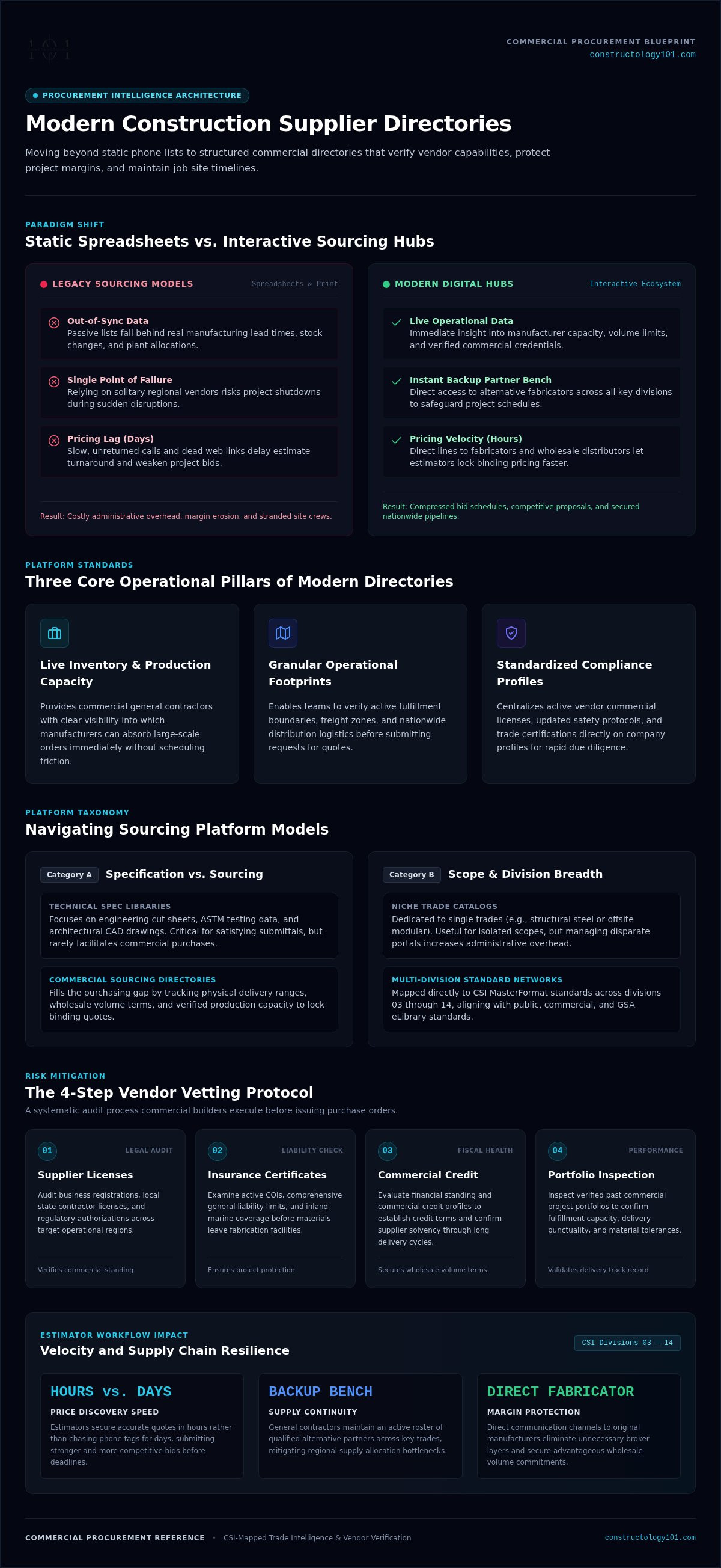
Traditional vendor lists create serious blind spots. Paper catalogs and outdated office spreadsheets quickly fall out of sync with manufacturing lead times, stock availability, and distribution changes. In contrast, cloud platforms organize commercial suppliers around real-time operational data:
- Live inventory and manufacturing capacity: Gain clear insight into which suppliers can handle large-scale volume immediately.
- Granular operational footprints: Confirm active fulfillment zones and nationwide distribution logistics before requesting quotes.
- Standardized compliance documentation: Access up-to-date vendor licenses, safety protocols, and commercial certifications directly on their profiles.
Why General Contractors and Estimators Rely on Supplier Platforms
Speed wins bids. Estimators who source accurate pricing in hours instead of days deliver stronger, more competitive proposals. A digital construction supplier directory lets estimating teams connect directly with verified distributors to lock down pricing before deadlines expire.
Equally critical is supply chain resilience. Relying on a single supplier invites disaster when unexpected regional delays occur. Interactive directories give general contractors an instant bench of backup partners across primary commercial trades. By establishing direct lines to original material fabricators, builders negotiate volume terms efficiently, safeguard their project margins, and keep work moving forward.
Types of Platforms in a Construction Supplier Directory Roundup
Every commercial procurement tool serves a distinct operational purpose. Choosing the right platform depends entirely on whether your team needs technical submittal approvals, specialized material fabrication, or active relationship-building across commercial trades. Navigating the modern supply ecosystem requires understanding the core categories that define the market today.
Technical Specification Libraries vs. Commercial Sourcing Directories
Submittal libraries excel at organizing cut sheets, ASTM testing data, and architectural CAD files. These platforms help engineers confirm performance thresholds before materials are specified. However, they rarely help you buy. Commercial sourcing directories fill that operational gap by tracking physical delivery ranges, wholesale volume terms, and verified commercial capacity. Leading preconstruction teams rely on both systems. They use technical libraries to satisfy project specifications and commercial networks to secure binding material quotes.
Niche Trade Catalogs vs. Comprehensive Multi-Division Networks
Specialized catalogs focus entirely on single trades, such as structural steel fabrication or offsite modular production. While useful for narrow bids, managing individual portals for every trade creates unnecessary administrative friction. In contrast, multi-division platforms map directly to CSI MasterFormat standards across divisions 03 through 14.
Commercial teams bidding on public or federally funded projects often cross-reference vendors with the GSA eLibrary of government contractors to confirm compliance standing. For broader private commercial work, choosing the best national construction directory enables estimators to source sitework, envelope systems, and interior finishes in one central workspace.
Static Search Engines vs. Interactive Professional Communities
Passive search portals act like digital phonebooks. They list company names alongside outdated generic inboxes, offering zero visibility into real-time job site capability. Modern procurement demands interactive engagement. Dedicated industry hubs introduce social business functionality, enabling suppliers to showcase live project installations and verified real-world applications directly on their profiles.
Instead of cold emailing a generic inbox and waiting days for feedback, estimators can message manufacturers directly inside an active peer-to-peer environment. If you want to expand your reach or source reliable partners nationwide, joining a verified hub like Constructology 101 transforms passive searching into immediate collaboration.
Key Features to Look for in a Construction Vendor Directory
A reliable construction supplier directory functions as an active procurement engine, not an ad-supported link farm. Evaluating modern platforms requires looking past surface-level company lists to assess operational transparency, data structure, and communication speed. Focus on platforms built specifically to handle the demands of commercial project lifecycles.
Granular Search Filters and MasterFormat Alignment
Basic keyword searches fall short when sourcing technical building components. Sifting through generic search results wastes hours and introduces costly procurement errors. Modern directories organize vendors strictly around CSI MasterFormat divisions, grouping suppliers by specific structural, mechanical, and architectural scopes.
Effective platforms allow estimators to filter by critical technical parameters:
- Commercial fire and acoustic ratings: Align exact assembly criteria without combing through third-party spec sheets.
- Sustainability criteria: Identify manufacturers offering EPDs, recycled content, and low-VOC formulations quickly.
- Structural load grades: Target distributors stocking precise structural steel, concrete additives, or heavy timber specifications.
Direct Communication Tools and Supplier Profile Depth
RFPs sent to generic sales inboxes often vanish without an answer. Bid windows close fast, leaving zero margin for administrative delays. Premium directories integrate direct messaging features that connect project managers straight to authorized sales reps, commercial dispatchers, and fabrication managers.
A comprehensive Interactive Directory Listing provides essential business data right upfront. Estimators can inspect active commercial credit terms, review verified licenses, and confirm logistics capabilities before opening negotiations. Direct communication cuts down response latency and locks in material commitments quickly.
Visual Project Portfolios and Case Study Proof
Marketing claims never substitute for delivered materials on an active job site. Modern directories incorporate visual project portfolios that highlight real-world installations. Suppliers showcase high-volume commercial pours, custom structural assemblies, and architectural finishes from recently completed projects.
Reviewing job site photography gives builders confidence in a vendor's delivery capacity. When directory profiles link suppliers directly to the general contractors they partnered with, verification becomes immediate. Seeing proven performance on comparable builds eliminates guesswork and protects your schedule.
How Builders Vet Vendors Found on a Construction Supplier Directory
Discovering a promising partner on a construction supplier directory is just the first step. Before signing major purchase orders or committing to project delivery schedules, you need a repeatable audit process. Protect your timeline and project margins by implementing this systematic four-step vetting framework:
- Step 1: Validate corporate standing and credentials. Confirm active state registrations, verify business entity standing, and check manufacturer distributor authorizations.
- Step 2: Inspect project references. Review past delivery logs on commercial jobs matching your project scale, scope, and structural complexity.
- Step 3: Test direct communication. Gauge quote turnaround times, assess administrative responsiveness, and confirm binding fulfillment lead times.
- Step 4: Audit financial terms and logistics. Establish commercial credit limits, verify freight damage policies, and align drop-off parameters.
Verification of Commercial Credentials and Distributor Status
Never assume every catalog entry is an authorized source. Third-party brokers often advertise wholesale materials without holding direct factory agreements, which creates unneeded markup and voided manufacturer warranties. Always confirm direct distributor agreements before sending deposit funds.
Demand active certificates of insurance. Suppliers of primary structural items, MEP machinery, or commercial glazing must maintain comprehensive product liability coverage that lists your firm as an additional insured. To strengthen your vendor screening workflow, review our comprehensive checklist on how to find reliable construction partners across the commercial building sector.
Assessing Logistics Capabilities and Freight Terms
Delivery failure halts production immediately. Determine whether your supplier runs a dedicated private delivery fleet or outsources transit to third-party common freight carriers. Dedicated fleets offer precise dispatch tracking, reliable drop windows, and experienced drivers familiar with active job site drop-offs.
Clarify offloading parameters upfront. Will the shipment require dedicated boom trucks, crane access, or specific gate delivery appointments? Establish written protocols for damaged goods upon delivery, including rapid replacement provisions and clear return policies. Solidify these logistics early to keep operations moving without costly disputes.
Ready to connect with vetted building partners and expand your commercial network? Secure an interactive listing on Constructology 101 today to build lasting supply partnerships nationwide.
Why Constructology 101 Redefines the Construction Supplier Directory
Traditional procurement databases treat companies like phone numbers on a page. Constructology 101 changes that dynamic entirely. By fusing a verified commercial construction supplier directory with a dynamic professional community, the platform transforms passive search into active, profitable collaboration. It creates a unified workspace where material manufacturers, specialty trades, and general contractors engage directly across commercial disciplines nationwide.
Instead of wrestling with detached PDF catalogs or unmonitored web portals, commercial builders access a vibrant supply ecosystem. You gain immediate access to verified material sources, transparent product applications, and established decision-makers. The result is faster procurement, fewer logistical surprises, and stronger project delivery across every build phase.
A Connected Professional Network Built Exclusively for the Trades
Commercial building succeeds through alignment. Constructology 101 bridges the gap between design specifications and job site delivery by connecting architects, engineers, general contractors, trades, and material suppliers inside a single digital environment. Serving as an interactive construction professional network, the platform enables true two-way industry dialogue.
General contractors post specific material needs, while suppliers showcase completed installations and real-time distribution capacity. Built-in direct messaging replaces sluggish email chains, allowing teams to clarify technical submittals, verify stock, and finalize delivery schedules without delay.
Elevate Your Business with Pioneer Membership
Early positioning creates lasting competitive advantages. Through the Pioneer membership, material suppliers and commercial contractors can establish an authoritative national footprint at an exclusive lifetime price. This early-access tier secures your place at the forefront of the industry's evolving digital landscape.
Pioneer members unlock high-impact networking features designed to accelerate business growth:
- Nationwide profile exposure: Position your business directly in front of active estimators, specifiers, and procurement teams.
- Integrated messaging system: Connect with key decision-makers instantly to discuss orders and resolve fulfillment questions.
- Dynamic project showcases: Highlight real-world material applications and demonstrate job site capabilities with rich visual portfolios.
Take control of your procurement pipeline. Showcase your commercial capabilities, build direct trade relationships, and claim an interactive directory listing today to secure your competitive edge nationwide.
Upgrade Your Procurement Network for Long-Term Growth
Outdated vendor lists and unreturned phone calls have no place on modern job sites. Success in commercial construction requires speed, transparency, and verified capability across every division. Relying on an interactive construction supplier directory bridges the gap between initial estimating and physical job site delivery, giving your team the agility needed to protect project timelines and maintain healthy margins.
Constructology 101 unites architects, general contractors, specialty trades, and material suppliers nationwide within one collaborative ecosystem. Take advantage of built-in direct messaging to resolve material lead times instantly, and review comprehensive project showcases to verify vendor capability on real-world builds. Your next successful project starts with the right trade connections. Join Constructology 101 and explore our interactive directory today to build dependable partnerships and secure your competitive edge.
Frequently Asked Questions
What makes an interactive construction supplier directory better than a standard search engine?
A standard search engine indexes general web pages, returning unvetted broker links, dead websites, and SEO-driven sales copy. In contrast, an interactive construction supplier directory organizes verified suppliers by trade divisions, operational capacity, and commercial credentials. It allows buyers to review real job site installations, inspect active commercial insurance, and message distributors directly within the platform. This targeted structure eliminates phone tag and connects contractors straight to authentic fulfillment channels.
How do general contractors verify the reliability of a new material supplier?
General contractors audit new material suppliers by confirming state business registrations, verifying active certificates of insurance, and authenticating factory-authorized distributor status. Builders also evaluate past delivery performance on commercial projects of similar scale, test team communication responsiveness during estimating, and review commercial credit terms. Confirming whether the supplier maintains a dedicated delivery fleet or relies on third-party freight helps prevent unexpected job site delays.
Can building material manufacturers and distributors list their services on Constructology 101?
Yes. Material manufacturers, fabricators, and commercial distributors can secure an Interactive Directory Listing on Constructology 101 to expand their nationwide reach. Early participants can also take advantage of the Pioneer membership at an exclusive lifetime price. This listing allows suppliers to showcase material portfolios, highlight technical capabilities, and communicate directly with active general contractors, specialty trades, architects, and engineers looking for reliable supply partners.
What is the difference between a product submittal library and a vendor directory?
Product submittal libraries focus strictly on technical engineering specifications, architectural cut sheets, and testing data sheets used for design compliance. A commercial construction supplier directory focuses on the business transaction itself. It details active distribution footprints, commercial credit terms, wholesale fulfillment capacity, and direct points of contact. Estimators use submittal libraries to confirm technical fit, then turn to vendor directories to request binding pricing and secure purchase orders.
How does integrated messaging improve the material procurement and bidding process?
Integrated messaging bypasses generic corporate sales inboxes where bid requests often stall or get lost. Project managers and estimators connect directly with authorized technical reps, dispatchers, or commercial sales leads. This immediate channel accelerates price checks, resolves material lead-time inquiries in minutes, and clarifies specification alternatives during tight bidding windows. Fast, recorded digital communication keeps preconstruction moving forward without missed deadlines or communication gaps.
Are construction supplier directories useful for specialty trade subcontractors?
Specialty trade subcontractors rely heavily on supplier directories to discover regional material yards, source specialized tools, and bypass markup from third-party resellers. When unexpected product allocations or shortages threaten installation schedules, directories provide specialty trades with an immediate bench of backup distributors. Subcontractors also use directories to build direct manufacturer relationships, allowing them to secure volume pricing, verify delivery windows, and protect installation margins.
How does a supplier profile showcase past commercial project experience?
Modern profiles move past static bullet points by featuring interactive project showcases. Suppliers upload high-resolution job site photography, document specific material applications, and detail the scope of completed commercial builds. Profiles often highlight structural specifications, quantities supplied, and delivery logistics managed on active sites. This visible portfolio allows prospective buyers to verify high-volume fulfillment capacity and confirm proven field performance before issuing major material contracts.


