

Static photo galleries on outdated websites don't win commercial bids; they hide your real field capability. While generic social feeds highlight clean finishes, commercial general contractors aren't scouting for vanity photos. When developers evaluate risk, they need verifiable jobsite data, not just visual aesthetics. You already know that serious decision-makers look for concrete proof: specialized trade execution, safety compliance benchmarks, and dependable delivery timelines. To effectively showcase construction projects online, your digital presence must translate field performance into commercial credibility.
Discover how to document, present, and showcase construction projects online to attract commercial general contractors and secure high-value contracts. In this guide, we'll examine how to turn static jobsite snapshots into interactive, scope-driven showcases that validate your technical competence. You'll explore practical methods to rank organically for in-demand specialty trades, demonstrate rigorous compliance to risk-averse developers, and generate steady inbound bid inquiries from verified commercial leaders.
Key Takeaways
- Learn why static visual galleries leave commercial estimators guessing, and how detailed scope breakdowns build immediate technical trust.
- Master the exact case study anatomy needed to showcase construction projects online with verified engineering metrics, delivery milestones, and safety data.
- Compare distribution channels to see how dedicated trade networks outperform standard websites and generic social media for peer-to-peer bidding.
- Follow a disciplined five-step documentation process that highlights complex field challenges, structural solutions, and specialized trade craft.
- Turn completed project profiles into living business assets that streamline pre-qualification and drive qualified inbound inquiries from commercial general contractors.
Why Traditional Portfolios Fail to Showcase Construction Projects Online
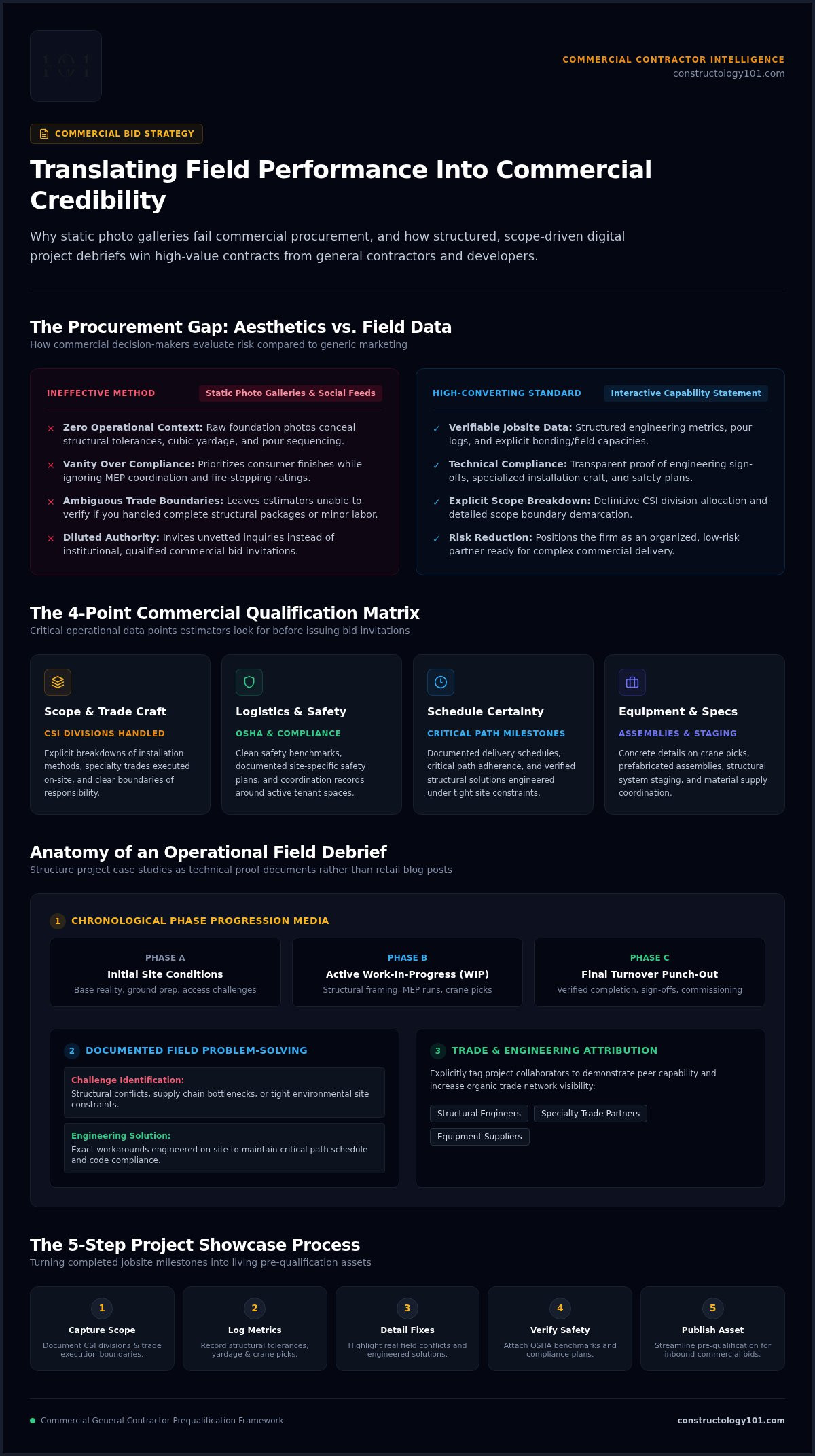
Most commercial contractor websites treat project pages like family photo albums. They upload uncaptioned, wide-angle pictures of completed structures and expect commercial estimators to award bids based on aesthetic appeal. That assumption costs firms millions in missed bid invitations. An effective digital showcase isn't an art gallery. It must function as an interactive capability statement that proves field competence, operational discipline, and schedule certainty.
Modern commercial procurement relies on verifiable data. Commercial estimators, project executives, and developers aren't casual web browsers; they evaluate risk, bonding capability, and specialized field capacity. When you aim to electronic portfolio standards that organize structured artifacts, your digital presentation transforms from a static photo dump into a credible record of performance. If a portfolio lacks technical scope descriptions, verified delivery milestones, and safety credentials, serious decision-makers simply move to the next bidder.
The Trap of the Unstructured Photo Gallery
Static photo galleries fail because images alone provide zero operational context. An uncaptioned photograph of poured foundation walls cannot reveal structural tolerances, cubic yardage, or pour sequencing under tight environmental controls. General contractors skip these profiles instantly. They cannot tell if you handled a complete structural package or merely supplied labor for minor formwork.
Social media feeds compound this problem. Platforms like Instagram reward visual trends rather than technical compliance. A polished picture of an exposed ceiling looks impressive to consumers, but an estimator needs to know the exact MEP coordination protocols, fire-stopping ratings, and engineering sign-offs. Relying on casual social channels dilutes your commercial credibility and invites unvetted inquiries instead of commercial invitations.
What General Contractors Actually Look for Online
Commercial leaders evaluate trade partners through a precise risk-assessment lens. To properly showcase construction projects online, your materials must answer the specific qualification questions estimators ask behind closed doors:
- Scope boundaries and specialized trades: Explicit breakdowns of CSI divisions handled, installation methods, and specialty craft executed on-site.
- Logistical and safety performance: Clean records highlighting OSHA benchmarks, site-specific safety plans, and tight coordination around active tenant spaces.
- Schedule and budget compliance: Documented delivery schedules, critical path milestones met, and verified solutions engineered under tight site constraints.
- Equipment and material specifications: Concrete details regarding structural systems, crane picks, prefabricated assemblies, and material supply coordination.
Transparent documentation builds immediate trust. When commercial estimators see measurable field data attached to project media, your firm stands out as an organized, low-risk partner ready to execute complex commercial contracts.
Anatomy of a High-Converting Online Construction Case Study
General agency blog posts fail commercial contractors because they treat heavy civil, mechanical, or structural projects like retail product releases. Winning commercial projects requires a distinct blueprint. When you showcase construction projects online to attract tier-one general contractors and institutional developers, your case studies must read like operational field debriefs. Every case study needs structured scope definitions, concrete engineering metrics, chronological visual proof, and verified safety achievements.
High-converting case studies present your field work in a predictable, high-utility framework that estimators can scan in seconds:
- Phase progression media: Group visual assets chronologically into initial site conditions, active work-in-progress, and final turnover punch-out.
- Documented field problem-solving: Highlight structural conflicts, supply chain bottlenecks, or tight clearances, followed by your exact engineering workarounds.
- Partner attribution: Tag structural engineers, specialty trade partners, and equipment suppliers to demonstrate collaborative competence and boost organic network visibility.
Detailing Scopes, Square Footage, and Technical Specs
Commercial estimators need immediate operational parameters to evaluate whether your crew can handle their upcoming job value. Skip vague descriptors like "large commercial facility" or "comprehensive mechanical overhaul." Instead, define exact structural systems, CSI division scopes, load requirements, and certified installation standards.
This 120,000-square-foot light industrial warehouse required 4,500 cubic yards of laser-screeded slab-on-grade concrete, delivered on a compressed 14-week schedule with zero schedule variances. Stating exact metrics validates your operational capacity immediately. Highlighting specific certifications, such as AWS D1.1 structural welding or specialized manufacturer envelope warranties, confirms compliance before preliminary pre-qualification forms even reach your inbox.
Documenting Field Problem Solving and Safety Standards
Flawless construction jobs don't exist. Commercial general contractors know this, which makes sanitized case studies look suspicious. Detail real site challenges: unexpected subsurface obstructions, zero-lot-line crane staging logistics, or active hospital operating room dust containment. Explaining how your project managers engineered real-time solutions proves proactive field management under pressure.
Safety documentation serves as your final risk filter. Outline site-specific safety plans, total craft hours logged without lost-time incidents, and full compliance with OSHA standards. Demonstrating consistent risk mitigation makes your firm the safest, most dependable choice for project executives. To present your scopes within an active trade network, consider publishing your detailed project profiles through an interactive directory listing designed specifically for commercial builders.
Where to Showcase Construction Projects Online: Platform Comparison
Deciding where to publish your project portfolios directly affects your bid invitation rate. While organic search drives 52.3% of website traffic for construction businesses, simply hosting case studies on a quiet domain won't guarantee procurement eyes. You need a distribution strategy that balances owned brand real estate with platforms where commercial estimators actively source trade partners. When evaluating where to showcase construction projects online, three distinct digital channels emerge: self-hosted company websites, consumer social networks, and specialized industry directory platforms.
| Channel | Discovery Potential | Technical Detail Fit | Procurement Audience |
|---|---|---|---|
| Company Website | Low (Requires active SEO/ads) | High (Complete control) | Mid-funnel validation only |
| Consumer Social (IG/FB) | Volatile (Algorithmic feed) | Low (Image-centric, no specs) | Residential / Consumer |
| Industry Directory | High (Searchable trade index) | High (CSI scope categories) | Commercial GCs & Developers |
Company Websites vs. Mainstream Social Platforms
Your self-hosted website anchors your brand identity. It acts as the central hub where buyers verify your corporate stability, certifications, and leadership team. Ranking a standalone website for competitive specialty scopes takes substantial domain authority and sustained optimization effort. Estimators rarely find obscure trade websites through cold Google queries unless those sites carry exceptional technical optimization.
Mainstream social platforms like Instagram or Facebook generate quick impressions, but their algorithms bury complex data. They feature no search filters for division specs, structural tolerances, or bonding limits. A photo post gets buried under viral consumer content within forty-eight hours. Instead of competing with consumer media, trade professionals rely on an established national construction directory to maintain visible, permanent portfolio records tailored directly to commercial builders.
Interactive Industry Directories: The Modern Discovery Channel
Specialized directory networks bridge the gap between static websites and generic social feeds. These platforms organize project profiles by standard CSI MasterFormat divisions, enabling estimators to filter by specific field capabilities instantly. Instead of digging through irrelevant company blogs, procurement managers search structured trade profiles that showcase crane logistics, concrete framing, or electrical distribution work.
Joining a dedicated modern B2B construction network puts your capabilities in front of peers who issue commercial subcontracts. Built-in peer messaging removes the gatekeepers, letting trade owners and project executives start preliminary scope reviews immediately. This direct channel transforms your digital portfolio from a passive archive into an active commercial pipeline.
How to Showcase Construction Projects Online: A 5-Step Process
Field documentation fails when teams treat it as an afterthought. You don't need an expensive media crew on-site every week to build a commercial portfolio. You simply need a repeatable, disciplined system that your superintendents and project managers can execute during regular site walks. Follow this practical five-step workflow to showcase construction projects online and capture the attention of commercial procurement teams:
- Capture phase-based imagery systematically: Record site preparation, active rough-ins, structural framing, and completed turnover.
- Compile technical benchmarks: Log total craft hours, safety milestones, material quantities, and schedule compliance data as milestones occur.
- Draft a lean, problem-solution narrative: Detail the client's operational objective, note the project constraints, and explain your exact engineering solution.
- Tag collaborative partners and suppliers: Credit trade partners, specialty subcontractors, architects, and structural engineers involved in the build.
- Distribute to targeted commercial procurement channels: Publish your structured case study where general contractors actively search for qualified trade capacity.
Systematizing Jobsite Media Capture and Milestones
Equip project managers with straightforward photo capture standards. High-resolution mobile devices handle this task easily during routine safety inspections. Direct your crew to photograph structural connection details, complex utility chases, and concrete reinforcement before backfill or drywall conceals their craftsmanship. Staged photos of finished conference rooms don't impress commercial developers; verified mechanical, electrical, and structural installations do.
Always audit media before publication to ensure full compliance with client confidentiality agreements and jobsite safety rules. Verify that every worker in the frame wears appropriate PPE, from hard hats to high-visibility vests. A single safety violation captured in a portfolio image can disqualify your bid during preliminary safety reviews.
Structuring Narrative and Tagging Collaborative Partners
Write lean project narratives focused strictly on operational outcomes. Outline the owner's delivery deadline, explain how unexpected soil conditions or supply disruptions were resolved, and state the final result. Keep the copy objective, factual, and direct. Commercial estimators want the operational facts, not marketing fluff.
Tagging material suppliers, equipment rental houses, and trade partners expands your visibility across industry networks. When you credit collaborators on a project, they share the win, creating cross-profile discovery that leads directly to new commercial inquiries. Publish your interactive directory listing on Constructology 101 today to turn your verified field achievements into an active bid-generation asset.
Transforming Digital Project Showcases into Long-Term Business Assets
Digital project showcases shouldn't expire when a ribbon is cut. When maintained systematically, project records transform into compounding commercial assets that work around the clock. Active profiles function as living operational resumes. They confirm current crew mobilization, highlight bonding readiness, and demonstrate continuous business solvency to risk-conscious developers. When you showcase construction projects online with consistent, structured updates, you signal that your firm is financially healthy, actively building, and operationally dependable.
Every completed project profile builds permanent institutional equity. Instead of letting past successes sit idle in job folders, active firms catalog their installations into a searchable track record. This visibility delivers three undeniable business advantages: it validates field capability, strengthens peer reputation, and generates consistent bid invitations from serious commercial builders.
Accelerating the Commercial Subcontractor Pre-Qualification Phase
Commercial pre-qualification typically bogs down in repetitive paperwork, delayed phone calls, and manual reference checks. An Interactive Directory Listing short-circuits this friction. Instead of mailing static PDF capability statements, you direct risk managers to a centralized profile featuring verified scopes, safety records, and high-resolution site milestones.
Estimators verify past performance instantly. Transparent project histories eliminate guesswork, confirm trade specialization, and validate field execution under actual jobsite constraints. Integrated peer messaging lets procurement executives clarify tolerances, verify crew availability, and issue bid packages directly without administrative bottlenecks.
Capitalizing on Early Platform Positioning for Lifetime Value
Early positioning creates lasting competitive separation. As digital procurement channels mature, proactive firms establish search authority, build expansive project libraries, and lock in prominent directory placement. Waiting until your competition dominates the field only increases the cost and difficulty of catching up.
Securing your brand through a construction industry lifetime membership locks in foundational placement across a national network while avoiding recurring monthly overhead. Pioneer members capture early trade relationships, establish category dominance, and ensure their portfolios remain visible to top general contractors year after year. Position your business as an industry frontrunner today. Build your interactive portfolio, showcase construction projects online to commercial buyers nationwide, and turn your jobsite achievements into a permanent pipeline of high-margin contracts.
Turn Your Jobsite Milestones into Inbound Commercial Contracts
Winning commercial contracts requires moving past passive photo albums. When you showcase construction projects online with verified engineering metrics, transparent safety benchmarks, and precise CSI division scopes, commercial estimators take notice. Structured digital portfolios eliminate qualification guesswork, streamline pre-qualification reviews, and validate your real-world field capabilities to institutional developers.
Stop leaving your bid pipeline to chance. Constructology 101 provides interactive directory profiles designed specifically for commercial trade discovery, backed by an integrated messaging system built for seamless peer-to-peer B2B networking. Gain immediate visibility among general contractors actively searching for reliable trade capacity. Join Constructology 101 as a Pioneer Member to secure an exclusive Pioneer Membership tier delivering permanent lifetime platform access. Take control of your commercial reach, publish your technical capabilities nationwide, and start securing the bids your craftsmanship deserves.
Frequently Asked Questions
How does an online project showcase differ from a standard photo gallery?
An online project showcase provides complete operational context, while a standard photo gallery only offers uncaptioned visual snapshots. High-impact showcases detail exact project scopes, structural specs, delivery milestones, and safety benchmarks. They explain field challenges and the technical solutions your team implemented. This structured documentation validates your commercial capacity, transforming basic images into an interactive capability statement that estimators can rely on.
What technical details should contractors include when showcasing projects online?
Contractors should specify CSI MasterFormat divisions, total square footage, schedule duration, structural materials, and installation methods. Include concrete safety achievements such as zero lost-time incidents or site-specific safety protocols. Highlighting technical tolerances, engineering adaptations, and specialized equipment deployment gives commercial estimators the verifiable proof they need to pre-qualify your firm for complex scopes.
Can specialty trade contractors showcase sub-tier project contributions?
Yes, specialty trade contractors can and should showcase sub-tier work. To showcase construction projects online effectively as a subcontractor, clearly define your specific CSI scope boundaries rather than claiming the entire project. Detail your labor hours, specialized equipment staging, and coordination with adjacent trades. Tagging the project's general contractor or engineering partners adds reciprocal validation and confirms your collaborative reliability.
How do online construction showcases help win commercial bids?
Online showcases shorten the preliminary vetting process by answering critical pre-qualification questions upfront. Commercial estimators use them to verify trade specialization, field safety discipline, and project delivery timelines before issuing invitations to bid. Providing transparent, data-rich proof of past performance reduces your perceived jobsite risk, placing your firm ahead of competitors who rely on vague PDF brochures or generic galleries.
How often should a construction business update its online project portfolio?
Update your project portfolio at every major jobsite milestone or at least once a month. Documenting active structural framing, MEP rough-ins, and completed turnovers signals continuous field momentum. Consistent updates demonstrate to general contractors that your business is solvent, actively mobilizing crews, and maintaining dependable bonding capacity. In contrast, outdated project records leave estimators questioning your current operational capacity.
Do contractors need professional photography to showcase jobsites online?
Professional photography isn't required for regular field progress. High-resolution mobile devices work exceptionally well for capturing critical installation details during superintendent site walks. Focus on good lighting, clear structural connections, and spotless safety compliance. Ensure all personnel wear mandatory PPE. Raw, well-documented progress photos often carry greater technical credibility with commercial estimators than heavily staged marketing photography.
What is the most effective platform to showcase construction projects online?
The most effective platform combines structured data with active peer networking. While company websites serve as digital home bases, specialized trade platforms like Constructology 101 let you showcase construction projects online directly to procurement decision-makers. Dedicated directories organize portfolios by CSI trade classifications and feature direct messaging, enabling general contractors to evaluate your technical credentials and initiate subcontracting conversations immediately.


