

A chamber membership is an investment in relationships, not a guaranteed source of work. Whether chamber of commerce memberships are worth it for contractors depends on the dues, the connections you can build, and how consistently you participate. If the costs and time outweigh the value of the introductions, visibility, and business opportunities you gain, joining may not be the right fit.
It makes sense to weigh the expense against the chance to meet potential clients, referral partners, and other professionals. This guide will help you assess that tradeoff before committing. Compare membership costs and benefits, consider networking and referral potential, and account for the time and participation needed to get value. Use these factors to decide whether a chamber supports your goals and contracting business.
Key Takeaways
- Compare membership dues and time commitments with the business value you want, rather than judging the investment by visibility alone.
- Build relationships through regular event attendance and participation; introductions are more useful when people know your work.
- Weigh committees, sponsorships, and ribbon cuttings as ways to raise your profile, while accounting for the effort and expense involved.
- Track introductions from events and member directories through to paying work to see which activities contribute to revenue.
- Compare membership tiers by the access and benefits they provide, then choose the level that fits your goals and budget.
1. Membership disadvantages and return on investment
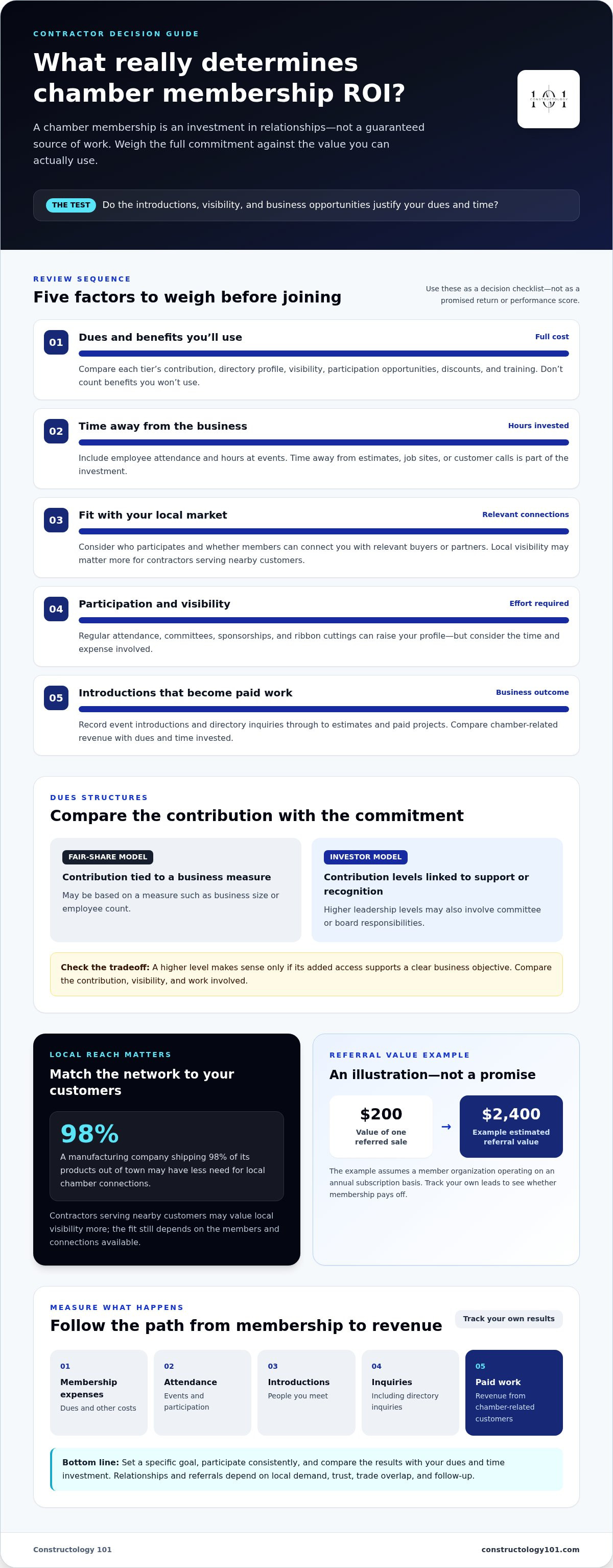
Before joining, compare the dues, included benefits, time commitment, and local business network. Ask what each membership tier provides, how your profile appears in the chamber directory, and whether any discounts apply to expenses your business already has. These details show whether membership fits your goals. Whether chamber of commerce memberships are worth it for contractors depends on the benefits you can actually use, not simply those listed.
Dues vary by chamber and membership tier, so compare the full commitment rather than focusing on one advertised benefit. A lower tier may include a basic directory profile, while a higher tier may offer more visibility or participation opportunities. Treat these as potential differences to evaluate, not guaranteed returns. Factor in employee attendance and the hours spent at events. Time away from estimates, job sites, or customer calls is part of the investment.
Fair-share and investor models structure dues differently. A fair-share model typically bases contributions on a measure such as business size or employee count; an investor model offers contribution levels associated with broader support or recognition. Higher leadership levels may also involve committee or board responsibilities. Compare the contribution, visibility, and work involved. A higher level makes sense only if its added access supports a clear business objective.
To measure return on investment, record membership expenses, event attendance, introductions, directory inquiries, and resulting paid work. Then compare revenue from chamber-related customers with dues and time invested. An example referral valuation estimates $2,400 in value when one referred sale is worth $200 and the member organization operates on an annual subscription basis. Use that example to understand how referrals can be valued, not as a promise of results. Track your own leads to see whether the investment pays off.
Local reach matters. A manufacturing company shipping 98% of its products out of town may have less need for local chamber connections. Contractors serving nearby customers may value local visibility more, but the fit still depends on who participates and whether those members can connect them with relevant buyers or partners. Discounts and training may add value, yet benefits you won’t use shouldn’t drive the decision.
Set a specific goal before joining, such as building referral relationships or improving your local profile. Attend relevant events, explain your work clearly, and follow up with people you meet. Keep your directory listing current so potential contacts understand your services. After a consistent period of participation, compare results with your dues and time investment. This helps distinguish useful business relationships from activity that hasn’t advanced your goals.
2. Chamber networking and relationship-building
Many chambers hold regular networking events, giving contractors a way to meet local business owners and potential referral partners. The value comes from repeated conversations, not simply collecting contacts. Attend events relevant to your work, describe your trade clearly, and follow up with people whose services complement yours. For example, a remodeler might build relationships with designers, real estate professionals, and specialty trades.
Some chambers also organize industry-focused groups and specialized committees. Many regional business associations, for instance, hold roundtable groups that meet regularly. These gatherings can help contractors meet people with shared business interests and learn how local firms work together. Joining a committee or attending consistently can build familiarity, making members more comfortable referring work to people they know.
To get more from each event, set a practical goal before you arrive. Choose a service or project type to explain, prepare a concise introduction, and identify contacts who could become clients or collaborators. Afterward, send a personal follow-up that refers to your conversation. For instance, a commercial electrician could reconnect with a property manager by sharing relevant project details and asking about upcoming needs.
Chamber event formats vary. A speed-networking session may give businesses a short time to speak before participants move to the next company. Use that window to explain your specialty, ideal project, and best referral connection. At longer events, make time for follow-up conversations instead of trying to meet everyone. Consistent, focused contact can turn a first introduction into a working relationship.
How much business do contractors typically get from chamber referrals and networking? There’s no fixed amount. Referrals depend on local demand, trade overlap, trust built through participation, and follow-up. Track introductions and inquiries, then note which lead to estimates and paid projects. That record shows whether networking is contributing meaningful business to your company.
Contractors can also build connections through trade associations, supplier events, peer groups, and online construction networks. These alternatives may connect you with people beyond a chamber’s local membership. A construction professional directory can also support discovery and industry connections alongside in-person networking.
Are chamber of commerce dues tax-deductible for contractors? Tax treatment depends on the membership’s purpose and included benefits. Keep the invoice, dues description, and records of business use for tax reporting.
Do contractors need chamber membership to bid on local government or commercial projects? Chamber membership is a networking choice, not a substitute for a project’s bidding and eligibility requirements. Follow the requirements for each procurement opportunity, and use chamber relationships to build awareness and connections.
3. Committees, sponsorships, and ribbon cuttings
Chamber committees, sponsorships, and ribbon cuttings offer contractors ways to build visibility beyond standard networking events. A committee role can bring you into regular contact with members who help shape local programs. For example, a contractor serving small businesses could contribute practical building knowledge to a business development committee. The value comes from both the work itself and repeated contact with people who see your expertise in action.
Event sponsorships can put a business in front of a larger audience and create promotional opportunities. Before committing, match the event’s audience with the customers or referral partners you want to reach. A residential contractor may find a neighborhood-focused event more relevant than a program aimed mainly at unrelated industries. Review what the sponsorship includes, such as event visibility or a chance to speak, and weigh that exposure against the time and contribution required.
A ribbon cutting gives a business a public occasion to mark an opening, relocation, expansion, or other milestone. For contractors, it can also introduce a new showroom, office, or community project to chamber members. Chamber ribbon-cutting services generally involve organizing or promoting this type of event, rather than construction work. The event can create opportunities for photographs, introductions, and local recognition, depending on who attends and how the business follows up.
Make the event useful by preparing a clear introduction before guests arrive. Explain your trade, the projects you take on, and the professionals you work well with. A general contractor could use a ribbon cutting to meet property managers, designers, or commercial tenants. Bring business materials, identify relevant attendees, and follow up afterward with a note tied to your conversation. A specific next step makes the connection easier to continue.
Choose participation based on a defined goal. If your aim is industry relationships, a committee may provide recurring interaction. If you want broader visibility, a sponsorship or ribbon cutting may create a stronger public profile. Compare each opportunity’s audience, preparation, time commitment, and promotional value. Don’t sponsor an event simply because it’s offered; connect the commitment to a business priority.
After a committee project or event, record the contacts you made and conversations that continued. Note whether a sponsorship led to introductions or a ribbon cutting brought relevant prospects to your business. This review helps separate exposure from useful engagement. It can also guide your next move: take a deeper committee role, choose a different event, or focus on following up with members you’ve already met.
4. Referrals and lead generation
Chamber referrals can connect contractors with customers who need work and professionals who influence project decisions. A real estate agent might refer a homebuyer to a remodeler, while a property manager could introduce a commercial electrician to a building owner. These opportunities depend on members understanding your specialty, ideal project, and service area. Explain those details clearly so contacts know when your business is a good fit.
Trust shapes referrals. 64% of adults familiar with their local chamber were more likely to purchase from a chamber member. That figure points to a potential advantage: membership can support recognition among people who value local business connections. It doesn’t replace a strong estimate, reliable communication, or relevant experience. Share examples of completed work and explain the projects you want, rather than relying on membership alone.
Some chambers help members promote one another through introductions, directories, or social media. Make your profile useful by describing your trade in plain language and naming the customers you serve. A specific listing such as “commercial roofing for property managers” is easier to refer than a broad label like “contractor.” Share chamber posts when relevant, and give members a clear way to pass along your information.
Referral rewards can include recognition, reciprocal introductions, or a thoughtful follow-up after a connection leads to work. Keep the exchange professional. Thank the person who made the introduction, update them when the customer gets in touch, and refer suitable opportunities back to members. Avoid treating every contact as a lead. A designer’s referral to a homeowner may fit your work; an unrelated introduction may not.
Track each lead from its source to its outcome. Record whether it came from an event, a member introduction, social media, or the directory. Then note the date, project type, estimate status, and whether the lead became a paying customer. For example, compare referrals from a property manager with inquiries from a chamber event. This shows which relationships contribute to business growth.
Measure success using both revenue and the effort required to earn it. One example describes a business generating $5,000 in new business from a chamber membership. Use that as an illustration, not a forecast for your company. Compare your own chamber-related revenue with dues, event expenses, and follow-up time. Review the results regularly, then focus on the relationships and promotional opportunities that produce qualified inquiries.
5. Chamber membership costs and pricing tiers
Chamber dues aren’t set by a national price list. Each chamber sets its own tiers, benefits, and contribution structure, so a contractor’s cost depends on the organization and selected level. Treat any sample price as an example, not a standard rate for chambers across the United States.
How do chamber membership costs and benefits vary by city and chamber size? A chamber in one area may offer different tiers, events, directory visibility, and member programs than an organization elsewhere. Larger chambers may provide broader connections, while smaller ones may focus on local relationships and events. Compare the actual benefits attached to each tier, not the chamber’s size alone.
What does a chamber of commerce membership cost for contractors in the United States? There’s no single nationwide rate; each chamber sets its own dues and pricing tiers.
Read the benefits for each tier closely. One sample membership description includes a business listing in three categories on the chamber website and one listing in the printed directory. That package shows why the details matter: a contractor seeking online visibility may value the digital categories, while a business seeking print exposure may weigh the directory placement. Compare what each level includes with the connections you want to build.
Look beyond dues when calculating the full commitment. Add event sponsorships, optional programs, travel, and staff time if they apply to your plan. For example, a contractor choosing a higher tier for added visibility should consider whether its audience includes customers or referral partners. A lower tier may be a better fit if its directory presence and events meet your immediate goals.
Before deciding, compare tiers in a simple table: dues, directory features, event access, sponsorship options, and expected participation. Mark each benefit as useful or unnecessary for your business. This makes the tradeoff clear and helps you avoid paying for visibility you won’t use. If you’re also comparing construction-focused membership models, explore a lifetime membership option as a different way to consider ongoing industry connections.
Constructology 101: Interactive Directory Listing
Constructology 101 offers an Interactive Directory Listing for contractors who want construction professionals and businesses to discover their profiles. Its construction-focused directory and professional network can support connections across trades, suppliers, architects, and engineers. Use the listing to explain your specialty and the work you take on, making it easier for relevant industry contacts to understand your business.
If you’re weighing ongoing participation in a local chamber against a construction-focused network, consider which audience better fits your relationship-building goals. Constructology 101 also offers Pioneer membership at a lifetime price. These options provide another way to build industry visibility alongside chamber involvement, not a replacement for the relationships you develop through active participation.
Explore Constructology 101 at constructology101.com to learn more.
Build Your Next Industry Connection
Your answer to whether chamber of commerce memberships are worth it for contractors should guide your next step: invest in local relationships, broaden your industry visibility, or combine both approaches. Choose an approach you can sustain, then make your expertise easy for potential partners and customers to understand.
For contractors looking to connect with construction professionals online, Constructology 101 offers an Interactive Directory Listing. Its Pioneer membership is available at a lifetime price. These options can complement the local relationships you build through a chamber, giving you another way to be discovered within the construction community.
Take the next step that fits your growth goals. Contact Constructology 101 today to explore its directory and membership options. Keep building connections, sharing your expertise, and creating room for new opportunities.
Frequently Asked Questions
Why Join a Chamber of Commerce?
Join to build business relationships, increase local visibility, and take part in programs that support business activity. A chamber can also provide a setting to meet potential customers and referral partners who might not find your company through job-site work alone. The Schapiro Group found consumers who know a small business belongs to a chamber are 49% more likely to think favorably of it and 80% more likely to purchase from it in the future.
Are Chamber Events Good for Lead Generation?
Chamber events can support lead generation when contractors choose relevant gatherings and follow up with useful conversations. A roofing contractor, for example, might prioritize events attended by property owners or real estate professionals over gatherings with little connection to those customers. Treat each event as a chance to learn who needs your expertise. Record where each inquiry came from and whether it becomes a qualified opportunity, so you can refine your event choices over time.
Is Chamber Membership Worth It for Small Businesses?
Chamber membership can suit a small business with time to participate and a clear goal for its local relationships. A new contractor might use member introductions to meet complementary trades, while an established firm may value visibility with local organizations. Compare the membership’s offerings with your current priorities. If you can’t attend, contribute, or follow up, benefits such as events and member recognition may have limited practical value.
What Businesses Benefit Most from Joining a Chamber?
Businesses that rely on local relationships often have a clear reason to join, including home-service contractors, real estate professionals, retailers, and business-to-business firms. A contractor serving nearby property owners can meet potential clients and referral partners through local connections. Businesses with customers spread across a wider area may place greater value on broader industry networks. Consider where your customers make decisions and who can introduce your business to them.
What Benefits Do Local Chamber Memberships Offer Contractors?
Local chambers can offer contractors member events, business directories, committees, sponsorships, and ribbon-cutting opportunities. These activities can help contractors meet prospective customers, become familiar to other members, and take part in local business programs. Some chambers also provide training, discounts, or information about support programs. Compare these benefits with your business needs, such as meeting commercial partners or increasing awareness among local homeowners.
How Can Contractors Calculate the ROI of a Chamber of Commerce Membership?
Calculate membership ROI by comparing chamber-related revenue with the full cost of participation. Track dues, event expenses, and staff time, then connect estimates and completed jobs to their sources. For example, record whether a lead came from a member introduction, directory inquiry, or event conversation. Subtract membership costs from revenue tied to those leads, then divide by membership costs. Review the result alongside relationship-building value, such as repeat introductions or stronger project partnerships.


