

LinkedIn can widen a construction professional’s reach, but it won’t make every connection useful. The limitations of LinkedIn for construction networking include unsolicited sales messages, uneven feed visibility, pressure to self-promote, and dependence on a platform you don’t control. It works best as one part of relationship-building, not a replacement for it.
If you’ve struggled to distinguish a genuine industry connection from a sales pitch, or wondered why a useful post barely gets seen, you’re not alone. Online networking can create opportunities, but it also takes time and attention without guaranteeing meaningful conversations.
This article explains how spam, feed visibility, self-promotion, and platform dependence can affect construction networking on LinkedIn. You’ll also find practical ways to reduce friction, build more relevant connections, and decide when to take a relationship beyond the feed.
Key Takeaways
- Personalize outreach and build context before sending a connection request to make networking feel less like a sales pitch.
- Feed visibility can vary, so don’t rely on posts alone to keep important industry relationships active.
- Share useful project insights and engage genuinely to balance self-promotion with trust-building.
- Keep professional contacts and conversations beyond one platform so changes to access or visibility don’t disrupt your network.
- Consider whether an interactive construction directory can help you connect with roles and trades that are harder to reach through a broad professional feed.
1. Spam messages and automated outreach
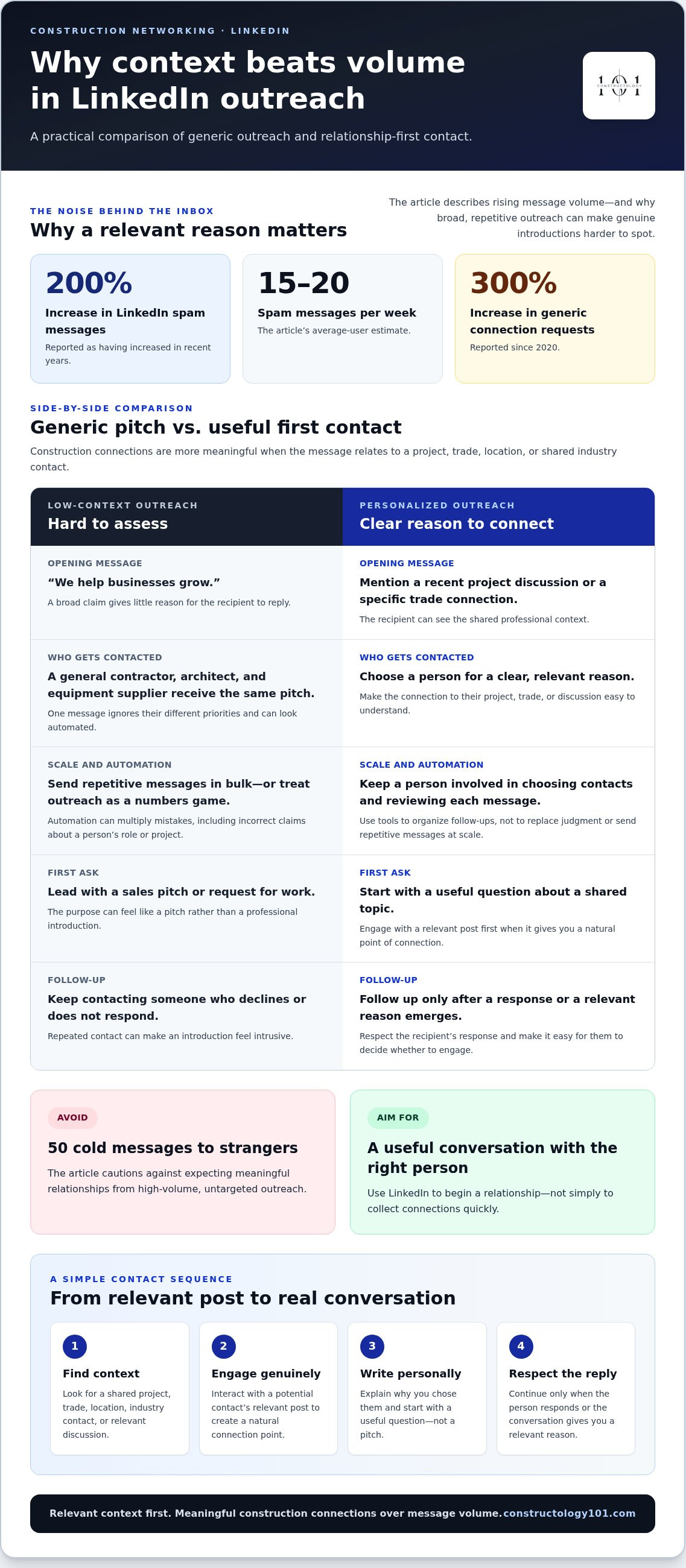
Spam turns a professional feed into another inbox to manage. LinkedIn spam messages increased 200% in recent years, and an average user receives 15-20 spam messages per week. For a construction estimator, supplier, or specialty contractor, a generic pitch can bury a useful introduction among irrelevant offers.
Construction networking often depends on context: a project type, trade, location, or shared industry contact. “We help businesses grow” gives someone little reason to reply. A note mentioning a recent project discussion or a specific trade connection gives them a clearer reason to engage. Personalization takes more effort, but makes the purpose easier to assess.
What LinkedIn rules limit messaging, connection requests, and outreach to construction professionals? In practice, focus on relevance, honest intent, and respect for the recipient’s response. Avoid bulk, repetitive requests and unsolicited sales pitches. Stop contacting people who decline or don’t respond.
Automation can multiply mistakes. Sending the same pitch to a general contractor, architect, and equipment supplier ignores their different priorities. That pattern can make even a legitimate introduction look automated.
LinkedIn networking automation may help organize follow-ups, but it shouldn’t replace judgment. Keep a person involved in selecting contacts, reviewing each message, and deciding whether a follow-up makes sense. Avoid tools or workflows that send repetitive messages at scale. A mistaken claim about someone’s project or role can damage trust faster than a delayed reply.
How can construction professionals improve their LinkedIn networking results? Engage with a potential contact’s posts, then send a short request explaining the shared project, trade, or topic. Start with a useful question, not a sales pitch or request for work. Follow up only if the person responds or the conversation gives you a relevant reason.
These limitations of LinkedIn for construction networking matter most when outreach becomes a numbers game. Don’t send 50 cold messages to strangers and expect meaningful relationships to follow. Choose contacts for a clear reason, write each message for that person, and use LinkedIn to begin a conversation rather than automate one.
Generic LinkedIn connection requests increased 300% since 2020. That rise makes a relevant reason for contact more important than simply adding another name to a list. A recipient should be able to understand why you chose them and what shared professional context makes a conversation worthwhile. If there is no clear connection to a project, trade, or discussion, wait until one exists rather than filling the request with broad claims or an immediate sales ask.
A LinkedIn member recommends building relationships through content engagement and personalized messages instead of sending recruiters vague, unsolicited requests. Engaging with someone’s relevant post can give you a natural point of connection, while a personal note shows the request is meant for them, not sent indiscriminately. Focus on a genuine shared topic and make it easy for the other person to decide whether to respond. The goal isn’t to collect connections quickly, but to start a useful conversation with someone whose work or perspective matters to you.
2. Algorithm-driven feed visibility
A useful construction update may reach only part of its intended audience. LinkedIn’s feed determines which posts appear prominently, so publishing doesn’t guarantee that local builders, estimators, or suppliers will see them. A subcontractor’s lesson about scheduling may interest project managers, yet the post competes with hiring news, personal updates, and company announcements.
This creates a visibility tradeoff. A post’s reach depends partly on who sees and engages with it, and professional contacts have different habits and interests. An architect may check LinkedIn regularly, while a field supervisor may use it less often. Even a strong post can miss the people who would find its project insight most useful.
Construction professionals can improve their chances by making posts specific and useful. Share a concise lesson from a completed project, explain a material choice, or ask a focused question about coordination between trades. Those details give readers a reason to respond. General updates such as “We’re excited for the week ahead” offer fewer practical ways into a conversation.
Consistency creates more opportunities to be seen, but doesn’t guarantee reach. A practical approach is to post two or three times per week and respond to comments on the day they arrive. For example, a supplier could share an insight about product use, then answer a contractor’s question while the discussion is active.
Engagement should be intentional, too. Follow three to five LinkedIn Groups where construction professionals discuss relevant work, such as regional building activity or a specific trade. Read the conversation before contributing. A thoughtful comment on a project challenge adds more value than repeating a company slogan across several group discussions.
Track the results beyond likes. Note whether posts lead to relevant profile visits, direct conversations, or useful introductions. Review those outcomes after 30 and 60 days, rather than judging a strategy after one week. If a post attracts broad attention but no relevant conversations, adjust its topic, audience, or call for discussion.
Feed visibility is only one route to industry discovery. A construction-specific professional directory can offer another way to find people by their industry role and interests, rather than relying only on what appears in a feed. Consider a construction industry directory when your networking needs depend on finding relevant professionals directly.
3. Inauthentic content and self-promotion
LinkedIn rewards visibility, but constant promotion can make a profile feel like a sales brochure. A construction executive who posts only project wins, award announcements, and service pitches gives readers little reason to join the conversation. The work may be real, but a one-way stream of claims can make professional networking feel transactional.
Posts can also seem inauthentic when they feel detached from daily work. A site superintendent sharing broad leadership slogans without a practical example may seem less credible than one describing how a crew coordinated a concrete pour. Specific details show experience and give architects, trades, and suppliers something useful to discuss.
Trust takes time. Robert F. Smith describes networking as ongoing relationship-building rooted in trust and genuine interest in others. In construction, that might mean recognizing a supplier’s insight, asking an engineer about a design choice, or sharing a lesson without immediately asking for a referral.
Self-promotion has a place, especially when a company needs to show its capabilities. The tradeoff comes when the pitch takes priority over the relationship. For example, a specialty contractor can explain a completed installation, describe the coordination challenge, and credit the project team. That tells a fuller story than simply declaring the company “the best.”
Make each post useful to someone beyond your own business. Before publishing, consider who benefits from the information and what they can do with it. A subcontractor might share a checklist for preparing a work area. An architect could explain a material choice and invite practical feedback from builders.
Use a simple balance: demonstrate expertise, recognize others, and invite conversation. When sharing a project milestone, credit the trades involved and explain one important decision. If you promote a service, pair the announcement with a real example of the problem it addresses. This keeps visibility connected to value.
Measure the quality of interaction, not just reactions. A post with fewer likes may still start a useful exchange with a project manager or supplier. Notice whether people ask informed questions, share relevant experience, or continue the conversation privately. Those signals show whether your content is building professional trust.
LinkedIn’s format can encourage polished personal branding, but construction relationships grow through credible work and follow-through. Keep claims accurate, give credit, and show interest in other professionals’ perspectives. A steady record of useful contributions makes self-promotion more believable because readers can see the experience behind it.
4. Platform dependency and limited alternatives
LinkedIn can support construction networking, but relying on one platform concentrates your contacts, conversations, and visibility in one place. If it’s your only professional channel, a change in account access or feed exposure can disrupt how people find you. For example, a construction estimator may have useful contacts but no separate record of their project roles or discussions.
LinkedIn is effective for some goals, less direct for others. 87% of recruiters use it as their primary sourcing tool, and 60% of B2B leads are generated through LinkedIn connections. Those figures show its reach for recruiting and business relationships, but they don’t establish that every trade, local project, or supplier is equally easy to find there.
For job seekers, LinkedIn can help identify openings and connect with recruiters. For companies, it can support visibility and introductions. Subcontractors and suppliers may find project contacts, but a profile search won’t show whether a company has the right scope, timing, or local fit. A structural engineer and a drywall subcontractor need different information before discussing work.
Build a network that remains useful beyond LinkedIn. Keep business contact details and project notes in a system you control, and record why each connection matters. For example, note that a supplier specializes in a certain material or that a project manager discussed upcoming work. Keep private information secure and don’t copy platform data in ways that violate its terms.
Use more than one channel to maintain professional relationships. Follow up by email when someone has shared an address for that purpose. Attend a construction association meeting, regional trade event, or project open house, then connect with relevant people afterward. A face-to-face conversation can reveal practical context that a short profile doesn’t capture.
Referrals also reduce dependence on feed visibility. Ask a trusted contact to introduce you to a specific role, such as a general contractor or specialty supplier. Make the request clear and relevant. “Could you introduce me to a commercial roofing contact?” gives more direction than a broad request for “industry connections.”
Review your networking mix from time to time. If LinkedIn brings recruiter conversations but few supplier contacts, add outreach through trade events or direct referrals. If local project discussions matter most, prioritize regional industry groups and in-person meetings. Match the channel to your goal, then track which conversations lead to useful next steps.
The main limitation isn’t that LinkedIn has no value. It’s that no single platform covers every construction role, project need, or relationship. Keep LinkedIn as one useful channel while maintaining direct contacts and real-world connections that remain accessible outside its feed.
5. Which construction roles and trades are least represented on LinkedIn?
LinkedIn doesn’t provide a reliable public count of which construction trades are least represented. Professionals who use the platform for recruiting, business development, or project updates are easier to find. As a result, field-based roles may be harder to discover, even when those workers are active on local projects.
For example, a project executive or architect may maintain a detailed profile with a current title and company. A concrete finisher, equipment operator, or drywall installer may rely more on referrals, crew relationships, and jobsite contacts. That difference affects discoverability, not the trade’s importance or expertise.
Small subcontractors can also be hard to find through broad searches. A two-person specialty crew may rely on repeat clients and local referrals without posting regularly. A search for “commercial flooring contractor” may surface larger firms first, while a local installer appears under a different title or company name.
Search terms can hide relevant professionals. A carpenter might list “finish specialist,” while a laborer could use “construction worker.” Try variations based on the actual work, not only formal job titles. Search by trade, project type, and region, then compare profiles for recent work descriptions and shared contacts.
- Field crews: Search for specific tasks, such as concrete finishing or site preparation, instead of broad “construction” terms.
- Small specialty firms: Try service descriptions alongside titles, such as commercial flooring installation and flooring subcontractor.
- Equipment operators: Search by equipment or work type, such as crane operator or earthmoving, when titles vary.
- Local suppliers: Look for product categories and regional terms, since a supplier’s profile may emphasize sales rather than construction.
Use LinkedIn as one way to discover professionals, then clarify their work through relevant conversations. If a profile lists a trade but little project detail, ask what work they handle before assuming there’s a fit. A brief discussion can clarify whether someone serves commercial projects, residential jobs, or a specific specialty.
For broader coverage, combine platform searches with local construction events, trade associations, and referrals from people who know the work firsthand. A general contractor may know reliable site crews; an architect may know specialist consultants. These connections can help you find skilled professionals whose profiles are quiet or difficult to discover.
When LinkedIn searches miss the trades or suppliers you need, broaden your discovery path with a construction professional directory and search around the roles your projects require.
These figures should not be treated as a count of construction trades on LinkedIn. The page reports that 98% of sales representatives with 5,000 or more LinkedIn connections meet or surpass their target quota. That describes quota outcomes for a sales group, not how often construction workers maintain profiles or appear in searches. A LinkedIn member post says 85% of U.S. professionals could see at least a quarter of their skills reshaped by AI. That statement concerns possible skills change across professionals, rather than the visibility or discoverability of any particular trade in platform searches.
Constructology 101: Interactive Directory Listing
Constructology 101 offers an Interactive Directory Listing for construction professionals seeking a more industry-focused way to connect. Use it to build business visibility and help others discover your role, trade, or construction-related offering. It can complement LinkedIn when broad feeds and profile searches don’t make relevant industry contacts easy to find.
Turn to the directory when you want to connect across construction specialties, share project information, or communicate with industry professionals through an integrated network. Constructology 101 also offers Pioneer membership at a lifetime price.
Explore the directory and decide whether it fits your networking approach. Visit Constructology 101 to learn more.
Build a Network That Moves With Your Work
Choose networking channels around the relationships you need to build, not just the platform you already use. The limitations of LinkedIn for construction networking are a reminder to make your professional presence discoverable in more than one way. Keep developing direct connections, sharing practical expertise, and creating space for industry professionals to find you.
Constructology 101’s Interactive Directory Listing gives construction professionals another place to build visibility and connect across the industry. Its Pioneer membership is offered at a lifetime price. Use these options to complement your networking approach and make it easier for relevant professionals to discover your work.
Take the next step at Constructology 101 and explore a construction-focused way to grow your professional network. Keep showing up with purpose, and let each useful connection create momentum for the next.
Frequently Asked Questions
What privacy, spam, and scam risks come with using LinkedIn for construction networking?
Risks include unwanted pitches, impersonation, and exposure of details you share publicly. In 2021, data from 700 million LinkedIn users was scraped and sold on the dark web. Avoid posting sensitive project schedules, access procedures, or personal contact details. Before engaging, compare a sender’s profile with their company information and verify unusual requests through a separate trusted channel. Don’t open unexpected files or share payment details in response to unsolicited messages.


