

Growth that depends on the owner handling every decision isn’t scalable. A scalable construction business can take on more work while keeping operations, cash flow, and quality under control. For many firms, a sustainable target is annual growth of 10% to 25%, depending on market conditions, staffing capacity, and financial strength. Scaling a construction business beyond your local network means building the people, processes, and relationships to support that growth.
Referrals are valuable, but relying on a small circle can limit the projects and partnerships you reach. Scaling a construction business beyond your local network does not mean expanding everywhere at once. First, build a business that can deliver consistently, then test new opportunities with a clear view of capacity and demand.
This guide explains how to assess expansion readiness, delegate effectively, create repeatable processes, and build referral relationships beyond your usual contacts. You’ll also learn how to test a new market before committing to a permanent presence, so each move is grounded in what your business can sustain.
Key Takeaways
- Assess staffing, cash flow, and quality before taking on more work, then set a growth pace your business can sustain.
- Delegate decisions and define responsibilities so the owner isn’t the bottleneck as the team grows.
- Build lasting relationships with architects, designers, and real estate agents by staying useful, responsive, and clear about your capabilities.
- Document repeatable workflows and quality checks to help teams deliver consistent results across projects.
- Test demand in a new market before committing to a satellite office, and use what you learn to guide the next move.
1. Delegating responsibilities and building a management layer
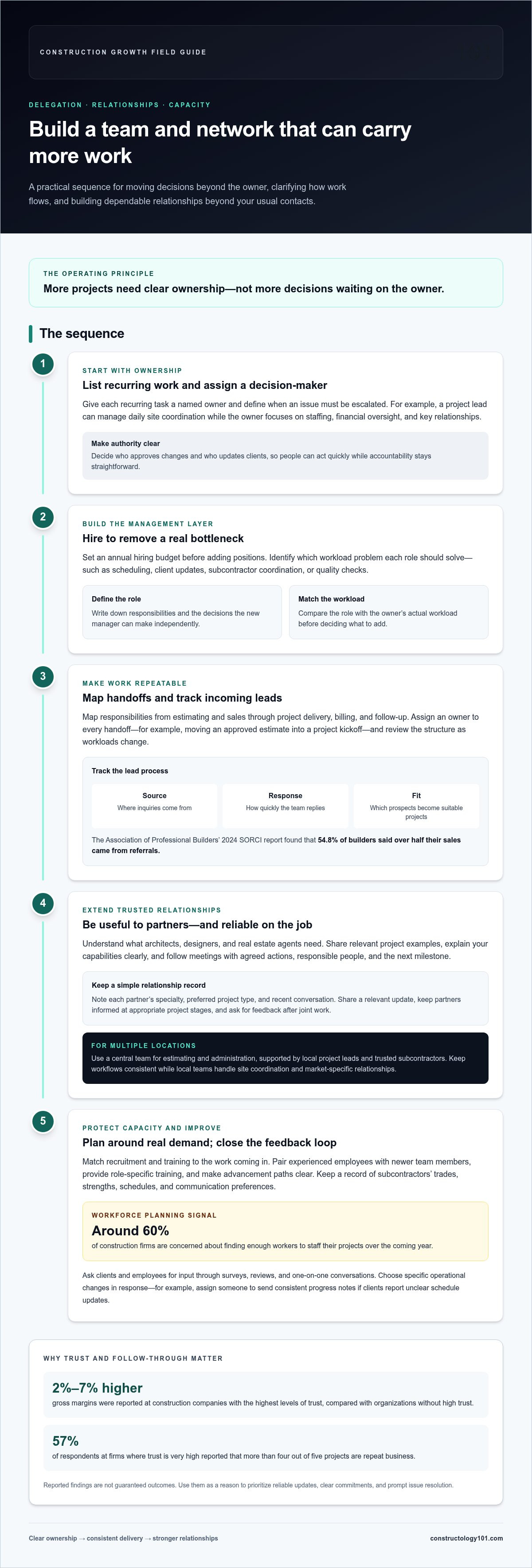
More projects bring more decisions, but the owner shouldn’t remain the default decision-maker. List recurring tasks, assign an owner to each, and define when an issue needs escalation. For example, a project lead can manage daily site coordination while the owner focuses on staffing, financial oversight, and key relationships. Clear authority helps contractors act quickly while keeping accountability straightforward.
Build the management layer around actual workload. Set an annual hiring budget before adding positions, then identify the bottleneck each hire should remove. Compare the role’s responsibilities with the owner’s workload, such as scheduling, client updates, subcontractor coordination, or quality checks. A written role description makes the decision easier to evaluate and clarifies what new managers can decide independently.
Give the organization a structure people can follow. Map responsibilities from estimating and sales through project delivery, billing, and follow-up. Assign an owner to each handoff, such as moving an approved estimate into a project kickoff. Review the structure when workloads change, not only when someone leaves. Undefined responsibilities are cited as one of the top five work stress factors, so clarify who approves changes and who updates clients.
Build a consistent marketing and lead-generation system instead of relying on occasional outreach. Track where inquiries come from, how quickly the team responds, and which prospects become suitable projects. The Association of Professional Builders’ 2024 SORCI report found that 54.8% of builders said over half their sales came from referrals. Make referrals easier by sharing clear project examples and keeping architects, designers, real estate agents, and past clients updated on your capabilities.
Subcontractor relationships also affect how much work you can take on. Keep a record of each contractor’s trade, strengths, schedule, and communication preferences. Share expectations early, including scope, milestones, and site coordination needs. After each job, discuss what worked and what caused delays. This practical feedback helps you build a dependable network and spot capacity gaps before accepting work in a new area.
Trust supports repeat business and stronger results. Construction companies with the highest levels of trust have gross margins 2% to 7% higher than organizations without high trust. At firms where trust is very high, 57% of one survey’s respondents reported that more than four out of five projects are repeat business. Use these findings as a reason to prioritize reliable updates, clear commitments, and prompt issue resolution, not as a guaranteed outcome.
Close the loop with feedback. Ask clients and employees for input through surveys, reviews, and one-on-one conversations, then choose specific operational changes to make. For example, if clients repeatedly mention unclear schedule updates, assign someone to send consistent progress notes. Delegation works when people understand their responsibilities, have authority to act, and see their feedback improve how the company operates.
2. Developing relationships with architects, designers, and real estate agents
For multiple locations, use a central team for estimating and administration, supported by local project leads and trusted subcontractors. This keeps company-wide workflows consistent while local teams handle site coordination and market-specific relationships.
Architects, designers, and real estate agents can connect you with projects before construction begins. Build those relationships by understanding what each partner needs: an architect may value reliable pricing input, while an agent may need a responsive contractor for a property renovation. Share relevant project examples and explain your team’s capabilities clearly.
Make outreach useful and specific. After a project meeting, send a concise follow-up listing agreed actions, who is responsible, and the next milestone. If a designer introduces a client, keep the designer informed at appropriate project stages. Reliable communication shows partners how collaboration works on actual jobs, not just in a sales conversation.
Use a simple relationship workflow to keep contacts active without turning every exchange into a pitch. Record each partner’s specialty, preferred project type, and recent conversation. Then share a relevant update, such as a completed project that fits their work or a change in the services your team can coordinate. Ask for feedback after joint projects and act on specific suggestions.
Strategic hiring supports those new relationships. Match recruitment to the work partners are bringing in, then identify whether the gap involves estimating, site supervision, or a trade skill. Around 60% of construction firms are concerned about finding enough workers to staff their projects over the coming year. Build workforce plans around actual project demand, rather than assuming every referral can be accepted.
When scaling a construction business beyond your local network, develop workers as well as recruiting them. Pair experienced employees with newer team members, provide role-specific training, and explain advancement paths. For example, a strong field worker could prepare for crew leadership through supervised coordination tasks and clear performance feedback.
Retention depends on the day-to-day experience of the job. Review policies, benefits, and working conditions for gaps that make the company less attractive than others in the same market. Ask employees which workflows create avoidable delays, discuss their longer-term goals, and use their ideas when shaping new protocols.
The AGC survey found that 52% of construction firms reported difficulty hiring hourly craft workers. A broader talent pool and stronger retention practices can help protect project capacity. Build a dependable subcontractor bench by recording each contractor’s trade, strengths, availability, and communication preferences. After collaboration, discuss what went well and what should change before the next project.
3. Scalable processes and standard operating procedures
A process that works for a small crew can break as the team grows. A construction team of two may coordinate tasks through quick conversations, but a crew of 15 needs clear handoffs, shared records, and defined approval steps. Document the workflows that affect safety, schedules, cost control, and client communication. Then make each procedure easy to find and follow on site.
Start with a completed project and map its path from estimate to closeout. Record who prepares the estimate, who approves scope changes, how materials are ordered, and when clients receive updates. Add checklists for recurring work, such as site setup, quality inspections, and final walkthroughs. XYZ Builders reduced project completion times by 20% after adopting standardized operating procedures and quality-control checklists.
Standardization should support good judgment, not replace it. A checklist can prompt a supervisor to record a change order, while the project lead handles the site-specific decision. Set a clear escalation path for unexpected conditions, and document how the team resolved them. That turns a lesson from one project into a useful update for future operations.
Construction technology can connect office staff and field teams across job sites. Digital project management platforms, estimating tools, and cloud-based documentation systems help teams coordinate schedules, costs, drawings, and updates. Mobile access can put current documents in workers’ hands on site. A guide estimates an average efficiency gain of 12% for construction businesses using project management software with mobile accessibility.
Choose technology to address operational problems, not to collect features. If teams repeatedly enter the same project details, assess whether automation can eliminate duplicate work. If job documents are hard to find, centralize them in cloud storage and adjust capacity to match project demand. Before buying standalone applications reactively, evaluate whether a complete, construction-specific ERP solution fits the company’s growth plans.
Review each process using actual project results. Compare estimates with final costs, planned schedules with completion dates, and documented issues across jobs. Ask employees where handoffs stall, then test one improvement on a suitable project. XYZ Builders was able to take on 30% more projects annually without adding staff after adopting standardized operating procedures and quality-control checklists.
Keep procedures current as the construction industry and company workflows change. Assign an owner to each document, collect employee suggestions, and revise instructions when recurring issues reveal gaps. Share updates with affected teams, then use the next project to see whether the change works. Standardized processes make growth more manageable: teams can repeat essential steps while still addressing each site’s specific needs.
4. Testing a new market before opening a satellite office
Start with a controlled test, not a permanent lease. Assess demand in a new market for 3 to 6 months before establishing a satellite office. Choose a nearby area where prospective work is 60 to 90 minutes from your existing business. That range can make site visits and coordination more practical while you learn how local customers buy.
Research demand through conversations with property owners, architects, designers, and real estate agents. Record the project types they expect, their timing, and the problems they need solved. Compare those signals with your backlog and available crews. A steady stream of inquiries matters less if the projects fall outside your expertise or overlap with periods when your team is fully committed.
Map the market before spending heavily on outreach. Identify the types of contractors already serving the area, the work they emphasize, and gaps your company can credibly fill. Check how your past projects match local needs, then test a clear message with prospective customers. Track inquiries, qualified opportunities, proposals, wins, and project delivery issues throughout the 3-to-6-month test.
Align sales and marketing around the work you can deliver. At $7 million in revenue, a construction business is advised to spend 2% to 5% of revenue on sales and marketing. Set a focused plan for the test market: share relevant project examples, maintain a consistent response process, and build relationships with local referral partners. Review which messages bring suitable opportunities, not just higher inquiry volume.
Licensing, permits, and contractor registration rules depend on the destination state, locality, trade, and project scope. Before pursuing work, create a checklist for each jurisdiction that covers the requirements relevant to planned projects, and make compliance part of your market-entry workflow.
Use the test to measure operational fit as well as demand. Track travel time, crew availability, subcontractor coverage, schedule changes, and client communication. If projects are successful, operate the new market as a satellite office for 6 to 18 months before expanding further. During that period, review whether local demand supports a lasting presence and whether the team can maintain quality without disrupting existing work.
Set a financial decision point before the test begins. A new construction business location should break even within 12 to 18 months. Use actual project costs, revenue, staffing needs, and local operating expenses to assess progress. If results support expansion, plan the next commitment around proven demand and delivery capacity. If they don’t, adjust the offer or keep serving the area without opening an office.
Assessing current capacity and readiness to expand
Set a growth pace your team can deliver without weakening quality. A sustainable target is annual growth of 10% to 25%, depending on market conditions, staffing capacity, and financial strength. Before committing, review backlog, available labor, cash reserves, and recent project performance together.
Use practical warning signs. Regularly working more than 50 hours per week may signal that the owner or team lacks capacity. Quality issues on 25% or more of projects are another red flag. Before expansion, identify the causes, assign an owner to each fix, and track whether those issues decline on later jobs.
Cash reserves should cover 2 to 3 months of overhead before scaling. Establish a line of credit before it becomes urgent, and maintain a rolling eight-week cash-flow forecast, updating it every Monday. This gives owners a view of upcoming payroll, material purchases, customer payments, and cash gaps.
To finance expansion and manage cash-flow risks, combine reserves with advance planning: require deposits of 25-35% for initial material costs, negotiate net 45-60 day vendor terms, and consider 2-3% discounts for early or on-time payments. Track receivables closely, since contractors may pay crews and buy materials 30 to 60 days before receiving project payments.
The main expansion risks are cash-flow strain, labor shortages, and quality problems when growth outpaces internal systems. Account for travel and coordination demands in a new market, then assess their effects on schedules, supervision, and existing projects. A written risk review can connect each challenge to a practical control, such as a staffing plan or closer job-cost tracking.
Build a recruiting pipeline before the coming workload arrives. Use trade schools, employee referrals, professional groups, and local industry relationships to reach candidates with the skills your project mix needs. Pair hiring with training, mentorship, and clear advancement paths. Review policies, benefits, and working conditions to address retention gaps and keep experienced workers engaged.
Set a break-even target for each expansion before committing resources. A new construction business location should break even within 12 to 18 months. Forecast revenue against staffing, travel, equipment, and operating costs, then review actual results against the plan. If performance falls behind, identify whether demand, project margins, or delivery capacity is driving the gap.
Make the decision using a short readiness review: confirm reserve coverage, quality trends, workforce capacity, and a realistic break-even plan. For stronger professional connections as you prepare to grow, connect with construction professionals across the industry.
Constructology 101: Interactive Directory Listing
Constructology 101 helps construction professionals build connections beyond familiar referral circles through its Interactive Directory Listing. Use it to make your business easier for industry peers to discover and to connect with professionals such as architects, engineers, specialty trades, and suppliers. The platform also supports sharing project information and communicating through integrated messaging, giving new relationships a place to develop beyond an initial introduction.
Consider an Interactive Directory Listing when you’re ready to expand your professional network and increase visibility among construction industry participants. A Pioneer membership at a lifetime price is another available option for professionals seeking to participate in the network. Explore the directory and its membership options, then visit constructology101.com to connect with Constructology 101.
Turn your next growth move into a connection
Expansion starts with deciding who should know your business next. As you plan your next move, build visibility among professionals across the construction industry, not just people you already know. A broader network can create new conversations, useful partnerships, and a stronger foundation for scaling a construction business beyond your local network.
Constructology 101’s Interactive Directory Listing helps construction professionals become discoverable and connect with others in the industry. A Pioneer membership at a lifetime price is another way to participate. Choose the option that fits how you want to grow your professional network, and take the next step at a pace that makes sense for your business.
Contact Constructology 101 today to explore how its directory can support your next connection. Keep building relationships, stay open to new opportunities, and move forward with purpose.
Frequently Asked Questions
What does “scalable” mean in the construction industry?
A scalable construction company can increase project volume without requiring the owner’s direct attention for every added job. Test this by asking whether a project can move from estimate to closeout through clear roles, shared information, and dependable decision-making. For example, a new project lead should be able to find current pricing assumptions and site documentation without relying on the owner’s memory.
What are the best strategies for scaling a construction business beyond local referrals?
To scale a construction business beyond its local network, combine relationship-building with a visible, credible record of work. Create project examples that show the challenge, scope, and finished result, then share them with relevant professional communities. Track which introductions lead to suitable conversations, and follow up with useful information rather than a generic sales message. This keeps outreach focused on partners and customers aligned with your expertise.
How can construction companies generate leads in new markets?
Generate opportunities by making your expertise easy to find and giving prospective partners a clear reason to start a conversation. Share project examples relevant to the target market, participate in construction industry networks, and connect with professionals who influence project decisions. An interactive directory listing can also help peers discover your company’s skills. Track inquiry sources and project fit to distinguish promising leads from attention that doesn’t match your capacity.
What digital marketing channels work best for contractors seeking customers outside their local network?
Use channels that demonstrate your work and reach people involved in project decisions. A portfolio website can organize completed projects by trade or type, while search-focused pages can explain the work your business does and where it operates. LinkedIn can support professional connections, and email can maintain relationships with past clients and referral partners. Keep project photos, descriptions, and contact details consistent across channels so prospects recognize your business.
How can a construction business enter a new city or state successfully?
Start by defining the project types you want to pursue, then map the practical requirements for operating in the target jurisdiction. Create a checklist covering applicable contractor registration, licensing, permits, insurance, and local project procedures. Build relationships with local suppliers and trade partners before committing to work. For a first project, assign someone to coordinate local requirements, document decisions, and share lessons with the team.
How much does it cost to expand a construction business into a new market?
There isn’t one useful expansion budget for every construction company. Build a market-specific forecast using costs that apply to your plan, such as recruiting, travel, equipment, workspace, marketing, insurance, and local professional support. Separate one-time setup costs from ongoing expenses. Then test how the forecast changes if project starts are delayed, revenue arrives later, or staffing needs rise before the new market contributes consistently.
How can contractors build partnerships with developers, architects, and suppliers in new regions?
Lead with a useful contribution to a partner’s project, not a broad request for referrals. For example, share relevant project experience with an architect, clarify how your team handles scope questions, or discuss material availability with a supplier. Follow up on agreed actions and communicate consistently. After working together, ask what would make coordination smoother next time, then apply that feedback to the relationship.
What systems and software help standardize estimating, project management, and quality across locations?
Construction companies can use estimating tools, project management platforms, and cloud-based document systems to keep information accessible across offices and job sites. Choose tools that support shared estimate templates, current drawing versions, task ownership, and recorded quality checks. Define common project fields before setup, such as scope, schedule status, and change documentation. Review how information moves between systems so staff don’t have to re-enter the same details.


