

Your most useful construction insight may come from a problem you solved this morning, not a polished keynote or a huge online following. The best construction industry thought leadership ideas often start with the work itself: a field lesson, a coordination challenge, or a decision that helped a project move forward.
If you’re struggling to turn everyday experience into content, you’re not alone. It can be hard to know what’s worth sharing, especially when your role is hands-on and your schedule is full. But useful thought leadership doesn’t require constant posting. It calls for clear, credible insights that help peers solve problems, make decisions, or see a familiar challenge differently.
Explore 25 practical ideas for sharing expertise across construction roles, from the jobsite to the office. You’ll find topics grounded in real work, formats that fit different schedules and strengths, and a simple way to keep conversations going. Start with what you know, share what others can use, and build credibility one helpful contribution at a time.
Key Takeaways
- Turn lessons from project delivery, workforce challenges, technology, sustainability, and collaboration into useful topics for your role.
- Use these construction industry thought leadership ideas to share practical expertise without relying on constant posting or self-promotion.
- Choose a format that suits your insight, evidence, audience, and available time, from a short post to a visual walkthrough.
- Build a repeatable routine to capture ideas, shape them into clear insights, support your points, and learn from responses.
- Make your content a starting point for constructive industry conversations and stronger professional relationships.
Why Construction Industry Thought Leadership Starts With Work You Already Know
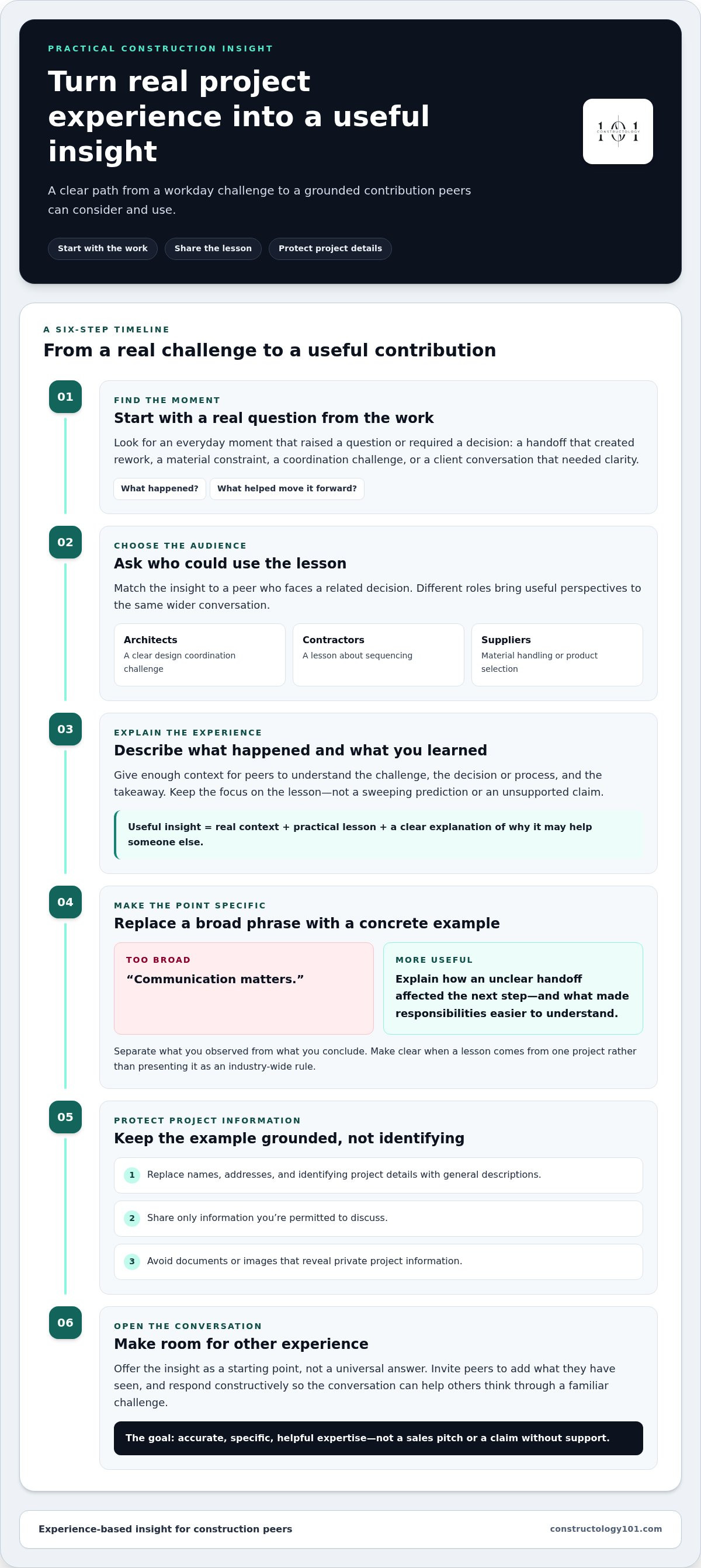
Useful expertise rarely begins with a grand prediction. It starts with a real question: Why did a handoff create rework? What helped a team resolve a material constraint? Which detail made a client conversation clearer? These everyday moments can become construction industry thought leadership ideas when you explain what happened, what you learned, and how the lesson may help someone else.
Construction thought leadership is the practice of sharing clear, experience-based insights that help construction peers understand challenges and make better-informed decisions. It isn’t a sales pitch, a sweeping opinion, or a claim without support. It’s practical knowledge, offered with enough context for others to consider and use.
That knowledge can come from any role. The construction industry includes a range of sectors and professions, as outlined in this overview of the construction industry. A supplier may notice a recurring ordering issue; an engineer may explain a coordination decision; a trade professional may share a sequencing lesson. Each perspective can add something useful to a wider conversation.
What makes a construction insight worth sharing?
Start with something you’ve encountered more than once, had to decide, or learned through experience. Then identify who could use the insight. Architects may benefit from a clear explanation of a design coordination challenge. Contractors may value a lesson about sequencing. Suppliers may help project teams understand material handling or product selection.
Make the point specific. Instead of saying “communication matters,” describe how an unclear handoff affected the next step, then share a process that made responsibilities easier to understand. You could also explore lessons about materials, safety planning, or client communication. Keep the focus on the decision or takeaway, not confidential details.
- Replace names, addresses, and identifying project details with general descriptions.
- Share only information you’re permitted to discuss, and avoid documents or images that reveal private project information.
- Separate what you observed from what you conclude. Explain the context so readers can judge whether the lesson applies to their work.
This approach keeps examples grounded without turning a project into a case study you’re not free to share. A useful insight should give peers a way to think through a familiar challenge, not ask them to trust an unsupported claim.
Why expertise does not require influencer status
You don’t need a large audience, a polished personal brand, or viral reach to contribute. Credibility comes from being accurate, specific, and helpful. A concise answer to a recurring question can be more valuable than a broad post designed only to attract attention.
For example, a short explanation of what helped your team resolve a coordination issue can give another professional a useful starting point. Invite others to add their experience, and respond constructively when they do. To build relationships alongside sharing insights, explore online construction networking as a way to continue relevant industry conversations.
Construction Industry Thought Leadership Ideas to Draw From Your Expertise
The strongest construction industry thought leadership ideas connect a real industry question with a practical insight. Start with a question someone on a project might ask, then explain what your experience has taught you. Keep the lesson in proportion: distinguish what happened on one project from what you can support as a broader industry observation.
Use prompts that fit your role. A specialty trade can share a sequencing lesson; a supplier can clarify a material selection issue; an architect or engineer can explain a coordination decision; a contractor can describe how a team handled a change. For a wider view of how established organizations frame sector insights, browse FMI's construction industry thought leadership.
Project delivery, coordination, and quality ideas
Look at the points where information, people, or materials move between teams. Ask what caused uncertainty, how the team addressed it, and what another project team could take away. Focus on the process and lesson, not confidential project details or claims that one approach works in every situation.
- Where did a handoff need clearer ownership, and what information made the next step easier?
- What sequencing decision helped teams avoid a clash or reduce the risk of rework?
- How did the team communicate a change so affected trades understood the impact?
- Which expectation was unclear at the start, and how could it have been made more specific?
- What quality check caught an issue early, and what would you do differently next time?
Make each prompt useful to peers by adding context. Explain the challenge, the decision or process you observed, and the lesson you drew from it. If you’re sharing a personal experience, say so. Don’t present a single project outcome as proof of an industry-wide rule.
People, technology, and sustainability ideas
People and tools shape how work gets done. Explore how teams pass on practical knowledge, support new workers, or improve cross-trade communication. Discuss BIM through a specific example, such as how a model helped clarify a coordination question, while noting what still required discussion or field judgment.
- What helps new team members learn a task or understand project expectations?
- How can a team share an update so the right trade can act on it?
- Where did a BIM model support coordination, and what information did it not resolve?
- What sustainability choice raised a practical question about materials, design, or documentation?
Use standards only when they directly fit your topic. For example, a post about embodied carbon documentation could explain a relevant LEED v5 requirement, while a safety-focused piece should stay within the specific guidance you can accurately support. Separate sourced facts from your own interpretation. Then share useful insights with peers through Constructology 101's construction professional network, where professionals can share project information and continue industry conversations.
Formats That Make Construction Thought Leadership Easier to Share
A useful idea doesn’t need a long article or polished production to make an impact. Match the format to the insight: a quick observation may fit a short post, while a complex decision may need an explainer or visual. The best construction industry thought leadership ideas are clear, credible, and sized to the time you have.
Choose based on four factors: what readers need to understand, who needs the information, what evidence you can share, and how much time you can commit. A short format isn’t a shortcut around substance. It’s a way to deliver one valuable point without padding it into a longer piece.
Choose a format that fits the idea and available time
Start with the reader’s question. If you can answer it clearly in a few sentences, write a short post. If the answer depends on steps, definitions, or trade-offs, give readers more structure. An interview or project walkthrough can add depth when different professional perspectives matter.
- Short post: Low effort and focused. Share one lesson, observation, or question, such as what made a trade handoff easier to understand.
- Checklist: Moderate effort and easy to scan. Use it to help readers review a process, prepare for a coordination meeting, or spot missing information.
- Project explainer: More depth and preparation. Describe the challenge, options considered, decision, and takeaway, while protecting private project details.
- Interview: Moderate to high effort. Ask a supplier, architect, engineer, or trade partner how they approach a shared challenge, and make each person’s perspective clear.
- Visual walkthrough: Useful for showing a sequence, detail, or decision. Add brief captions or annotations so the visual has context and readers know what matters.
Keep the scope manageable. A checklist doesn’t need to cover every project condition, and a walkthrough doesn’t need to document an entire job. State the situation the advice applies to, and note where readers may need to adapt it.
Adapt an insight for professional channels
One well-supported lesson can take several forms without requiring you to invent new content each time. First, write the full explanation for your own reference. Then pull out the central point for a concise post, create a visual summary of the key steps, and end with a focused question that invites practical responses.
Keep the facts consistent across versions. Don’t turn a project-specific result into a universal rule just because a shorter post needs a sharper line. If you share a claim, preserve its context and evidence; if an example is based on your experience, say so.
LinkedIn can be one channel for a professional insight, but the platform doesn’t replace the insight itself. Offer a useful answer before inviting discussion. Ask a specific question, such as which information helps teams clarify a handoff, rather than prompting for comments just to boost activity. A relevant response can extend the conversation; a clear, useful post stands on its own.
Build a Sustainable Thought Leadership Routine Around Real Projects
A repeatable process makes construction industry thought leadership ideas easier to develop, even when project work fills your schedule. Don’t wait for a perfect topic or a free afternoon. Capture useful moments as they happen, then shape and share them when you have the time.
Consistency means building a repeatable routine, not posting constantly. Set a pace you can maintain, whether that means sharing an insight every few weeks or contributing when you have something useful to say. A reliable routine gives you room to check details and protect project information, without turning publishing into another daily demand.
Turn a field observation into a useful piece
Keep a running list in a notebook or document. Add questions that come up in meetings, lessons from completed work, and topics that recur in conversations with peers. A few brief notes can preserve an insight that might otherwise disappear in the rush to the next task.
When you’re ready to develop one, use this workflow:
- Capture: Record the challenge or question while the details are fresh. Note what made it worth discussing.
- Shape: Identify the intended audience and the practical takeaway. Decide whether a reader needs a short answer, a sequence of steps, or more context.
- Support: Add relevant evidence, project context, or a clear explanation of what you observed. Separate your experience from claims about the wider industry.
- Publish: Choose a format and channel that fit the idea. Remove confidential information and edit jargon into plain language without changing technical meaning.
- Learn: Review the response and note what readers asked, where they wanted more detail, or which part helped them.
Before sharing, check that your example doesn’t identify a client or reveal private project information. If you’re simplifying a technical point, ask whether a peer could misunderstand it. Clear writing should make the idea easier to follow, not less accurate.
Learn from response without chasing vanity metrics
Look beyond likes and follower counts. A thoughtful question, a useful exchange between peers, a save, or a follow-up connection may tell you more about an insight’s value. Notice which parts prompted discussion, then use that feedback to clarify your explanation or develop a related topic.
Keep your review simple. After each post, jot down what resonated, what readers found unclear, and what you could explore next. You’re looking for signals that help you serve the audience better, not a score that pressures you to publish more. Strong professional relationships grow through useful exchanges and follow-through; explore construction business relationships for more ways to strengthen those connections.
When you’re ready to share an insight with construction peers, use the Constructology 101 professional network to continue relevant conversations.
Use Construction Thought Leadership to Start More Useful Industry Conversations
A useful post can do more than explain an idea. It can give peers, collaborators, and potential project partners a clear reason to connect around a shared challenge. That doesn’t guarantee new work or a particular outcome. It creates an opening for people to exchange perspectives, learn about each other’s expertise, and continue a relevant conversation.
Think of publishing as the beginning of an exchange, not the finish line. The construction industry thought leadership ideas you share can help others understand how you approach a problem, while their questions may reveal where your insight needs more context. Keep the conversation useful, specific, and respectful of different project conditions.
Turn a published idea into a two-way discussion
End a piece with one focused question that makes it easy for a peer to contribute practical experience. Instead of asking, “What do you think?”, ask, “What information helps your team clarify a handoff between design and field work?” A precise question invites a more meaningful response and helps keep the discussion tied to the topic.
When someone responds, answer with care. Add useful context, acknowledge that their project may have different constraints, and avoid treating a disagreement as a contest. If another professional offers a helpful example, credit their contribution and build on it. Good exchanges make room for more than one valid approach.
Notice the questions that keep coming up. A detailed comment may point to a follow-up explainer; different perspectives may suit a short interview; repeated requests for practical steps could become a checklist. This turns discussion into a source of future topics, while giving readers a reason to return for more specific guidance.
Keep building professional connections
A clear professional presence helps peers understand what you do, where your expertise lies, and what kind of conversations you can contribute to. Describe your skills in plain language, share relevant project information when appropriate, and make it easy for others to understand the context behind your work. A focused profile gives a useful post a professional home beyond a single conversation.
Constructology 101 brings together an interactive construction-industry directory and professional network. Professionals can use directory listings to showcase skills and services, share project information, and communicate through integrated messaging. These tools can support continued conversations with industry peers, while meaningful connections grow through relevant contributions and thoughtful follow-through.
Keep the next step simple. Respond to a peer’s insight, share a useful project lesson, or reach out with a specific question connected to the discussion. Constructology 101’s directory listings and networking tools give construction professionals a place to showcase expertise, share project information, and continue those exchanges.
Put Your Next Insight Into Motion
Your next contribution doesn’t need to cover everything. Choose one question from your work, share a perspective peers can use, and stay open to what the conversation teaches you. Over time, those small contributions can help shape how others understand your expertise and create new opportunities to exchange knowledge.
The right construction industry thought leadership ideas are the ones you can stand behind and keep developing. Let your experience guide the topic, and let the needs of your peers guide the next step.
Start with one useful insight. Your voice belongs in the industry conversation.
Frequently Asked Questions
What is thought leadership in the construction industry?
Thought leadership in construction means contributing knowledge that helps others understand a work-related issue or make a more informed choice. It can come from a company or an individual, and it doesn’t require a formal title. For example, a project engineer might explain how a design clarification affected sequencing, while distinguishing personal experience from guidance that applies more broadly.
How can a construction company demonstrate thought leadership?
A construction company can demonstrate thought leadership by answering the questions its clients, employees, and industry peers regularly ask. A firm might explain how it approaches preconstruction communication, what information helps clarify a scope, or how it evaluates a new process. Use subject-matter experts as contributors, verify technical details, and get permission before sharing project examples or client information.
What are good construction industry thought leadership topics?
Good construction industry thought leadership topics address decisions people face in their roles. Consider how to compare material options, prepare for a design review, improve closeout documentation, or share lessons from adopting a new tool. A specialty contractor could explain scope coordination, while an architect might discuss how design intent is communicated. Choose a narrow question, then support the answer with relevant experience or reliable evidence.
Can a small construction business become a thought leader?
Yes. A small business can earn trust by explaining a specific part of its work clearly and consistently, without trying to cover every industry issue. For instance, a trade team could describe the information it needs before starting a complex installation, or share a lesson about coordinating with other trades. Keep the advice relevant to your expertise, and let useful contributions build recognition over time.
How often should construction professionals publish thought leadership content?
Publish at a pace you can sustain while still checking your facts and completing project responsibilities. There’s no universal schedule that suits every professional. You might share one well-developed insight each month, or publish when a recurring question gives you something genuinely useful to add. A simple editorial list can help you plan ahead, but don’t publish filler just to maintain a streak.
Which platforms are best for sharing construction expertise?
The best platform is one where your intended readers can find and use your contribution. LinkedIn can support professional discussion, while your company website can hold detailed articles or technical resources. Construction-specific communities and directories can help peers discover relevant expertise. Constructology 101 is an industry-focused directory and professional network; choose channels based on audience fit, discussion quality, and the format you can maintain.
How do you measure the impact of construction thought leadership?
Measure impact against your goal, not just the number of reactions. If you want to support peer learning, track substantive questions, shares with added context, or invitations to continue a discussion. If the goal is professional awareness, review relevant profile visits or inquiries over time. Record a baseline, look for patterns across several contributions, and treat results as feedback rather than proof of guaranteed business outcomes.


