

A GC doesn’t need another broad pitch. They need a clear reason to trust your firm with a specific scope. If you’re asking what convincing a GC to hire my firm takes, start by making project fit and delivery confidence easy to assess. A polished introduction matters less than proof that answers a contractor’s practical questions.
Standing out can be difficult when other subcontractors offer similar services, and cold outreach is easy to ignore when it feels generic. GCs look for relevant capabilities, clear communication, and signs that your firm can deliver reliably. Put those details up front to make the conversation more useful for both sides.
This guide shows you how to present your experience and capabilities, prepare information that reduces perceived risk, and reach out without a hard sell. You’ll also learn how to follow up professionally and build visibility over time. A clear presence on Constructology 101 can support that relationship-building by helping you showcase your services, share project information, and connect with construction professionals.
Key Takeaways
- Match your introduction to the GC’s project, scope, and team needs so your firm feels relevant from the start.
- Build a concise capability statement with your services, experience, and contact details, supported by project examples that protect confidential information.
- When considering convincing a GC to hire my firm, show scope alignment, communication, capacity, and qualifications instead of relying on a low bid alone.
- Use a simple outreach sequence: research the GC, personalize your message, share relevant proof, and follow up professionally.
- Keep your firm’s information consistent across professional channels. Constructology 101 can help you showcase services, share project information, and connect with industry peers.
Convincing a GC to Hire Your Firm Starts with Understanding Their Project Needs
A general contractor needs a dependable fit for a defined scope, schedule, and project team. Your firm may have strong capabilities, but a broad introduction doesn’t show how they apply to a particular job. Understanding the GC’s needs helps you make that connection clear before reaching out.
A general introduction says what your firm does. A project-specific reason explains why your work may suit the GC’s current or upcoming project. For example, “We provide electrical contracting” is a starting point. A more useful introduction identifies the electrical scope you handle and connects it to a similar project type you’ve completed. Keep claims accurate and make the relevance easy to see. The Role of a General Contractor also helps explain why coordination across trades and project responsibilities matters to a GC.
What does a GC need to know before considering a firm?
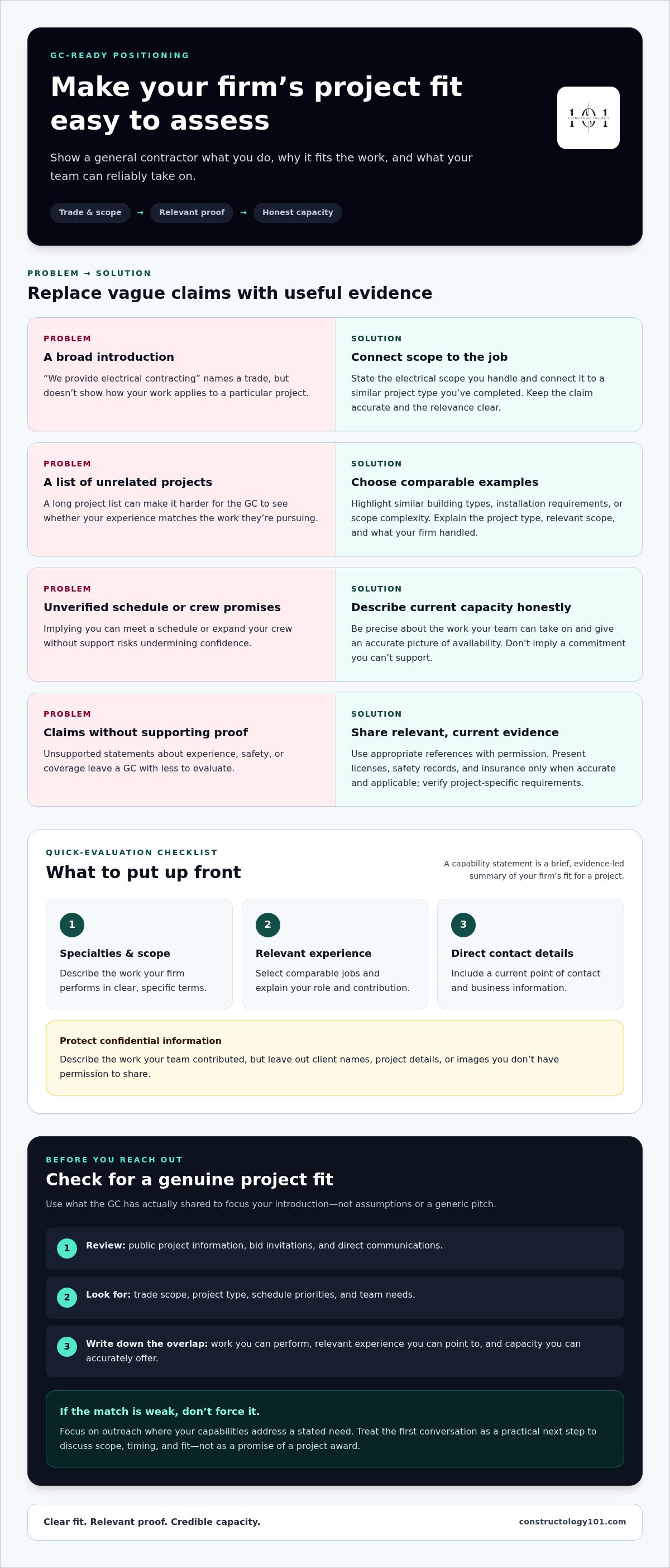
Make your first impression easy to evaluate. Lead with the trade and scope you handle, then connect your experience to the kind of work the GC is pursuing. Avoid listing unrelated projects. Choose examples that show a meaningful match, such as comparable building types, installation requirements, or scope complexity.
Be equally precise about capacity. Describe the work your team can take on and give an accurate picture of availability. Don’t imply that you can meet a schedule or expand your crew unless you can support that commitment. A concise introduction can cover:
- Trade and scope: State the work your firm performs in plain language.
- Relevant experience: Highlight examples that relate to the GC’s project type.
- Capacity: Describe your team’s current ability to take on work honestly.
This is the foundation for convincing a GC to hire my firm: not a promise of a project award, but a credible reason to continue the conversation.
How can you identify a genuine project fit?
Start with what the GC has actually shared. Review public project information, bid invitations, and direct communications for clues about the trade scope, project type, schedule priorities, and team needs. Then compare those details with your firm’s experience and capacity. If the match is weak, don’t force it. Focus your outreach where your capabilities address a stated need.
Before contacting the GC, write down the specific overlap: the work you can perform, the relevant experience you can point to, and the capacity you can accurately offer. This check keeps your message focused and helps you avoid generic outreach. For a broader framework on assessing professional fit, see this guide to finding reliable construction partners.
Think of the first conversation as a practical next step, not a closing pitch. A clear, relevant introduction gives the GC a reason to learn more while leaving room to discuss scope, timing, and fit. That’s a solid start to building a professional relationship, even if the immediate project isn’t the right match.
Build a Capability Pitch That Makes Your Construction Firm Easy to Evaluate
A GC should be able to understand your firm’s strengths without sorting through a long, generic introduction. A capability statement gives them a quick, evidence-led view of what you do, where you’ve done similar work, and how to reach you. If you’re focused on convincing a GC to hire my firm, aim for clarity rather than a glossy pitch packed with claims.
A capability statement is a brief, evidence-led summary of your firm’s fit for a project. Keep it focused on the proposed scope. Industry resources, including the Associated General Contractors of America, can also help you stay informed about contractor priorities and industry practices as you tailor your materials.
What belongs in a GC-ready capability statement?
Make the document easy to scan. Put your firm’s trade specialties and service scope near the top, then identify the project types that best reflect your experience. Add current contact details and business information so a GC can follow up without searching through multiple documents.
- Specialties: Describe the work you perform in clear, specific terms.
- Project examples: Select comparable jobs and explain your role.
- Contact details: Include a direct, current point of contact.
For each example, name the project type, summarize the relevant scope, and state what your firm handled. Describe the outcome in concrete terms you can support, such as completing a defined installation scope. Leave out client names, project details, or images you don’t have permission to share. A useful example tells the GC what your team contributed without exposing confidential information.
How should you demonstrate reliability without overpromising?
Back up claims with relevant evidence. References should be appropriate to the work and shared with permission. Present licenses, safety records, and insurance information only when they’re accurate and applicable to the proposed scope. Keep documentation current, and verify project-specific requirements before submitting it. A clear record helps a GC assess your firm without relying on unsupported claims.
Be factual about safety practices and coverage. If you reference training, written procedures, or insurance documents, describe what you have rather than implying a certification or level of coverage you can’t substantiate. Avoid phrases such as “best in the industry” unless you can prove them. Don’t promise a schedule, crew size, or result you can’t confidently deliver.
Keep a detailed prequalification package ready for situations where a GC requests more information, but make the first pitch concise. That balance respects the contractor’s time and gives them a straightforward way to ask for relevant supporting documents.
A professional profile can keep your firm’s capabilities visible beyond a single introduction. Constructology 101 lets construction firms showcase services through an interactive directory listing and share project information with industry peers. Use Constructology 101’s construction directory as part of a consistent professional presence, alongside your capability statement and direct outreach.
Differentiate Your Firm by Showing Project Fit, Not Just a Low Bid
A competitive proposal does more than state a price. It helps a GC see what your firm will deliver, how your experience relates to the project, and whether your team can support the work. A low bid can raise questions if the scope is vague or key assumptions are hidden. Make your strongest differentiators easy to verify instead of criticizing other bidders or relying on claims like “best quality.”
Use the proposal to show fit across practical criteria. The evidence should connect directly to the work being considered:
| Criterion | Evidence to show | Questions the GC may consider |
|---|---|---|
| Scope alignment | Included work, exclusions, assumptions, and dependencies | Does this cover the requested scope? |
| Relevant experience | Comparable project examples and your firm’s role | Has the firm handled similar work? |
| Communication | A clear point of contact and a practical response process | Will coordination be straightforward? |
| Capacity | An accurate description of available team capacity | Can the firm support the planned work? |
| Qualifications | Current, applicable documentation | Can the firm provide the required information? |
How can your proposal make scope and assumptions clear?
Organize the proposal so a reviewer can distinguish what’s included from what isn’t. State assumptions and dependencies in plain language, then identify any information you need to price or plan the work accurately. For example, note whether your proposal depends on access being available at an agreed time. Follow the GC’s submission instructions and keep your response aligned with the requested scope.
Clarity protects both sides from avoidable misunderstandings. If a drawing, specification, or project detail appears incomplete, identify the specific item and explain how it affects your proposal. Don’t quietly fill gaps with assumptions that could later change the work.
Which differentiators matter beyond price?
Show evidence that answers project-specific concerns: similar completed work, the exact tasks your firm performed, realistic capacity, responsive communication, and organized documentation. Keep comparisons focused on your own strengths. For broader context, construction business relationship management connects reliable communication and follow-through with stronger professional relationships.
Before submitting, compare your proposal against the GC’s stated requirements. Check that the scope, exclusions, assumptions, qualifications, and contact details are consistent throughout. This disciplined review can help with convincing a GC to hire my firm because it makes your value easier to assess without promising an award. Lead with what you can substantiate, and let the fit speak for itself.
Use a Professional Outreach and Follow-Up Process to Reach GCs
Good outreach is specific, brief, and easy to respond to. Instead of sending the same pitch to every contractor, connect your firm’s capabilities to a GC’s project or trade needs. A thoughtful message may not lead to an immediate opportunity, but it can start a professional conversation and make future contact more relevant.
Use a repeatable sequence to stay focused:
- Research: Review public project information and the GC’s communications to understand the work and stated priorities.
- Personalize: Identify the specific trade or scope where your firm may fit.
- Introduce: Say who you are and what your firm does in direct language.
- Share proof: Include one relevant project example or a concise capability statement.
- Follow up: Check back respectfully with useful context, then accept that timing may not align.
What should a first message to a GC say?
Write a subject line that names your trade and a relevant project or scope, rather than using a vague subject like “Introduction.” Briefly identify your firm, the work you handle, and where you operate. Connect your experience to the GC’s project or stated need, and include only the most relevant capability information. Close with a low-pressure next step, such as asking whether a short introductory conversation would be useful.
For example, a message might say: “We’re a [trade] subcontractor. Our team has completed [relevant scope] on [comparable project type], and we’d welcome a short introduction if that scope aligns with your upcoming work.” Replace the bracketed details with accurate information. Don’t imply you know the GC’s plans unless they’ve shared them publicly or directly.
How can follow-up feel useful rather than pushy?
Follow up by referring to your earlier note and adding something relevant, such as a project example that clarifies your experience or a brief update to your availability. Keep the cadence reasonable and consistent with any instructions the GC has provided. If there’s no response, avoid repeated nudges or pressure tactics. A respectful follow-up leaves the door open without demanding an immediate decision.
Track the date, contact, message, and agreed next step in a simple record. That helps you avoid duplicate outreach and keeps details accurate if you reconnect later. Treat every exchange as part of a longer professional relationship, not a test of whether you’ll win one job. These online construction networking ideas can help you build connections beyond a single email.
Make it easier for industry peers to learn about your firm between conversations. Create a construction firm listing on Constructology 101 to present your services and support ongoing professional networking. A clear profile can complement personalized outreach, while project opportunities still depend on fit, timing, and the GC’s needs.
Build Long-Term GC Visibility Through a Strong Construction Professional Presence
A strong pitch works best when a GC can find consistent information about your firm after the first conversation. Keep your trade specialties, project examples, and contact details aligned across your capability statement, directory profiles, and other professional channels. Consistency makes it easier for industry peers to recognize your firm and understand what work may fit.
Visibility is an ongoing effort, not a promise of a project award. For subcontractors focused on convincing a GC to hire my firm, a clear professional presence can support the relationship-building that happens before, during, and after a specific opportunity.
How can a directory profile support your credibility?
Use your profile to explain your services and trade specialties in language construction professionals can quickly understand. Add relevant project information that gives peers something concrete to discuss, while respecting confidentiality and sharing only details you’re authorized to provide. Keep the profile current, and check that its description matches your capability statement and outreach materials.
A consistent profile reduces friction: the GC sees the same core information wherever your firm appears. Update contact details when they change, and refresh project examples as your experience develops.
How can you turn visibility into professional relationships?
Build familiarity by sharing useful project information and engaging thoughtfully with relevant construction professionals over time. Focus on meaningful contributions rather than frequent, generic promotion. If a genuine fit emerges, use platform messaging to start a direct, professional conversation related to the work or a shared interest.
Constructology 101 brings an interactive directory, project-sharing features, and integrated messaging together for construction-industry networking. These tools help firms present their services, share project information, and build relationships with industry peers. They support visibility and connection, but don’t guarantee hiring, leads, or awarded projects.
Make your presence useful between active bids. Keep descriptions and project details accurate, respond professionally when someone reaches out, and share updates that reflect work your firm actually performs. A steady, credible profile gives future conversations a clear starting point, even if there isn’t an immediate project match.
For more ideas on building connections across the industry, explore the construction professional network guide. Then build your construction-industry presence with a profile that clearly presents your firm and supports ongoing professional networking.
Make Your Next GC Conversation Count
Professional relationships grow through steady, thoughtful contact. Choose one practical next step: refresh a project example, review your profile for outdated details, or identify a GC whose work aligns with your firm’s strengths. Small updates keep your introduction relevant and make it easier to continue a conversation when the right opportunity comes along.
If you’re thinking, “convincing a GC to hire my firm,” focus on building trust over time rather than forcing an immediate yes. Show up consistently, share accurate information, and make each interaction useful. Pioneer Membership gives construction professionals access to the platform’s networking tools, project-sharing features, and messaging through a lifetime deal at a one-time price.
Build your construction-industry presence on Constructology 101 with an interactive directory listing and take a practical step toward stronger professional connections. Your next project conversation can start with a clear, credible presence.
Frequently Asked Questions
What should I do if a GC asks my firm to perform work outside our trade?
Clarify the requested tasks and document where your firm’s capabilities end before agreeing to the work. Taking on unfamiliar responsibilities can create delivery, coordination, and accountability risks for both your team and the project. Explain the boundary professionally, then discuss whether the request can be adjusted to fit your expertise. If it can’t, decline that portion or propose a suitable alternative your firm can responsibly deliver.
Can a small construction firm win work with a large GC?
Yes, a firm’s size alone doesn’t determine whether it fits a project. A smaller team can make a credible case by matching its experience and available capacity to a manageable scope, then communicating clearly about how it would perform the work. If you’re focused on convincing a GC to hire my firm, target opportunities your team can support rather than stretching to appear larger. No pitch can guarantee a contract.
Should my firm bid on every project a GC sends us?
No. Before investing estimating time, compare the requested work with your trade strengths, schedule, available capacity, and project requirements. For example, a project may include a specialty task your team doesn’t perform, even if the overall trade seems familiar. Selective bidding helps you focus effort on opportunities where you can submit a complete, credible response. If it isn’t a fit, decline politely and keep the communication professional.
Who should I contact first at a general contracting firm?
Follow the GC’s published bid process and contact the role relevant to the opportunity. An estimator may handle bid invitations, while a project manager or procurement contact may be appropriate in other situations. Use the contact named in the project communication when available, and address your message accordingly. Keep it concise, and avoid sending the same pitch to several unrelated employees, which can create confusion rather than a useful introduction.
How can I respond when a GC says my bid is too high?
Ask which scope items or assumptions the GC would like clarified, then compare your proposal with the requested work. A misunderstanding may be resolved by explaining what your price includes. If the GC wants a different scope, identify what would change and document the revision clearly. Don’t reduce the bid automatically if doing so would affect your ability to deliver. Keep the discussion focused on scope, assumptions, and workable terms.
What if my firm has limited project references?
Present the strongest relevant evidence you can substantiate, even if your project list is short. You might describe applicable experience held by the firm’s owners, explain your role in completed work, or share project examples you’re authorized to discuss. Be clear about what the company itself has done versus what individual team members have done. Avoid implying a track record you haven’t built. A focused, transparent introduction gives the GC a fair basis to assess fit.


