

What if the next larger contract isn’t won by submitting more bids, but by proving you’re ready for the right one? Knowing how to win larger construction contracts takes more than a competitive price. You need the capacity to deliver, a clear view of project risk, and relationships that help you understand where your strengths fit.
It’s reasonable to hesitate before taking on bigger work. A wider scope can stretch crews, cash flow, and estimating accuracy. Even a strong bid can miss the mark if the opportunity doesn’t match your capabilities or you haven’t reached the right people.
This guide gives you a practical framework for deciding when to pursue larger projects and how to prepare. You’ll learn how to assess readiness, find and qualify opportunities, build a disciplined bid that protects delivery capacity and margin, and strengthen professional relationships. Industry-specific directories and project sharing can support your visibility among construction peers as part of a broader business-development approach. The goal is a repeatable process, not a gamble on one big contract.
Key Takeaways
- Use proven delivery experience, staffing, cash flow, and project controls to gauge whether your business is ready to pursue a larger scope.
- Make your bid easy to evaluate by choosing evidence that directly matches the project’s requirements and demonstrates reliability.
- Compare strategic fit, delivery capacity, commercial risk, and bid effort before committing time to an opportunity.
- Follow a consistent pre-bid sequence to research the opportunity, prepare your submission, and review it before delivery.
- Learn how to win larger construction contracts by combining disciplined bidding with professional relationships and visibility among construction peers.
Before You Pursue a Larger Construction Contract, Check Your Readiness
Contract size should follow proven capacity, not ambition alone. A bigger project can expand revenue and strengthen your portfolio, but it also increases demands on people, cash, coordination, and decision-making. Before pursuing one, compare its scope with work your business has delivered and the resources you can realistically commit.
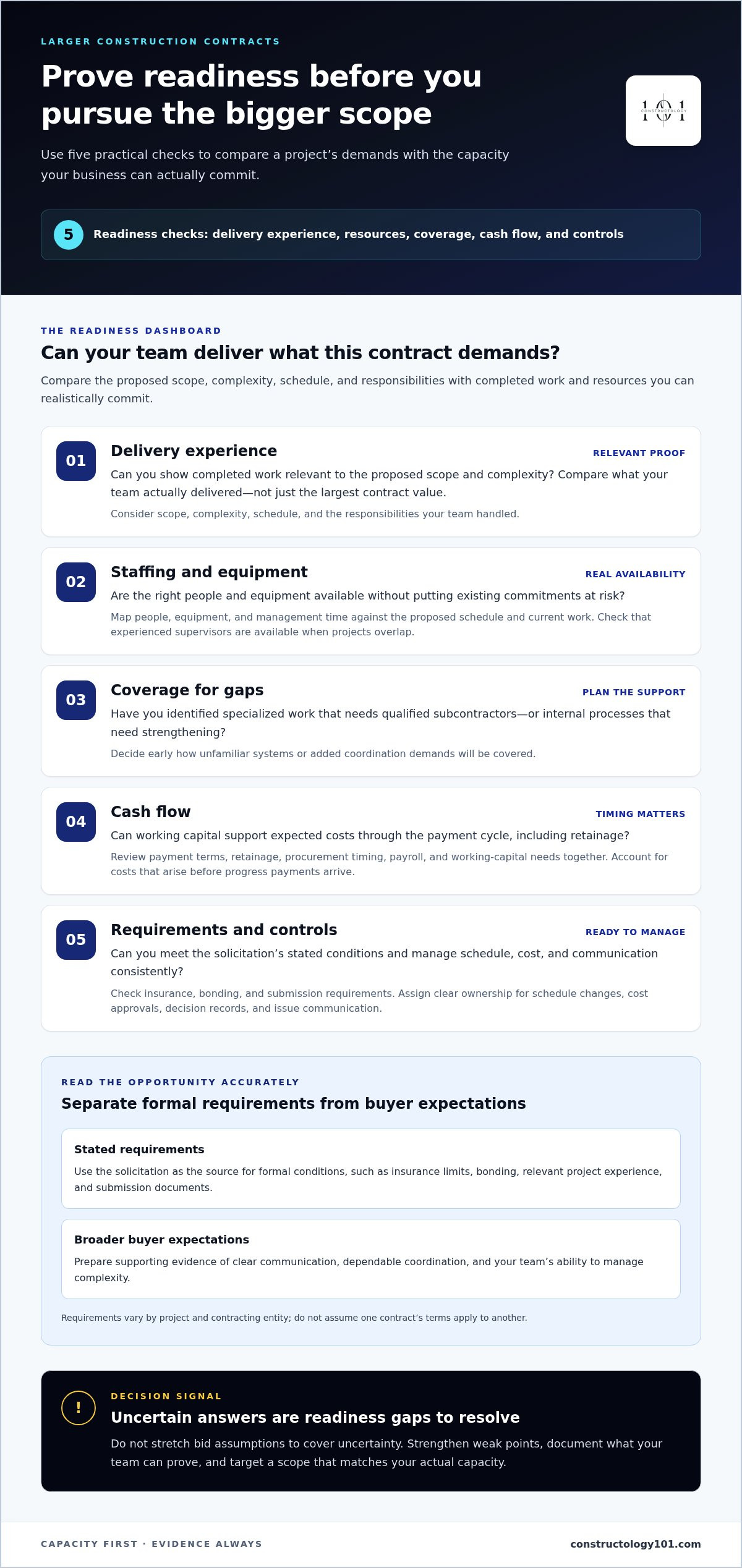
Separate stated requirements from general buyer expectations. The solicitation may specify insurance limits, bonding, relevant project experience, or submission documents. Buyers may also look for clear communication, dependable coordination, and evidence that your team can manage complexity. Use the solicitation as the source for formal requirements, then prepare supporting evidence that addresses broader concerns. For background on contract structures and terms, see Understanding Construction Contracts.
Assess delivery capacity before increasing project size
Compare the proposed work with completed projects, not just your largest past contract. Look at scope, complexity, schedule, and the responsibilities your team actually handled. A project with a larger value may still be a poor fit if it introduces unfamiliar systems or coordination demands.
Map people, equipment, and management time against the proposed schedule and existing commitments. For example, you may have enough workers overall but lack experienced supervisors when two projects overlap. Identify gaps early. Decide whether qualified subcontractors can cover specialized work or whether internal processes need to improve before you take on the added scope.
Understand the financial and operational exposure
Build a realistic view of when costs will arise and when payments are expected. Review payment terms, retainage, procurement timing, payroll, and working-capital needs together. A profitable-looking estimate can still create pressure if labor and materials must be paid for well before progress payments arrive.
Check the solicitation for insurance, bonding, and other formal conditions. Requirements vary by project and contracting entity, so don’t assume one contract’s terms apply to another. Also consider operational controls: who tracks schedule changes, approves costs, documents decisions, and communicates issues? Larger work needs clear ownership before a problem appears.
Use this readiness check before deciding whether to pursue the opportunity:
- Delivery experience: Can you show completed work relevant to the proposed scope and complexity?
- Staffing and equipment: Are the right people and resources available without putting current commitments at risk?
- Coverage for gaps: Have you identified specialist work that needs qualified subcontractors or stronger internal processes?
- Cash flow: Can working capital support expected costs through the payment cycle, including retainage?
- Requirements and controls: Can you meet the solicitation’s stated conditions and manage schedule, cost, and communication consistently?
If several answers are uncertain, treat that as a readiness gap to resolve, not a reason to stretch your bid assumptions. Learning how to win larger construction contracts starts with knowing which projects your business can deliver well. Pursue growth in steps: strengthen weak points, document what your team can prove, and target a scope that matches your actual capacity.
Build the Capabilities Buyers Look for in Larger Construction Contracts
A buyer should be able to see quickly why your company fits the work and how you’ll deliver it. A strong submission connects three things: relevant capability, reliable execution, and a clear match to the project scope. Replace a broad company history with focused evidence that answers likely buyer questions: Have you handled comparable work? Who will lead it? How will the team manage delivery?
A project-specific capability statement is a concise summary of your relevant experience, resources, and delivery approach, prepared to show how they match a particular opportunity.
Present relevant experience as evidence, not a project list
Choose completed projects that resemble the proposed scope, complexity, or coordination demands. For each, state your role, the work performed, and the delivery context. If the new contract is larger than your past projects, explain what transfers. Your team may have managed a similar technical scope, while a proposed subcontractor adds capacity for the expanded workload.
Support claims with verifiable references, documented outcomes, and examples you have permission to share. Avoid vague statements such as “experienced in major projects.” Specific evidence helps evaluators understand what your company did and what that experience says about its fit. A smaller project can be relevant, but explain the connection rather than presenting size alone as proof.
Show how the project will be staffed and controlled
Name the proposed project leader and key roles, then clarify who owns scheduling, site coordination, quality checks, communication, and change tracking. A simple responsibility outline can reassure buyers that important tasks have clear owners. Explain how progress and issues will be recorded and escalated, using processes your team can actually maintain.
If subcontractors cover parts of the scope, describe their role and how their work will connect with yours. Show where responsibilities meet, who coordinates handoffs, and how the full scope will be covered. Don’t imply that a partner’s experience is your own; make the team arrangement clear.
Keep the submission tailored. Map each major requirement to a specific example, team member, or process, and remove material that doesn’t help explain project fit. For federal opportunities, Federal Contracting Opportunities on SAM.gov can help businesses find solicitations to evaluate against their capabilities. Your evidence should still respond to the individual solicitation, not rely on a generic company profile.
Consistency across your bid materials and professional presence also helps others understand what your business does. An interactive construction directory listing can present your services to construction peers, while project details and references in a bid should be selected for that specific opportunity. You can also build a clearer industry presence through construction professional networking, as one part of a broader business-development effort.
That focus is central to how to win larger construction contracts: make your fit easy to assess, your delivery plan credible, and your supporting evidence relevant.
Choose Larger Contracts Carefully: Compare Fit, Risk, and Bid Effort
A promising contract can still be the wrong pursuit if it strains capacity, carries unclear commercial exposure, or demands more bid work than the opportunity justifies. Use a consistent bid/no-bid review to compare opportunities before committing estimating and leadership time. Score each factor from 1 to 5, where 1 signals a serious concern and 5 indicates a strong, evidence-backed fit.
| Factor | Low score | Strong score | Your score |
|---|---|---|---|
| Strategic fit | Scope is outside your core work or offers little business value. | Scope aligns with your strengths and longer-term direction. | 1 to 5 |
| Delivery capacity | Staff, schedule, equipment, or partner coverage has major gaps. | Resources and responsibilities can support the work. | 1 to 5 |
| Commercial risk | Terms, payment exposure, or scope uncertainty could threaten expected margin. | Key terms and risks are understood and can be managed. | 1 to 5 |
| Bid effort | Submission demands are heavy relative to fit and likely value. | Effort is manageable and proportionate to the opportunity. | 1 to 5 |
Add the scores to guide discussion, not to create an automatic go-ahead. A low rating in a critical area may matter more than a strong total. The table is a decision aid, not a substitute for reading the full solicitation, attachments, amendments, and contract terms. Record open questions and seek written clarification when a material requirement remains ambiguous.
Use a consistent bid/no-bid decision
Assess scope alignment, client fit, schedule feasibility, available resources, commercial terms, and known risks. Identify unanswered questions and who will resolve them. Assign one internal decision owner to gather input, lead the review, and document why the team will pursue or decline. This creates a useful record for refining future decisions.
Include partner capacity in the review rather than treating it as an assumption. Confirm which portions of the scope rely on outside firms and how their work fits the schedule and coordination plan. A thoughtful approach to finding reliable construction partners can help you assess coverage and working relationships before those dependencies become bid risks.
Protect estimate quality and expected margin
Before pricing, check takeoffs, labor assumptions, material quantities, equipment needs, schedule logic, and subcontractor inputs. Trace each major cost to its basis. If the schedule assumes ideal conditions or a supplier quote is still unverified, flag that exposure rather than burying it in the estimate. Avoid a low bid built on unpriced scope or optimistic assumptions.
Track your bid-hit ratio, the share of submitted bids that result in awards, over time. It isn’t a universal benchmark or a standalone measure of performance. Review it alongside bid effort, project fit, and reasons for wins or losses to spot patterns and improve pursuit choices. The Associated General Contractors of America can also be a useful industry resource as you build a more informed approach to project opportunities.
Strengthen Your Larger-Contract Pursuit with Relationships and Preparation
A larger-contract pursuit is stronger when opportunity research, professional relationships, and bid preparation work together. Connections can help you stay aware of industry activity and coordinate with potential partners, while a consistent process keeps each submission focused. Neither guarantees an award. Both help you pursue opportunities with better context and fewer last-minute gaps.
Build relationships before a bid is announced
Stay in touch with owners, general contractors, designers, and trade partners before you need a project team. Share a concise update about your capabilities or a relevant completed project, and make the conversation useful to both sides. Follow up thoughtfully, exchange relevant information, and don’t turn every interaction into a sales pitch. For deeper guidance, explore construction business relationship management.
Use this repeatable sequence to move from finding an opportunity to a reviewed submission:
- Research opportunities. Track relevant procurement notices, project announcements, and conversations across your professional network.
- Review the solicitation. Read the scope, schedule, submission instructions, contract terms, and any amendments. Note requirements and questions that need answers.
- Confirm the pursuit decision. Bring the opportunity to the people responsible for estimating, delivery, and business decisions. Agree on whether to proceed and who owns each next step.
- Coordinate partners. Identify where trade partners or suppliers contribute, share relevant scope information, and align on responsibilities and timing.
- Build the response. Assign each requirement to a response, supporting document, or responsible person. Keep experience and qualifications relevant to the project.
- Review the full bid. Compare scope, schedule, pricing, qualifications, and required forms against the solicitation. Resolve inconsistencies before submission.
- Submit with time to spare. Leave room to address administrative or file issues, while following the stated deadline and delivery instructions exactly.
Prepare a responsive, complete submission
Use a compliance checklist to track every requested item, its owner, and its completion status. Have someone who did not assemble the package review the final version for missing attachments, inconsistent figures, unclear responses, and submission-format errors. A careful final check can catch avoidable problems before the bid leaves your hands.
A complete bid aligns scope, evidence, pricing, and delivery plan. Keep that standard visible during review. If a requirement is unanswered or an assumption affects the offer, resolve it through the solicitation’s stated clarification process rather than relying on informal interpretation.
Professional visibility can support these efforts by making it easier for construction peers to understand your services and experience. Constructology 101 is an industry-focused directory and professional social network where members can present their services, share project information, and build business relationships. Build your construction network on Constructology 101 as one part of a broader pursuit strategy. It supports discoverability and connection alongside your bid preparation.
Use Constructology 101 to Support Your Construction Business Visibility
Winning larger work takes more than a strong bid. Relevant professionals also need to understand what your business does, where your capabilities fit, and how to start a conversation. Directory visibility and networking support that wider business-development process. They work alongside project readiness, a well-prepared proposal, and careful opportunity selection.
Make your construction business easier to discover
Constructology 101 is a construction-focused interactive directory and professional social network for people across the industry, including architects, engineers, specialty trades, and suppliers. An interactive directory listing gives you a place to present your services and skills to construction peers. Describe your specialties in clear terms, then add relevant experience so readers can quickly understand the kind of work your company is equipped to pursue.
Keep that professional presence aligned with your bids and proposals. If your listing describes one set of capabilities while your submission emphasizes another, it can be harder for others to see a clear picture of your business. Keep your information aligned with your services, experience, and focus. For more on how directory listings can support industry visibility, read the interactive construction directory guide.
Turn visibility into professional conversations
Visibility matters most as a starting point for relevant professional interaction. Project sharing lets members communicate project information and showcase work in an industry context. Use it to make your experience easier to discuss with peers, potential collaborators, and other construction professionals. Keep the information clear and appropriate to share.
Integrated messaging gives members a channel to communicate with one another. A thoughtful message can open a practical discussion about capabilities, project experience, or potential coordination. Build connections consistently, not only when a bid is due. Follow up with useful information and be specific about where collaboration may make sense. These interactions can strengthen awareness and working relationships.
Think of this platform as one part of a repeatable strategy for how to win larger construction contracts: show your strengths, stay visible among relevant peers, and combine those efforts with focused bidding and dependable delivery. Constructology 101 offers interactive directory listings and Pioneer Membership with access to networking, project-sharing, and messaging features.
Build a professional presence that reflects your capabilities. Explore Constructology 101 to choose an interactive directory listing or Pioneer Membership and support your construction-industry visibility and connections.
Make Your Next Growth Move Deliberate
The next larger opportunity can be a reason to strengthen your business before the bid arrives. Keep building a track record, refining how you present your capabilities, and growing relationships with the professionals who shape construction projects. That steady groundwork makes how to win larger construction contracts a repeatable business-development goal, not a one-time push.
Visibility can be part of that groundwork. Constructology 101 brings construction professionals across industry roles into an interactive directory and professional social network, supporting business presence and connection through listings, project sharing, and member messaging. Use it alongside focused opportunity research, sound bid decisions, and delivery your team can stand behind. A clear professional presence helps others understand what your business brings to the industry.
Take a practical next step today. Build your construction industry presence with Constructology 101, and keep moving toward the larger work your team is ready to deliver.
Frequently Asked Questions
How do I qualify for larger construction contracts?
Start by meeting the opportunity’s stated eligibility conditions, then organize the records that demonstrate your qualifications. Keep business details, insurance documents, safety information, references, and project records current so you can respond without scrambling. For how to win larger construction contracts, qualification is more than checking boxes: make sure your documented experience supports the specific role you’re proposing, whether as a prime contractor or a subcontractor.
What should a contractor include in a bid for a large project?
Include every item requested in the solicitation, such as completed pricing forms, a scope response, schedule, qualifications, required certifications, and supporting documents. Make a requirement-by-requirement index and identify the exact page or attachment that answers each item. If the bid requests a project schedule and a list of key staff, make both easy to find rather than burying them in a company overview.
How can a small construction company compete for larger contracts?
Small companies can compete by focusing on a defined scope where their expertise is clear, then building a credible team around any capacity gaps. Consider pursuing a subcontracting role on a larger project to gain experience with broader coordination and documentation demands. Keep evidence specific: show exactly what your company delivered, what it was responsible for, and how that work connects to the new opportunity. Company size alone does not determine delivery capability.
How do I decide whether to bid on a construction project?
Bid when the opportunity fits your capabilities, available resources, commercial boundaries, and business priorities. Before committing, identify any disqualifying condition, unresolved scope question, or schedule conflict that could make a competitive bid impractical. Consider the time your team will spend preparing the submission and what other work that effort may displace. Record the decision and revisit it after the outcome to improve future pursuit choices.
Do larger construction contracts require bonding?
Requirements depend on the project and contracting entity. For federal construction projects, performance and payment bonds are required for contracts over $150,000 under the Miller Act. For contracts between $35,000 and $150,000, alternative payment protections may be accepted. A federal contract requiring a performance bond also requires a bid guarantee of at least 20% of the bid price, capped at $3 million. Review the solicitation for the applicable terms.
How can construction companies find larger contract opportunities?
Check official procurement portals, public agency procurement pages, and general contractors’ subcontractor or vendor registration channels. Federal opportunities are posted through SAM.gov. Build awareness before a bid appears by staying in touch with owners, designers, general contractors, and trade partners. A construction-focused directory such as Constructology 101 helps present your services to industry peers as a visibility and networking tool.


