

What if asking for a testimonial felt less like asking for a favor and more like capturing what went well on a project? Getting commercial client testimonials can feel awkward, especially when you’re unsure of the right moment or worry you’ll receive vague praise. But a useful testimonial doesn’t need to be long. It should give prospective clients a clear picture of the project experience, your collaboration, and the results the client is comfortable sharing.
Generic compliments don’t help commercial prospects assess whether your business is the right fit. Make a timely, focused request, then guide the conversation toward specific details without putting words in your client’s mouth.
This guide explains when and how to ask, what prompts can draw out meaningful feedback, and how to get permission to share it with the right context. You’ll also learn how to respect confidentiality and present approved testimonials alongside your services, including on a construction directory profile. The result is credible proof that supports your professional visibility and helps prospects make a more informed decision.
Key Takeaways
- Make getting commercial client testimonials easier by choosing a thoughtful moment and making a personal, focused request.
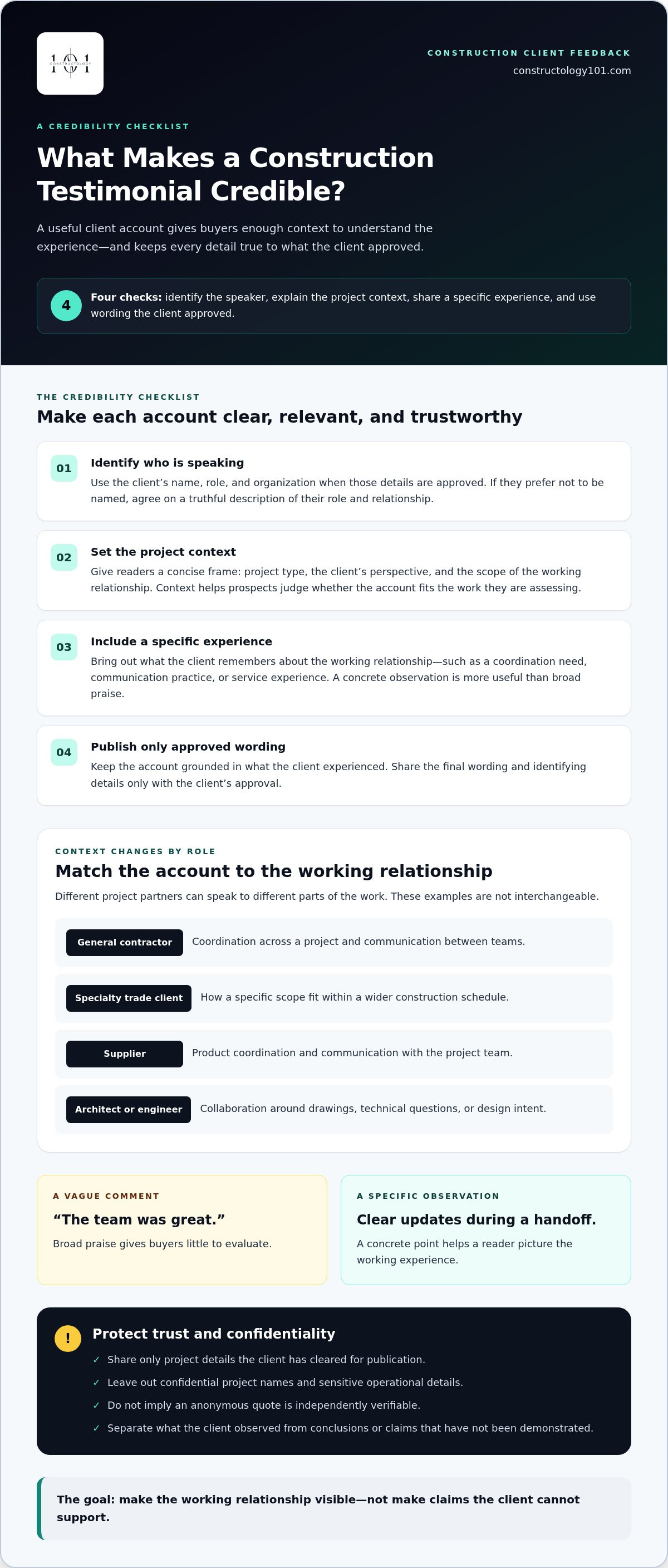
- Build credibility with an identifiable client, clear project context, specific experience, and wording they’ve approved.
- Choose written, interview, or video testimonials based on the client’s comfort, the detail you need, and how you plan to use the feedback.
- Use focused questions to draw out useful details, then share the draft for approval before publishing.
- Match each approved testimonial to a buyer concern and relevant service across your website, capability materials, or professional profile.
Why getting commercial client testimonials matters in construction
Asking a commercial client for public praise can feel sensitive. The project may involve several decision-makers, confidential details, or work that’s still part of a larger program. A testimonial is an approved client account of working with a business. It gives prospective buyers a view beyond a company’s own description of its services, while leaving the client in control of what they’re comfortable sharing.
That perspective matters in construction, where buyers are assessing more than the finished work. They may want to understand how a company coordinated with other teams, responded to changes, communicated across a project, or handled responsibilities within a particular scope. A client’s first-hand account can make those working practices easier to picture. It can inform an evaluation, but it can’t guarantee a contract, referral, or project outcome.
What commercial buyers need testimonials to clarify
Commercial prospects often need evidence that speaks to reliability, coordination, responsiveness, and project fit. Company materials can describe processes and capabilities, but an approved client account can add details about how those capabilities showed up during a real working relationship.
For example, a client might describe how a team kept communication clear while coordinating with other trades, or how a supplier handled an agreed delivery schedule. These details are more useful than broad praise because they help buyers compare the account with their own needs. As general context, Customer Review Wikipedia discusses the role of authenticity in customer feedback. The same principle applies here: a genuine account should reflect the client’s experience, not marketing language placed in their mouth.
A specific project account shows how the work unfolded; generic promotional praise only says the company is great.
Why construction testimonials need project context
Project type, the client’s role, and the scope of work help readers interpret feedback. Without that context, even sincere praise can leave prospects wondering what the company actually contributed. Include enough background for a relevant comparison, while respecting confidentiality limits and sharing only details the client has approved.
Consider how context changes the meaning of feedback across the industry:
- A general contractor can speak to coordination across a project and communication between teams.
- A specialty trade client can describe how a specific scope fit within a wider construction schedule.
- A supplier can comment on product coordination and communication with the project team.
- An architect or engineer can describe collaboration around drawings, technical questions, or design intent.
These examples aren’t interchangeable. A testimonial about a specialty trade’s coordination may help a buyer evaluating similar work, but it may not answer questions about a supplier’s role. Match the account to the kind of work and relationship a prospect is assessing. That context also supports sounder partner decisions, alongside practical guidance on finding reliable construction partners.
Use getting commercial client testimonials to make the working relationship visible, not to make claims the client can’t support. A clear, contextual account lets prospects judge relevance for themselves.
What makes a commercial construction testimonial credible
A testimonial earns a buyer’s attention when its details can be understood and its wording can be trusted. Use a simple framework to assess each one: who is speaking, what project or working relationship they’re describing, what they experienced, and whether they approved the final wording. These elements help turn a positive comment into relevant evidence without inflating what happened.
A useful construction testimonial gives buyers an identifiable source, clear context, specific experience, and client-approved wording. Leave out any element the client hasn’t authorized. If a person prefers not to be named, don’t imply that an anonymous quote is independently verifiable. Instead, agree on a truthful description of their role and relationship that respects their privacy.
Include enough client and project context
Identify the speaker by name, role, and organization when they’ve approved those details. Then give readers a concise frame: the project type, the client’s perspective, and the scope of the working relationship. A project owner discussing a renovation brings a different perspective from a general contractor describing a trade partner’s coordination on a commercial build.
Keep the context useful, not revealing. Avoid confidential project names, sensitive operational details, or information the client hasn’t cleared for publication. Construction Owners Association’s testimonial guidance for construction companies offers additional industry context for using client feedback to support credibility.
Replace general praise with specific experience
Ask the client what stood out in the working relationship. Was there a coordination need, communication practice, or service experience they remember? A response such as “the team was great” offers little for a buyer to evaluate. A client-approved explanation of how a team kept updates clear during a handoff gives the reader a concrete point to consider, without claiming a result that hasn’t been demonstrated.
Separate observations from conclusions. A client can describe what they experienced, such as receiving clear responses to questions or coordinating around a defined scope. Avoid adding performance metrics, superlatives, or promises unless the client can verify and approve them. “Always finished ahead of schedule” is a broad claim that may need evidence; don’t turn one positive experience into a universal guarantee.
Keep the client’s first-person voice. Light editing for clarity is reasonable, but a polished quote that sounds like corporate copy can weaken trust. Preserve their meaning, remove repetition, and send the final version for approval. That review matters whether the feedback appears on a company website, in capability materials, or beside services in a professional profile.
For a broader professional presence, an interactive construction directory listing can showcase your skills and services alongside approved proof. The testimonial remains the client’s account; the profile gives prospects another place to understand your work.
Written, interview, or video testimonial: choose the right format
The best format is the one that lets a client share a useful account comfortably and clearly. A short written quote may suit a client with limited time; an interview can bring out the steps behind a complex collaboration; video can add a personal voice when the client is happy to appear on camera. Match the format to the project story, the client’s preference, and how you plan to use the approved material.
Use this comparison to weigh the practical differences before getting commercial client testimonials:
| Format | Client effort | Detail and production | Likely use |
|---|---|---|---|
| Written response | Low, especially with a few focused prompts | Can capture one clear experience; requires light editing and approval | Website quotes, capability materials, professional profiles |
| Interview | Moderate, with time set aside for a conversation | Allows follow-up questions; needs scheduling, note-taking, and review | Longer client stories or project explanations |
| Video | Higher, with scheduling and on-camera participation | Needs recording, editing, client review, and approved captions | Website features, presentations, or other visual marketing materials |
When a written testimonial is the practical choice
A written quote is often a straightforward option for a time-constrained commercial client. It works well when one point captures the value of the relationship, such as clear communication during a defined scope or a positive experience coordinating with the project team. Send a small set of focused questions rather than asking for a polished statement from scratch.
You can tighten the response for clarity, but don’t change its meaning or add claims the client didn’t make. Share the edited quote and its attribution for approval before publication. A concise, authentic sentence is more useful than a longer statement that sounds like company copy.
When interviews or video add useful context
Choose an interview when a buyer needs to understand how coordination or decision-making unfolded. Follow-up questions can clarify the client’s role, what the project required, and which part of the working relationship they want to describe. You can later select a short approved excerpt without losing the full account.
Video makes sense only if the client is comfortable speaking on camera. Plan for scheduling, review, and approval of the final edit, including captions. Captions help make the message accessible and should reflect the client’s approved words. Don’t assume a more produced format makes the account more credible; the client’s genuine experience is what matters.
Collecting a testimonial and repurposing it are separate steps. Confirm permission for each intended use, such as a website, a proposal, or a professional profile, and keep the approved version and context consistent. An interactive directory listing can complement this work by showcasing your services and professional presence alongside approved proof.
How to request and approve a commercial client testimonial
A clear process keeps the request respectful and the final quote accurate. Ask after a meaningful milestone, such as a completed phase, a successful handoff, or project closeout, when the client can recall the working experience. Avoid tying the request to a contract decision or making public praise feel like part of the relationship.
Use this sequence to make getting commercial client testimonials manageable:
- Choose the client. Select someone who worked directly with your team and can speak to the experience you want to describe.
- Make a personal request. Explain why you’re asking, how you hope to use the feedback, and that declining is completely fine.
- Ask focused questions. Offer a few written prompts or a brief conversation, based on what’s easiest for the client.
- Draft for clarity. Keep the client’s meaning and voice; don’t add claims or details they didn’t provide.
- Get approval. Send the final wording, attribution, and intended use for review before anything is published.
A request can be simple: “Thanks for working with us on the project. Would you be comfortable sharing a short comment about your experience, particularly the part of our collaboration that stood out? We’d ask for your approval before using it publicly. No pressure at all if you’d rather not.”
Ask focused questions that prompt useful detail
Good prompts help a client recall the work without steering them toward praise. Ask what they needed from the team, what working together involved, and what stood out. Then invite one example: “Was there a particular moment that illustrates that?” Don’t supply the answer or suggest a claim you’d like them to make.
Keep the process low-effort. Send a few prompts by email or offer a short conversation, and let the client choose. A specific response about communication during a handoff, for instance, can be more informative than a broad statement about being satisfied.
Review wording, permissions, and confidentiality
Before publication, confirm the exact quote and approved attribution, including the speaker’s name, role, and organization if they want them included. Clarify the project reference, any image use, and the channels where the testimonial may appear. Permission for one use shouldn’t be assumed to cover every format.
Check project descriptions, figures, and claims with the client. Remove confidential details, and revise anything they flag. Ask, draft, verify, approve, then publish. That permission-first sequence protects the client’s control over their account and gives your business a clear basis for sharing it.
Once you have approved proof, pair it with a professional profile that presents your construction skills and services. Build your construction profile on Constructology 101’s interactive directory and connect with construction professionals through its networking platform.
Use approved testimonials to strengthen construction business visibility
An approved testimonial is most useful when it appears where a prospective client is already assessing your work. Add relevant quotes to your company website, capability materials, and professional profiles, with enough context for readers to understand the client relationship. A testimonial about coordination on a particular scope, for example, can support a service description that addresses similar work. It helps prospects evaluate fit, but it doesn’t prove every capability or guarantee a contract.
Place each testimonial where it answers a buyer question
Match each quote to the service, trade, project type, and audience it genuinely reflects. A comment from a project partner about clear communication may help address how your team works with others. Feedback about a specific scope may be relevant to buyers considering that work, but shouldn’t be presented as evidence of unrelated services.
Introduce the quote with a brief, accurate description of the client relationship and project context. This gives readers a useful frame without exposing confidential details. For example, identify the speaker’s role and the kind of project only as the client has approved. Avoid placing isolated praise beside a broad list of services if the quote doesn’t speak to those capabilities.
Keep the surrounding copy measured. Let the client’s account support the specific point it makes, rather than turning it into a sweeping claim about quality, performance, or results. This makes your marketing more credible and helps commercial prospects judge whether the experience is relevant to their own needs.
Build credibility through relationships and visibility
Testimonials work best as one part of a complete, accurate business presence. Keep your profile current, describe your skills and services clearly, and share only client feedback approved for public use. Review testimonials periodically, especially when project details, service descriptions, client roles, or publication permissions may have changed. If a quote no longer fits your current materials, revisit its context and approval before continuing to use it.
Visibility also comes from professional relationships, not only published proof. Sharing project information and communicating with industry peers can help sustain connections across the construction community. Constructology 101 offers construction professionals an interactive directory and professional network where members can showcase skills and services, share project information, and connect through integrated messaging. A profile can complement approved testimonial proof as part of a broader credibility strategy, while visibility alone can’t promise business outcomes.
Use getting commercial client testimonials to make genuine client experience easier for the right audience to understand. Pair each quote with relevant services, keep its context intact, and maintain a professional presence that reflects the work you do.
Make client proof part of your next growth step
Every finished project can strengthen the relationships that support your next stage of growth. Treat getting commercial client testimonials as an ongoing practice: build trust with clients, keep permission clear, and make approved feedback part of a professional presence that reflects the work you want to be known for.
That presence can extend beyond your own marketing materials. Constructology 101 gives construction professionals an interactive directory listing to showcase skills and services, with project sharing and integrated messaging to support industry connections. Its Pioneer Membership offers a lifetime membership option for professionals seeking access to the platform’s networking tools.
An interactive profile, clear service information, and approved client proof can help construction peers understand your professional presence.
Frequently Asked Questions
How do you ask a commercial client for a testimonial without making it awkward?
Make a brief, optional request as a separate conversation from invoices, contract discussions, or requests for future work. For example: “I’m gathering client perspectives on our project work. Would you be open to sharing a few comments? There’s no pressure, and we understand if you’d prefer not to.” This makes getting commercial client testimonials feel like an invitation, not an expectation. If they decline or don’t respond, thank them and move on.
What questions should I ask a construction client for a testimonial?
Ask open questions that help the client describe their own experience. Try: “What were you hoping the team would handle?” “What part of the process required the most coordination?” and “What would you tell a colleague considering similar work?” For a project with several firms involved, ask which part of the collaboration they can speak to directly. Their answers can clarify what’s useful to share without prompting them to make claims outside their knowledge.
How many testimonials should a construction business have?
There’s no universal target. Prioritize useful coverage over volume: consider whether your feedback represents different services, project types, and client perspectives that matter to the work you pursue. A small set of distinct, well-attributed accounts can be more informative than a long page of similar praise. Review your collection as your business focus changes, and seek new perspectives where existing testimonials don’t address the questions prospective clients commonly raise.
Can I use an anonymous testimonial from a commercial client?
Yes, if the client agrees to the wording and how you’ll identify them. Explain why anonymity is needed and offer a truthful description, such as “project owner” or “commercial construction partner,” only if the client approves it. Don’t imply a name or organization has been verified when it hasn’t been shared. Add enough non-sensitive context to help readers assess relevance, and leave the quote out if anonymity would make its source or experience misleading.
Should I offer a client an incentive for a testimonial?
Don’t make a reward conditional on positive feedback, and don’t ask a client to praise work they can’t honestly endorse. The safest approach for credibility is to request candid feedback without offering a benefit. If a client receives anything of value connected to an endorsement, disclose that connection clearly where the testimonial appears and follow applicable advertising guidance. Keep the request independent of project decisions, payment, or future work.
What should I do if a client gives vague feedback?
Thank them, then ask one neutral follow-up rather than rewriting the response yourself. For example: “Could you share a moment that shows what you mean by ‘good communication’?” If they can’t recall a specific instance, don’t press them or turn their general compliment into a detailed claim. You can ask permission to use a short, accurate quote, or decide it doesn’t offer enough context to help a prospective client.
Can a client change or withdraw approval for a testimonial?
Yes. If a client asks to revise or stop using their testimonial, respond promptly and discuss what they want changed or removed. Check the places where you published or distributed it, then update materials you control and contact partners who reused it where practical. Keep a note of the client’s current preferences so the old version doesn’t reappear in future materials. Clear, ongoing communication helps preserve the relationship.
Showcase your construction skills and services alongside approved client proof with an interactive directory listing on Constructology 101, and build connections through the construction professional network.


