

What if a subcontractor’s clean-looking incident rate tells only part of the safety story? A low TRIR or EMR can be useful, but neither shows on its own how a company trains crews, reports near misses, or closes corrective actions. Effective subcontractor safety record evaluation criteria connect documented evidence to the work, hazards, and project conditions, rather than relying on one number.
Before approving a subcontractor, you need clear records and a fair way to compare companies with different trades and project scopes. A consistent process helps you spot meaningful patterns without treating every metric as equal or overlooking signs of improvement.
This checklist explains which records and performance signals to review, how to interpret lagging indicators alongside leading ones, and how to account for scope and workforce differences. It also shows how to document decisions and address gaps before work begins and as the project progresses. The result is a repeatable, evidence-based evaluation that supports informed decisions and stronger safety follow-through.
Key Takeaways
- Use subcontractor safety record evaluation criteria that connect documented evidence to the work scope, hazards, and project conditions.
- Review performance history alongside safety programs, worker training, incident records, and corrective actions for a fuller picture.
- Compare lagging metrics with prevention efforts, and look at trends across review periods rather than relying on a single result.
- Record each finding consistently, including its evidence source, review date, any gap, the person responsible, and its resolution.
- Turn evaluation findings into practical orientation topics and site controls, then reassess when project conditions materially change.
Why subcontractor safety record evaluation criteria matter before work begins
Before crews arrive, a project team needs more than a stack of forms. It needs a clear way to judge whether a subcontractor’s safety practices fit the work ahead. Consistent subcontractor safety record evaluation criteria turn records into a documented decision: what evidence was reviewed, what it suggests about the planned work, and what needs follow-up.
The stakes reach beyond one company. A subcontractor’s planning, training, and communication can affect its own workers, nearby trades, and the sequence of work. For example, if a crew will work at height near another trade’s work area, the project team needs to understand how hazards will be controlled and communicated. Gaps can create exposure, disrupt schedules, and complicate coordination. A structured review surfaces questions before they become jobsite problems.
What does a subcontractor safety record evaluation cover?
A structured review examines performance history, safety systems, worker training, incident records, corrective actions, and relevant documentation. The depth and focus should reflect the subcontractor’s assigned tasks and exposures. A trade working around energized equipment, for instance, may call for different evidence and follow-up than a crew performing lower-exposure work.
A safety record review is a documented screening of available evidence for a defined scope. It informs project decisions but is not a complete safety assessment or a guarantee of safe performance. Records offer useful signals, but they can’t show every condition workers will encounter or predict every decision made in the field. Use the review to identify informed questions and practical controls, not to create a false sense of certainty. This fits within the broader contractor management process, which includes organizing safety information before and during contracted work.
Why one-size-fits-all approval rules can mislead
Apply the same review process, but not necessarily the same interpretation. Scope, workforce size, hazard exposure, and the period covered by a record all affect what the evidence can tell you. A small subcontractor may have fewer recorded events simply because it has fewer workers or hours of exposure. That context doesn’t prove strong or weak performance. It shows why raw numbers need a fair frame of reference.
Keep two decisions separate:
- Minimum documentation check: Are the requested records present, current for the review, and relevant to the assigned work?
- Performance judgment: What do the records, trends, safety practices, and corrective follow-through indicate when considered together?
Don’t turn a single metric or cutoff into a universal pass-or-fail rule. A threshold can flag a topic for review, but it may not reflect the subcontractor’s specific scope or explain changes over time. Record the evidence consistently, weigh it against project hazards, and identify any corrective actions. This supports fairer comparisons and gives the project team a clear starting point for managing risk once work begins.
Which subcontractor safety records and evidence should you review?
Build the file around five evidence groups: performance history, written safety programs, worker training, incident records, and corrective actions. The goal isn’t to collect the most paperwork. It’s to determine whether records are relevant to the assigned work, current enough to inform a decision, and detailed enough to support their claims.
A document’s presence matters less than its quality: useful evidence is relevant, dated, complete, and supported by records that make its claims understandable. A policy that names hazards the crew won’t face offers little insight into readiness for this scope. A training roster without dates or course details may not show whether the workers assigned to a task received relevant instruction.
Review incident history and applicable safety metrics
Where relevant, review the Total Recordable Incident Rate (TRIR), which reflects recordable injury and illness cases relative to hours worked; the Days Away, Restricted, or Transferred (DART) rate, which focuses on cases involving those outcomes; and the Experience Modification Rate (EMR), a workers’ compensation rating. Note each metric’s reporting period and the workforce or hours behind it. Compare the figures with available incident records and the type of work performed. Treat a rate as a prompt for discussion, not automatic proof of safe or unsafe performance.
A change in a rate may reflect a different workforce size, reporting period, or work mix. Ask what the figure covers, then compare it with underlying records and documented actions. When reviewing regulatory documents or reporting details, distinguish project requests from requirements that apply to the employer and work. Requirements can depend on factors such as jurisdiction, industry, and establishment size, so verify them against current authoritative guidance rather than treating a generic checklist as a legal determination.
Check safety programs, training, and corrective-action evidence
Read written programs against the subcontractor’s actual tasks and hazards. Review role-specific training records for worker names, dates, and subject matter instead of assuming one credential covers every task. For incidents and near misses, look for investigation findings, corrective steps, assigned responsibility, and evidence that actions were completed. An open item isn’t automatically a reason to reject a subcontractor, but it should have a clear owner and follow-up plan.
Keep the review traceable with a simple register. Use one line per document or finding:
- Evidence: Record or program reviewed, plus the period or scope it covers.
- Review date and status: Date checked; mark complete, outdated, missing, or follow-up needed.
- Follow-up owner: Person responsible for resolving a gap and recording its outcome.
Use the same fields across trades, then tailor the evidence requested to each scope. Construction-focused professional directories and networks can help you connect with industry peers. Constructology 101’s construction network helps construction professionals find one another, while safety records still require your independent review.
How to interpret safety metrics without missing project-specific risk
A rate can make a record look simple. The work behind it rarely is. To apply subcontractor safety record evaluation criteria fairly, read outcome measures alongside evidence of prevention, consider the work and reporting period they represent, and document what still needs clarification. No single figure can capture how hazards are controlled on a specific project.
Lagging indicators show outcomes, not the whole safety system
Lagging indicators summarize events that have already happened. TRIR relates recordable injury and illness cases to hours worked. DART relates cases involving days away, restricted work, or job transfer to hours worked. EMR is a workers’ compensation rating that reflects claims experience in relation to an expected level. Calculation rules and reporting periods matter, so verify the current methodology and compare like with like.
Low reported incident counts alone don’t establish that hazards are controlled. A small workforce may have limited exposure hours, while incomplete records may leave important context unclear. Neither fact proves underreporting or poor safety. Treat them as reasons to understand what the numbers include. Don’t rank subcontractors doing unlike work using unadjusted figures. Compare scope, workforce, hours, and period first.
Leading indicators reveal prevention and learning
Leading indicators show whether preventive practices are happening. Look for dated hazard reports, toolbox talks tied to current tasks, inspection findings, worker participation, and corrective actions tracked through completion. Lagging measures show reported outcomes; leading evidence shows how a team identifies hazards, responds, and learns before the next incident.
Test the records against field conditions. If an inspection log identifies an access hazard, look for a documented response and evidence that the issue was closed. If toolbox talks are recorded, check whether their subjects match the work planned for the review period. Specific examples make broad statements about a safety program easier to assess.
Use a comparison like this to turn metrics into documented follow-up, not an automatic score:
Reported rates | Evidence strength: offers a defined outcome measure when period and exposure data are clear. | Limitation: doesn’t explain the cause or show preventive practice. | Follow-up: clarify the calculation period, hours, work type, and supporting records.
Low incident counts | Evidence strength: describes reported events for the period reviewed. | Limitation: small workforces or incomplete records can limit interpretation. | Follow-up: establish what the record covers and note missing context without assuming why.
Hazard reports and inspections | Evidence strength: can show hazards identified and actions initiated. | Limitation: activity counts alone don’t establish effective control. | Follow-up: review examples, assigned owners, and closure evidence.
Training and toolbox talks | Evidence strength: can show safety topics addressed with workers. | Limitation: attendance alone doesn’t show relevance to current tasks. | Follow-up: match dates and subjects to crew roles and planned hazards.
Look for patterns across review periods, then record both strengths and unresolved questions. A rising report count may reflect increased hazard reporting rather than worsening conditions, so examine the underlying cases and responses before drawing conclusions. Consistent interpretation keeps the review grounded in evidence and project risk.
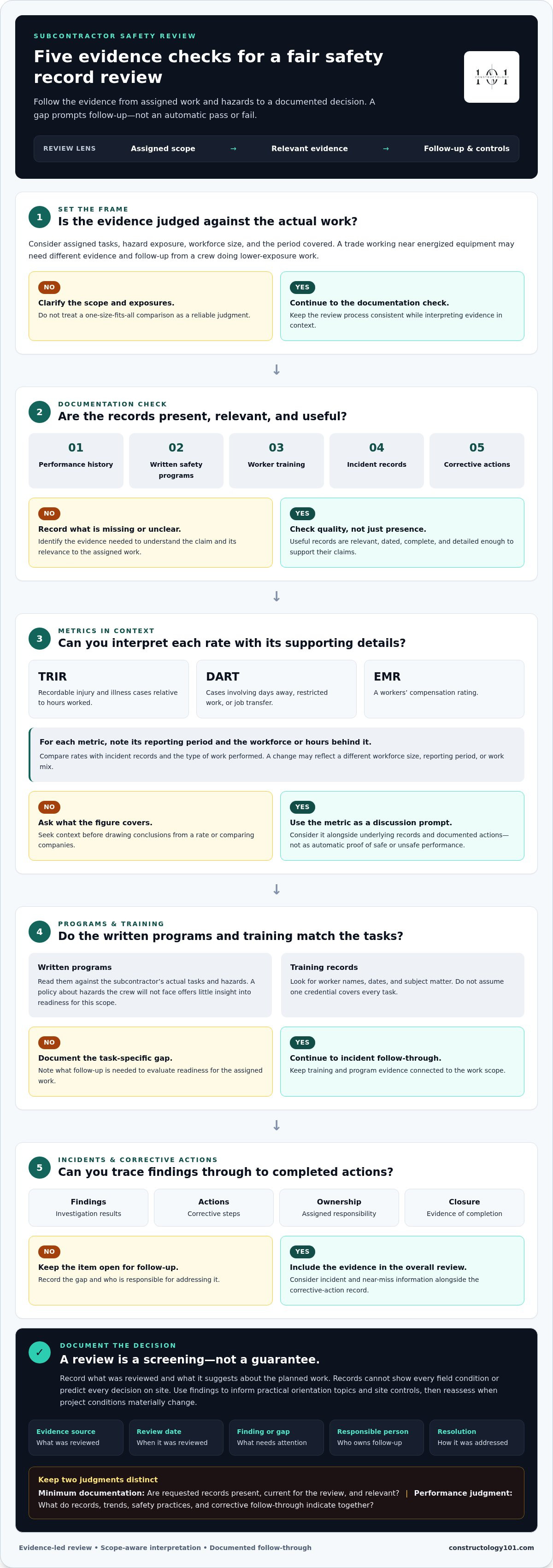
A practical checklist for evaluating a subcontractor safety record
A repeatable checklist turns the review into a decision trail, not a paperwork exercise. Apply the same core steps to each subcontractor, then tailor the evidence and follow-up to the assigned work. These subcontractor safety record evaluation criteria help reviewers explain what they considered, what remains open, and why the decision fits the project.
- Define the work and exposure. Describe the subcontractor’s tasks, work areas, site conditions, interfaces with other trades, and relevant hazards. Use this scope to set the depth of review.
- Set the evidence request. Identify applicable performance records, safety programs, role-specific training, incident and investigation records, corrective actions, and insurance documentation. Separate project requests from requirements that must be checked against current applicable rules.
- Log and assess each item. Record the evidence source, period covered, review date, and relevance to the planned work. Note whether a record is complete, outdated, missing, or needs clarification.
- Classify each finding. Mark it acceptable when relevant evidence supports the requirement; needing clarification when context or documentation is incomplete; or requiring corrective action when a gap needs resolution before or during the work.
- Record the decision and follow-through. Document the reviewer, rationale, open questions, conditions attached to approval, action owner, due date, and closeout evidence. Revisit open items at the agreed checkpoint.
Build a review that fits the work
Keep the core process consistent across trades, but don’t demand identical evidence for unlike hazards. The work scope should shape which program details, training records, and performance information matter most. For broader partner-screening context, use this reliable construction partners checklist alongside your safety review, not in place of it.
Document decisions and close evidence gaps
Make every finding traceable. A useful register can include:
- Evidence source and review date: Name the record and when it was assessed.
- Status and gap: State what is acceptable, unclear, or unresolved.
- Owner, due date, and resolution: Assign responsibility and record how closure was verified.
For example, if a training record doesn’t identify the task covered, classify it as needing clarification, assign an owner, and set a follow-up date. If the evidence reveals a hazard-control gap, document the required action and any conditions for proceeding. This makes the decision understandable to the next reviewer and easier to revisit if the scope changes.
Finding potential partners is separate from evaluating their safety evidence. Construction directories help professionals discover businesses and make industry connections. To build construction-industry connections, explore the Constructology 101 directory and network, then assess each prospective subcontractor independently using your documented review.
Turn safety evaluation findings into stronger project partnerships
A prequalification decision is useful only if it shapes the work that follows. Translate findings into clear expectations for orientation, site controls, and communication. If the review identified a training gap, make the relevant topic part of the crew’s onboarding. If records flagged a hazard-control concern, clarify the control, who is responsible for maintaining it, and how the team will report a problem.
Keep responsibilities specific. Identify who leads the subcontractor’s safety communication, who receives site updates, and how changes or concerns will be raised. This turns review notes into working agreements the project team can revisit, rather than leaving them in a file.
Monitor performance during the work
Use documented check-ins to compare field practices with the evidence reviewed before work began. Track inspections, hazard reports, incidents, corrective actions, and recurring concerns. Record what was observed, who owns the response, and whether the issue was resolved. If a concern appears more than once, review whether the existing control, communication, or orientation needs adjustment. Address issues early and capture lessons that can improve coordination.
Reassess when conditions materially change. A new task, changed hazard, different personnel, or observed practice that conflicts with the reviewed evidence may call for a focused review and updated controls. Document the reason for reassessment and any resulting changes. That creates a clear line from the original decision to the project’s current conditions.
Build connections while keeping safety decisions evidence-based
Professional connections can support discovery and communication, but they don’t replace independent safety review. A construction-focused directory gives businesses a place to showcase their services and helps industry professionals find one another. Project sharing and integrated messaging can support professional communication and connection. They don’t verify, certify, or endorse a subcontractor’s safety records.
Keep that distinction clear: a directory can help you discover potential partners; your project team remains responsible for evaluating their records, matching evidence to the work, and monitoring performance on site. Use the same documented process for prospective and current subcontractors, and revisit findings when the work or conditions change.
For construction businesses looking to increase visibility and build professional connections, explore Constructology 101’s construction professional network. Use those connections as a starting point for conversation, then make project decisions through your own evidence-based safety evaluation.
Make your next project connection count
Put your review process to work beyond the current bid. A documented approach to subcontractor safety record evaluation criteria can help your team make clearer decisions as project needs evolve, while consistent communication turns expectations into shared working habits. Keep learning from each project: note what helped teams coordinate well, where handoffs became unclear, and which review steps could be sharper next time.
Strong project partnerships start with informed conversations and clear expectations. Constructology 101 brings construction professionals together through interactive directory listings, project sharing, and integrated messaging. These connections can support discovery and communication, while safety decisions remain grounded in your team’s independent review of the work and its evidence.
Build your professional connections and discover construction businesses through Constructology 101’s construction professional network. Create your directory listing or join the network to connect with construction professionals and share project information.
Frequently Asked Questions
Is a single OSHA citation an automatic reason to reject a subcontractor?
A single OSHA citation isn’t automatically a reason to reject a subcontractor. Review what condition it involved, whether the matter is open, contested, or resolved, and what corrective response is documented. Then consider whether the cited hazard relates to the proposed work. A past finding and a current, uncontrolled exposure aren’t the same decision. Apply your company’s written requirements and verify any legal obligations that govern the project.
How far back should a subcontractor’s safety record be reviewed?
Choose a review period that your team applies consistently to candidates, while accounting for project risk, company policy, and available records. The subcontractor safety record evaluation criteria should identify exact start and end dates, not just say “recent history.” If a company changed ownership, workforce, or trade focus during that period, note it. Gaps may limit comparisons and deserve a clear explanation in the review file.
What if a subcontractor has incomplete safety records?
First identify what’s missing and why it matters to the planned tasks. For example, if a training roster omits crew names, request a roster or other reliable evidence connecting workers to relevant instruction. Incomplete files don’t automatically prove unsafe performance, but a material gap that remains unresolved should influence approval conditions, added safeguards, or whether work can proceed under company policy.
Can a subcontractor improve its safety evaluation after corrective action?
Yes. A later review can reflect documented corrective action and evidence that the change lasted, such as follow-up inspection records showing a revised control in use. Separate proof that a task was completed from proof that it addressed the underlying hazard. Record the evidence, date, responsible person, and later observation. This can strengthen the current assessment, but it doesn’t erase the original concern or guarantee future performance.
Should every subcontractor provide OSHA Form 300 logs?
Not in every case. OSHA recordkeeping duties and exceptions can vary by employer and establishment, so verify current requirements using OSHA guidance before making Form 300 logs a blanket request. In your review file, mark whether each record was requested, received, or not applicable, and document the basis for that status. Apply the same approach to comparable subcontractors and consider relevant evidence without treating a missing form alone as a safety verdict.
How often should subcontractor safety performance be reassessed?
Set reassessment timing based on project duration, risk, company procedures, and observed performance, rather than assuming one interval fits every job. Define planned check-ins and triggers such as a major scope change, an incident, or repeated control failures. Record when each review occurs, what changed, the findings, and assigned follow-up. This keeps reassessment responsive without presenting an invented schedule as a legal requirement.
What should a contractor do when a safety metric conflicts with strong field observations?
Don’t let either source win by default. Check whether the metric and observations cover the same dates, workforce, scope, and definitions, then review supporting records and actual controls. Strong site practices today may not explain a metric from an earlier period. Log the discrepancy, the evidence examined, and any needed follow-up. Avoid assuming underreporting or dismissing the metric until the difference is understood.


