

A prequalification form that stops at insurance and safety records leaves key questions unanswered. What to include in a subcontractor prequalification form is a complete picture of financial strength, safety performance, compliance, insurance, ownership, workforce, licenses, and relevant project experience. Gather these details together to assess whether a firm is suited to the work.
It’s easy to focus on certificates and past projects, but ownership, management, workforce capacity, and licensing also affect a subcontractor’s ability to deliver. A clear, consistent form helps you compare applicants and identify missing information before making qualification decisions.
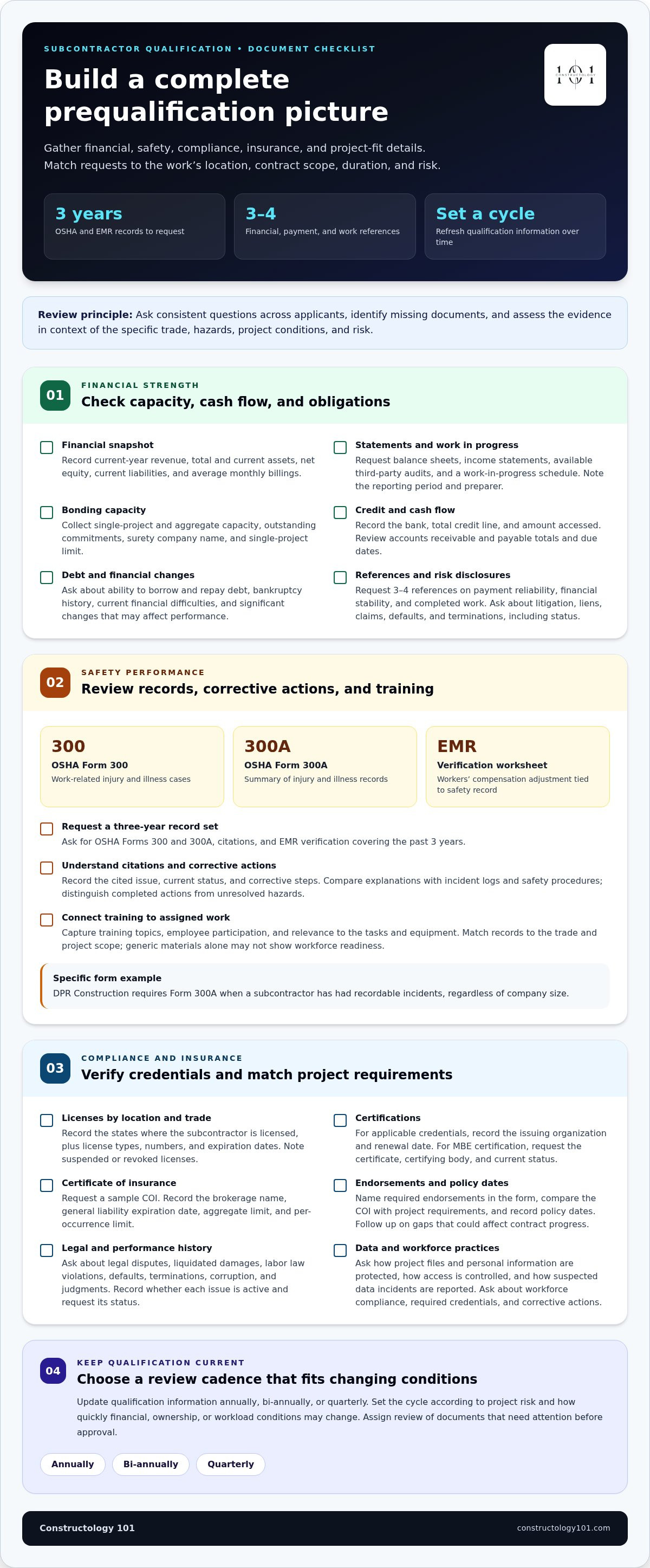
This guide covers the details and documents to gather, from financial statements and OSHA records to insurance certificates, company information, references, and project scope. Use it to build a practical checklist suited to the work, location, and risk.
Key Takeaways
- Gather financial records that show bonding capacity, available credit, cash flow, and current obligations.
- Prepare OSHA logs, EMR documentation, and safety training records to give a clear view of safety performance.
- Organize insurance certificates, required endorsements, licenses, and compliance history for review.
- Document ownership, workforce capacity, references, and project experience to show how well the subcontractor fits the work.
1. Financial statements and alternative submissions
Requirements vary by state, trade, and project type. Match financial requests to the work’s location, contract scope, duration, and risk, and clearly list the records you’ll accept.
Build a financial snapshot using current-year revenue, total and current assets, net equity, current liabilities, and average monthly billings. Request balance sheets and income statements, along with third-party financial audits when available. A work-in-progress schedule can provide context by showing active commitments alongside capacity for another contract. Ask applicants to identify the reporting period and who prepared each document.
Bonding records help show whether a firm can support the project’s size. Request single-project and aggregate bonding capacity, outstanding bond commitments, the surety company’s name, and the single-project limit. For credit, collect the bank’s name, total credit line, and amount currently accessed. Review these details with accounts receivable and payable, including totals and due dates, to understand cash flow and near-term obligations.
Use the financial section to assess the firm’s ability to borrow and repay debt, not just its revenue. Ask about bankruptcy history, current financial difficulties, and significant changes that could affect performance. Request three to four references who can speak to payment reliability, financial stability, and completed work. Compare their feedback with the submitted statements and bonding details.
Ask about current litigation, liens, and claims, including their status and connection to the company or its owners. Record contract defaults and terminations as related risk disclosures. Keep questions factual and consistent for all applicants.
Update qualification information annually, bi-annually, or quarterly. Set the review cycle according to project risk and how quickly financial, ownership, or workload conditions may change.
2. OSHA records, citations, experience modification rate, and safety training
Request OSHA injury and illness records, citations, and safety training documentation. These records support consistent comparisons of safety performance across potential partners. Review them in light of the work’s hazards, trade, and project conditions. Evaluate safety through documented incidents and corrective actions, not a single summary figure.
Request OSHA Forms 300 and 300A covering the past 3 years, plus Experience Modification Rate (EMR) verification for the past 3 years. Form 300 records work-related injury and illness cases, while Form 300A summarizes them. The EMR worksheet shows the workers’ compensation adjustment based on the company’s safety record. Together, these documents provide incident history and insurance-related context.
What safety statistics and EMR should subcontractors provide? Request OSHA 300 information, OSHA Form 300A, and EMR worksheets, with records covering the past 3 years. DPR Construction requires Form 300A when a subcontractor has had recordable incidents, regardless of company size.
Ask applicants to explain OSHA citations, including the issue cited, its status, and corrective steps taken. Compare their explanations with incident logs and safety procedures. Context matters: a completed corrective action is different from an unresolved hazard. Ask each applicant the same questions, then note any follow-up needed before approval.
Request safety training records showing the topics covered, employee participation, and how the training relates to assigned tasks. For example, records for a crew using elevated work platforms should connect the training to that equipment and the planned work. Match documentation to the subcontractor’s trade and project scope; generic materials alone may not demonstrate workforce readiness.
Use the findings to set project-specific safety expectations and track performance after award. Construction professionals can also build industry relationships through a construction industry directory, connecting with potential partners and sharing project information.
3. Compliance, licensing, certifications, and insurance
Build a compliance record around the work location and trade. Ask which states the subcontractor holds contractor licenses in, then record license types, numbers, and expiration dates. Request applicable certifications and note the issuing organization and renewal date. If a firm claims Minority Business Enterprise (MBE) certification, request its certificate, certifying body, and current status. This helps reviewers distinguish active credentials from expired or unrelated documents.
Request a sample certificate of insurance (COI) and record the insurance brokerage’s name, general liability expiration date, aggregate limit, and per-occurrence limit. Name required endorsements in the form so applicants can provide matching evidence, not just a certificate. Compare the COI with the project’s insurance requirements before qualifying the firm. Record policy dates and follow up on any gap that could affect contract progress.
Include questions about current litigation and past legal disputes, liquidated damages, labor law violations, defaults, terminations, suspended or revoked licenses, corruption, and judgments. Ask whether any issue is still active and request a brief explanation of its status. Use neutral wording consistently across applicants.
What cybersecurity, data privacy, and workforce compliance questions should forms include? Ask how the firm protects project files and personal information, controls access, and reports suspected data incidents. Also ask about workforce compliance practices, including labor law violations, required credentials for assigned work, and corrective actions.
Use the answers to identify documents that need review before approval, such as license records, certification evidence, and policy endorsements. Separate project requirements from company-wide disclosures, then assign each item a reviewer and status. This makes gaps visible and ties the qualification decision to documented compliance, insurance coverage, and the work under consideration.
4. Company ownership, management, workforce, licenses, and project scope
Record the company’s legal name, ownership structure, principal contacts, and management roles. Ask who can authorize contracts and who will lead field operations. A Dun & Bradstreet number can help identify the business, if it has one. Record contractor license states here as well, and connect each license to the proposed trade and location.
Workforce details show whether the firm has capacity for the schedule and scope. Ask for employee counts by trade, key supervisors, and the share of work it expects to self-perform. Include apprenticeship program participation where relevant. For trades seeking prequalification with the New York City School Construction Authority, the firm is assessed for enrollment in New York State Department of Labor-approved apprenticeship training programs, except firms participating exclusively in the SCA Mentor Program. Apprentices employed by firms in that exclusive program must be registered with the New York State Department of Labor.
What project experience, references, and past performance should you include? Request comparable project names, locations, scope, contract size category, duration, completion status, and the applicant’s role. Include references who can speak to schedule, workmanship, and communication. The New York City School Construction Authority considers a minimum of two years in business when evaluating a firm’s experience for prequalification.
Compare experience against the job’s location, market sector, award size, duration, and complexity. Ask about current backlog and how planned staffing will support overlapping commitments. Include questions about quality issues, project delays, and contract defaults, and record explanations alongside project references. This gives reviewers a practical view of past performance and current capacity, beyond a list of completed jobs.
Use the information to compare each firm against the actual project requirements. For broader industry connections, connect with construction professionals and share relevant project information.
Constructology 101: Interactive Directory Listing
Constructology 101’s Interactive Directory Listing helps construction professionals make their businesses easier to discover and build industry connections. After organizing prequalification records, use a listing to present your company and its work to a relevant professional community.
The directory and professional social network connects construction businesses and individuals, supports relationship-building, and provides tools to share project information and communicate through integrated messaging. It can complement your qualification efforts by helping you expand your professional network, not replace project-specific applications or documentation.
Choose the Interactive Directory Listing to strengthen your visibility, or explore Pioneer membership at a lifetime price if that membership suits your goals. Contact Constructology 101 to learn more about getting listed.
Make Your Next Qualification Cycle Stronger
Knowing what to include in a subcontractor prequalification form gives your team a starting point. To make the process useful beyond approval day, connect qualification records with project feedback. Future decisions can then reflect how work progresses, not just what an application says. This ongoing view can help your team refine its questions and focus reviews on project needs.
Build industry relationships alongside your qualification process. Constructology 101 offers an Interactive Directory Listing for construction professionals seeking visibility and connections. Its Pioneer membership is available at a lifetime price. These options support professional discovery and networking, while your prequalification process remains the place for project-specific evaluation.
Take the next step at your pace. Contact Constructology 101 today to explore its directory and membership options, and keep building connections that support your work.
Frequently Asked Questions
What Documentation Do I Need?
Prepare a document package covering the subcontractor’s identity, financial condition, safety history, compliance credentials, insurance, workforce, and relevant project experience. To decide what to include in a subcontractor prequalification form, start with the proposed trade and project requirements. Label files by category and reporting period, and identify documents specific to particular work, such as trade licenses or safety training records.
What information should a subcontractor prequalification form collect?
Collect company details, ownership and management contacts, workforce capacity, licensed states, financial and safety records, insurance information, and comparable project history. Ask about active litigation, contract defaults, terminations, and judgments so reviewers can assess relevant disclosures. For example, identify the supervisor who would lead the proposed work and ask about similar projects they have managed. This connects company-wide information to the assignment.
What insurance certificates and coverage limits should a subcontractor submit?
Request a sample certificate of insurance and record the brokerage, policy expiration, general liability aggregate and per-occurrence limits, and required endorsements. Coverage limits should match the applicable project and contract requirements, not an invented universal figure. Compare the listed limits and endorsements with the project’s insurance schedule, then flag mismatches for review before qualification or contract award.
What licenses, certifications, and registrations should subcontractors document?
Ask subcontractors to list contractor licenses by state and trade, with license identifiers and expiration dates. Request supporting certificates for claimed qualifications, including Minority Business Enterprise certification where relevant, and record the issuing organization and status. For work involving an apprenticeship program, document program enrollment and apprentice registration details where applicable. Match each credential to the applicant’s proposed role and project location.
What financial statements and credit information are commonly requested?
Common submissions include balance sheets, income statements, current-year revenue, credit-line details, bonding capacity, and accounts receivable or payable. If an audit is unavailable, reviewers may consider other financial records, such as internal statements or a work-in-progress schedule. Compare assets and liabilities with current commitments to assess capacity. References can provide additional context about payment reliability and financial stability.
What OSHA records and safety programs are required for subcontractor prequalification?
Prequalification requests commonly include OSHA Forms 300 and 300A, EMR verification, citation history, and safety training documentation. The requested records and program details can depend on the project, trade, and qualification process, so avoid treating one checklist as a universal rule. A useful submission pairs incident records with explanations of corrective actions and training relevant to the crew’s planned tasks.


