

The best construction connections start with useful conversations, not a sales pitch. Construction trade networking groups bring contractors, subcontractors, suppliers, and other construction professionals together to build relationships, share knowledge, and explore project collaborations. The aim is to connect across trades and disciplines, not simply collect contacts.
It’s reasonable to be wary of networking that feels like a string of sales pitches. Strong professional relationships grow through shared experience, practical conversations, and trust built over time.
Learn how construction networking groups work, what members can gain, and how to find a setting that suits your goals. We’ll look at associations, peer groups, and ways to take part without putting pressure on every conversation. You’ll also see how an online construction directory and professional network can help you build industry connections at your own pace.
Key Takeaways
- Choose a group based on the people and trade connections you want to build, then take part consistently to develop useful working relationships.
- Use peer groups to exchange practical knowledge, learn about opportunities, and connect with professionals who understand construction work.
- Keep conversations low-pressure by focusing on shared challenges and genuine follow-up rather than pitching at every introduction.
- Compare local association chapters with online industry networks to find a format that fits how you prefer to connect.
What is networking in construction?
Construction networking connects contractors, subcontractors, suppliers, architects, engineers, and other industry professionals. Construction trade networking groups support business development through relationships, referrals, shared knowledge, and project collaboration.
Referrals and Business Relationships
A referral is useful when it connects a contractor with someone suited to the project. For example, a remodeler may build relationships with architects, engineers, and specialty trades, then introduce a trusted contact when a client needs that expertise. Look for groups where members have complementary roles and can discuss real construction work.
These connections can also support hiring and operations. A conversation with an experienced trade partner may surface a staffing contact, a supplier recommendation, or a more efficient way to coordinate work. Follow up with a specific next step, such as sharing a relevant article or arranging a conversation about a common challenge.
Comparing Networking Groups and Sharing Information
Compared with BNI and other general business groups, construction-focused groups center discussions on the industry, its trades, and project needs. General groups can still introduce contractors to clients and professionals outside construction. Choose based on whether you need broad business relationships or peers who understand construction workflows.
Before sharing leads or business information, consider who will receive it and what the project contact expects. Share only details you’re authorized to pass along, and make a warm introduction rather than distributing someone’s contact information without permission. For a bid or staffing need, describe the role or scope first, then share sensitive details directly with a suitable contact.
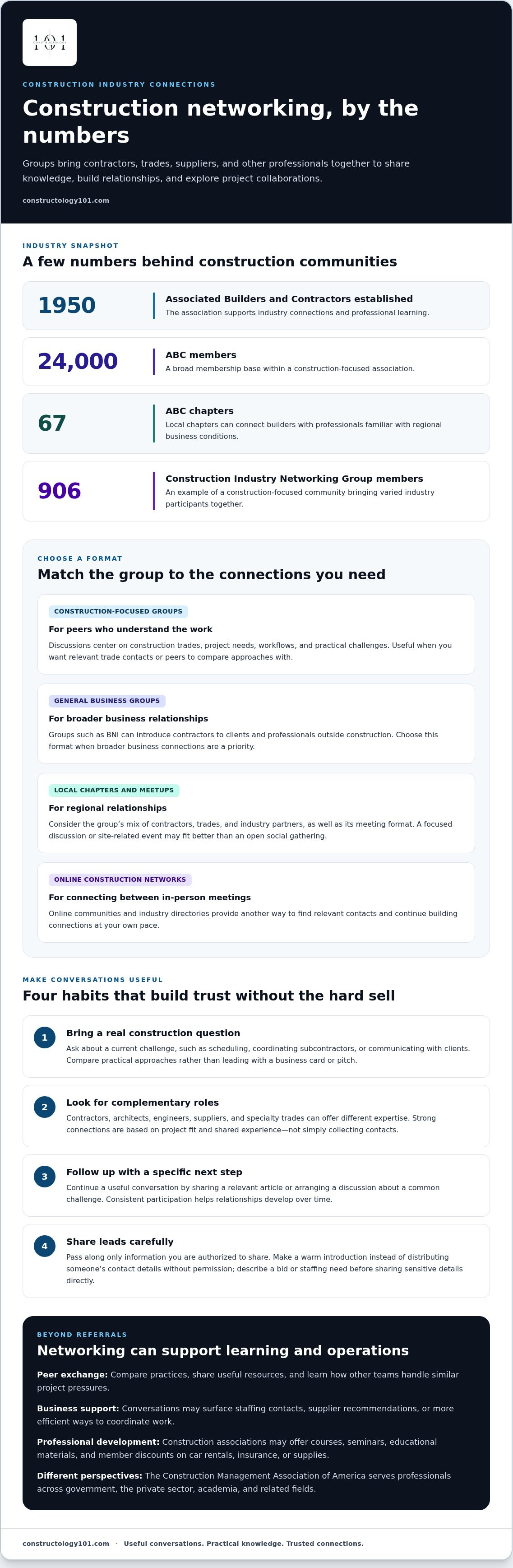
Networking can also support business growth through learning. Associated Builders and Contractors was established in 1950 and has 24,000 members. Construction associations may offer courses, seminars, educational materials, and member discounts on car rentals, insurance, or supplies. Use these resources to follow industry trends, strengthen practical skills, and connect with construction leaders.
Builder and remodeler peer groups
Peer groups give contractors a place to compare practices with people who understand construction work. Local meetups and national connections create different ways to learn, collaborate, and build lasting industry relationships.
Peer-to-Peer Collaboration
Peer-to-peer collaboration works best when contractors bring a real question, not just a business card. A remodeler might discuss scheduling challenges with another contractor, then compare approaches to coordinating subcontractors or communicating with clients. Look for discussions that welcome practical examples and different perspectives, rather than requiring every exchange to produce an immediate referral.
National connections can extend those conversations beyond a contractor’s immediate market. Members can compare how teams handle similar project pressures, share useful resources, and learn from peers with different specialties. Keep the exchange specific: describe the challenge, explain what you’ve tried, and invite relevant experience. That makes peer discussions useful without exposing confidential project details.
Local Association Networking Groups
Local groups connect builders and remodelers with professionals who understand regional business conditions. Associated Builders and Contractors has 67 chapters, while many construction associations maintain local chapters in major U.S. cities. Consider the chapter’s mix of contractors, trades, and industry partners, along with the format of its meetings. A focused discussion or site-related event may suit your goals better than an open social gathering.
Construction Industry Networking Group has 906 members. Its scale illustrates how a construction-focused community can bring varied industry participants together. Before joining a local group, identify the connections you want to develop, such as reliable trade contacts or peers who can discuss operations. Then attend with one useful question and follow up with people whose experience fits your needs.
Contractors who want to keep building connections between in-person meetings can use an online construction networking community to continue finding relevant industry contacts.
San Diego Contractors Networking Group lists Thursday, March 26, 2026; April 23, 2026, Novo Brazil Mission Valley, 5:00 PM; July 16, 2026, ProSource San Diego, 6:00 PM; and July 23, 2026, ProSource of San Diego.
Building professional relationships without sales pressure
Build trust through useful conversations, steady participation, and thoughtful follow-up. At an industry event, ask about a current challenge before describing your services. A residential remodeler, for example, might compare client communication practices with another builder instead of opening with a pitch.
Yes. Women, minority professionals, and young professionals can look for construction groups and events centered on their communities, alongside broader industry organizations. Choose settings where members can exchange career advice, discuss shared experiences, and form connections across trades.
The Construction Management Association of America serves construction and program management professionals across government, the private sector, academia, and related fields. That mix can help members understand different career paths and connect with people involved in projects from multiple perspectives. At an event, ask how another member entered their role or developed a particular skill.
Professional development can make networking more useful. Construction associations may offer courses, seminars, and educational materials on industry trends. Choose a session tied to a practical goal, such as strengthening communication or learning about a construction method. Then follow up with a specific question that continues the discussion.
Construction Industry Networking Group encourages professionals in residential and commercial construction, as well as people who support the industry, to apply. Its broad scope gives contractors a chance to meet peers beyond their own specialty. Before attending, identify one topic you can contribute to and one perspective you hope to learn from.
Keep the exchange balanced. Share a useful resource, introduce two professionals with relevant interests, or offer a lesson from a completed project. Participating in a construction association can help members develop professional skills and learn about job opportunities. Follow up with a short note that refers to your conversation, then build the relationship without making an immediate sales request.
CING's philanthropic efforts are conducted with HomeAid Colorado. New York Build is held at Hall 3B, Level 3, Jacob K. Javits Convention Center, at 429 11th Avenue, New York, NY 10001, USA.
Which construction industry associations offer local networking groups?
National associations connect contractors through local chapters, events, education, and industry discussions. Associated Builders and Contractors has 67 chapters, while many construction associations maintain local chapters in major U.S. cities. A nearby chapter can make national membership more relevant by connecting you with professionals in your market.
Associated Builders and Contractors focuses on helping members develop people, win work, and deliver work safely, ethically, and profitably. The Associated General Contractors of America provides advocacy, education, and research for contractors and industry-related companies. Compare their chapter activities with your priorities, such as workforce development, business education, or industry representation.
Other associations serve distinct professional needs. The Construction Management Association of America includes professionals from government, private industry, academia, and related fields. The American Institute of Constructors promotes construction professionals’ status and ethical standards. The National Institute of Building Sciences connects government and the private sector while supporting advances in building science and technology.
Use a practical selection process. First, identify the people you want to meet, such as contractors, construction managers, or specialty trades. Next, compare each association’s purpose, chapter presence, educational offerings, and event formats. Finally, attend an event or chapter meeting and assess whether its discussions fit your business goals. Some contractors may find value in participating in more than one association, with colleagues sharing membership responsibilities when several organizations appeal.
Choose based on relevance, not name recognition alone. A contractor focused on local connections may prioritize nearby chapter events, while a construction manager may value cross-sector discussions. Association participation can also provide courses, seminars, and educational materials on industry trends. Match the group’s activities to the relationships and professional knowledge you want to develop.
Extend those connections beyond association meetings. Explore construction networking connections to discover an online way to connect with professionals across the industry.
Constructology 101: Interactive Directory Listing
Constructology 101 helps construction professionals connect through an Interactive Directory Listing. Use it to make your business discoverable, find industry services, and build relationships beyond in-person meetings. The directory supports a range of construction roles, including architects, engineers, specialty trades, and suppliers.
For builders and remodelers, an online directory can complement local association events and peer discussions. Share relevant project information, find professionals whose work fits your needs, and continue conversations through integrated messaging. It’s a practical option when you want to develop industry connections on your own schedule.
Pioneer membership is also available at a lifetime price. Explore the directory to see how it can support your approach to construction networking, then decide whether it fits your goals.
Visit Constructology 101 to explore the directory.
Turn Your Next Connection Into Momentum
The value of construction trade networking groups grows when you turn a good introduction into an ongoing professional relationship. Choose one practical next step after each conversation: share a useful resource, follow up on a project-related discussion, or connect with someone whose expertise complements your own. Small, thoughtful actions help keep your network active without turning every interaction into a pitch.
Keep building those connections in the format that fits your work. Constructology 101’s Interactive Directory Listing helps construction professionals find services and be discovered, while Pioneer membership is available at a lifetime price. Use the directory when you want to extend your industry connections beyond in-person events and keep professional conversations moving.
Contact Constructology 101 to explore the directory and take your next step toward stronger industry connections.
Frequently Asked Questions
What networking groups are available for general contractors, subcontractors, and builders?
Options include construction associations, chapter events, professional organizations, and peer groups focused on the building trades. Associated Builders and Contractors and the Associated General Contractors of America serve contractors, while the Construction Management Association of America connects professionals across construction management. For example, a subcontractor seeking trade-specific peers can prioritize contractor-focused events, while a builder interested in broader project perspectives can explore cross-discipline groups.
How do I find construction trade networking groups near me?
Search for construction trade networking groups alongside your city or state, then review association chapter pages and event listings. Compare the audience, meeting format, and topics before attending. A builder looking for subcontractor connections might favor trade-focused gatherings, while a remodeler seeking business education may prefer an association chapter. Keep a short list of groups and track which events lead to relevant conversations and useful follow-up.
How much do construction trade association memberships and networking events cost?
Membership dues and event fees vary by organization and what participation includes. Costs may depend on membership category, chapter offerings, event format, and whether registration includes meals or educational sessions. Compare the dues and event terms for each group, then weigh them against practical benefits such as relevant contacts, professional education, and member resources. This helps you assess the fit without assuming every association has the same fee structure.
What are the membership requirements for construction networking groups?
Requirements vary by group. Construction Industry Networking Group encourages professionals in residential and commercial construction, as well as people who support the industry, to apply.


