

What if a subcontractor who looks ready on paper still puts your project at risk? A bid, insurance certificate, or strong first impression can’t answer every question. If safety, financial, insurance, or scheduling gaps are missed, approval becomes harder to explain, and different subcontractors may be judged by different standards. A consistent subcontractor risk assessment checklist helps you connect the evidence to the work and document the decision.
You need a practical process that works before the job starts and stays useful as conditions change. This guide shows you how to assess risk consistently, compare documentation with project demands, and identify what needs follow-up before work begins. It also explains how to record why a subcontractor is approved, conditionally approved, or not ready to proceed.
Use the checklist to review key risk areas, note missing or outdated evidence, and assign clear next steps. Then revisit the assessment when the scope, schedule, site conditions, or subcontractor performance changes. The result is a repeatable process for clearer decisions, targeted follow-up, and better project visibility.
Key Takeaways
- Match each review area to the subcontractor’s scope and project conditions instead of relying on a one-size-fits-all review.
- Use a subcontractor risk assessment checklist to compare evidence, exposures, and controls, not just a single risk score.
- Record evidence gaps, assign follow-up actions, and document the reasons behind approval decisions.
- Set reassessment triggers for changes in scope, schedule, staffing, site conditions, or performance.
- Use construction directories and professional networks to discover and connect with industry professionals, while conducting your own due diligence.
Why a Subcontractor Risk Assessment Checklist Matters Before Work Starts
A subcontractor can be capable in general and still face risks tied to a particular task, site, or schedule. A documented review helps project teams look beyond a bid or broad company credentials to consider whether the subcontractor’s evidence, controls, and capacity fit the work ahead. That matters because subcontractors perform defined parts of a larger project, as explained in this overview of the Subcontractor role.
A subcontractor risk assessment is a documented review of the exposures tied to a specific scope of work and the controls in place to manage them. Completing one early gives the team a shared basis for coordination, clearer expectations, and better-informed decisions. It can also surface gaps while there’s still time to assign follow-up, adjust plans, or document why a decision was made.
A repeatable subcontractor risk assessment checklist supports consistency across bidders and projects. Consistency doesn’t mean giving every subcontractor the same review regardless of the work. Use the same review process, then tailor the questions and evidence to the actual scope and conditions.
What a Subcontractor Risk Assessment Can and Cannot Tell You
An assessment supports a decision; it cannot guarantee future performance. Company-level information may help you understand broad capability, but it doesn’t automatically show whether the subcontractor’s resources or controls match a specific task. A crew’s experience may be relevant, for example, while access constraints or site conditions create separate exposures that need review.
Keep the assessment distinct from related processes. Qualification considers whether a firm meets defined entry criteria; contract administration manages obligations after an agreement; risk assessment examines project-related exposures and controls. None guarantees performance. Use the findings to guide questions and follow-up, and don’t treat a completed checklist as a substitute for professional, legal, or safety advice.
When to Complete and Revisit the Checklist
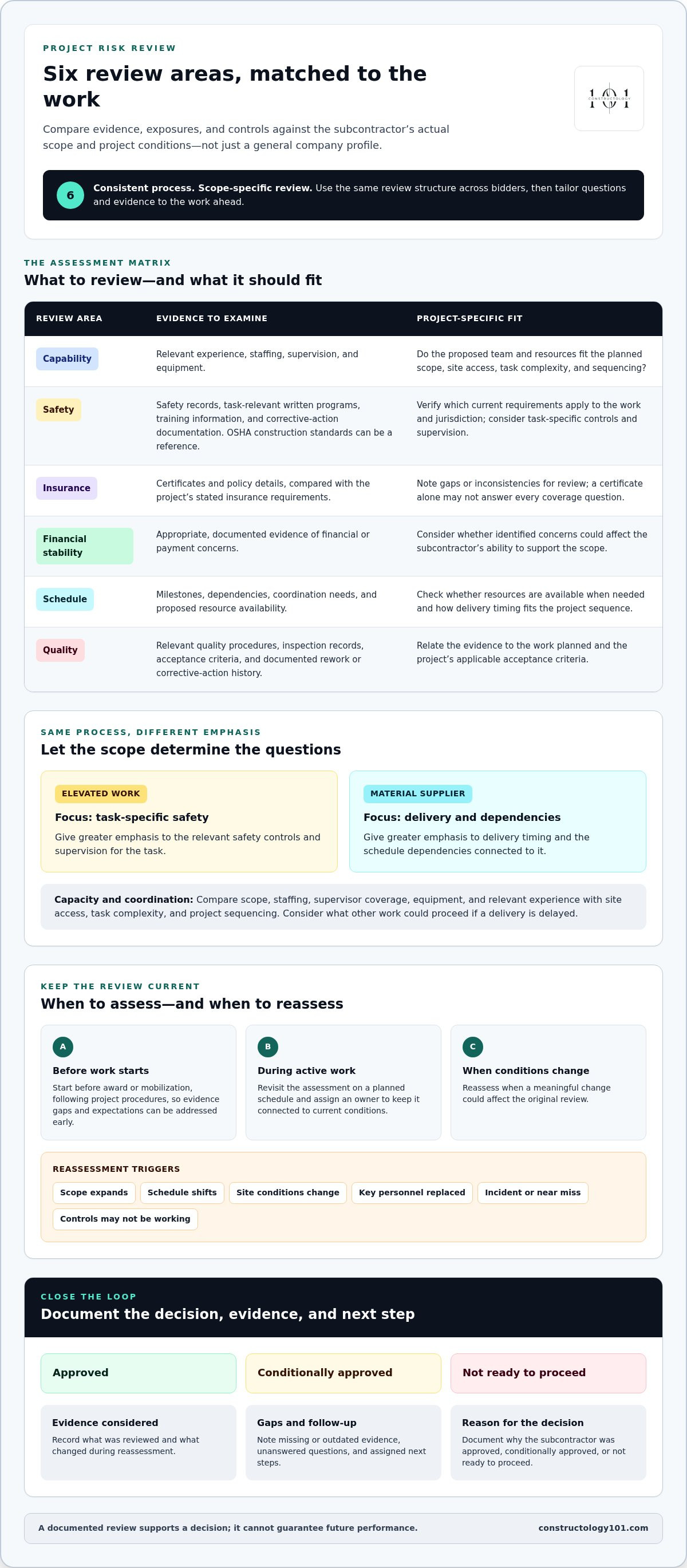
Start before award or mobilization, following your project procedures. Early review gives the team time to resolve evidence gaps and align expectations before work begins. Revisit the assessment during active work on a planned schedule and whenever meaningful changes could affect the original review.
Set clear triggers and assign an owner. Reassess when the scope expands, the schedule shifts, site conditions change, or key personnel are replaced. Incidents, near misses, or signs that controls aren’t working can also prompt a review. Record what changed, what evidence was considered, and what action follows. This keeps the assessment connected to current project conditions instead of leaving it as a one-time approval document.
What to Review: Core Categories in a Subcontractor Risk Assessment Checklist
Build the review around the work being performed, not a generic company profile. A subcontractor handling elevated work presents different exposures from one supplying materials or completing interior finishes. For each category, note the evidence that matters, the project-specific concern it addresses, and any unanswered question that needs follow-up. For example, a review of a material supplier may focus on delivery timing and schedule dependencies, while a review of elevated work may place greater emphasis on task-specific safety controls and supervision.
Review capability, safety, insurance, financial stability, schedule, and quality in proportion to the subcontractor’s scope and project conditions. This gives the team a consistent structure without treating every category as a one-size-fits-all compliance test.
- Capability: Compare relevant experience, staffing, supervision, and equipment with the work planned. Check that the proposed team and resources fit the scope, not just the firm’s general profile.
- Safety: Review safety records, task-relevant written programs, training information, and corrective-action documentation. Use OSHA’s construction standards as a reference, and verify which current requirements apply to the work and jurisdiction.
- Insurance: Compare certificates and policy details with the project’s stated insurance requirements. Note gaps or inconsistencies for review rather than assuming a certificate answers every coverage question.
- Financial stability: Consider appropriate, documented evidence of financial or payment concerns that could affect the subcontractor’s ability to support the scope.
- Schedule: Review milestones, dependencies, coordination needs, and whether proposed resources appear available when required.
- Quality: Consider relevant quality procedures, inspection records, acceptance criteria, and documented rework or corrective-action history.
Company Capacity, Scope, and Schedule
Start with the proposed work. Compare the scope, staffing plan, supervisor coverage, equipment, and relevant experience with site access, task complexity, and project sequencing. For example, if several crews depend on a delivery, confirm how the proposed delivery timing fits the sequence and identify what other work could proceed if it is delayed. A tight work window can make crew availability and coordination with adjacent trades central to the review, even when the subcontractor has completed similar work elsewhere.
Write down assumptions, exclusions, and scope interfaces. If responsibility for temporary protection or a handoff between trades isn’t clear, record the gap and assign follow-up before it becomes a field dispute. Also note who owns each interface and what needs to be resolved before the related work starts.
Safety, Insurance, and Financial Evidence
Match safety records and written programs to the hazards of the assigned work. Look for evidence of how corrective actions were handled, not only whether a document exists. For federally covered projects, the Federal Acquisition Regulation (FAR) Subcontracting Policies offer a procurement-specific reference; they shouldn’t be treated as a universal checklist for every project.
Keep evidence current and relevant. Record the insurance details reviewed, the requirement they relate to, and any unresolved issue. For financial concerns, document the basis for the concern and how it could affect performance, rather than relying on impressions. A well-organized subcontractor risk assessment checklist makes these distinctions easier to compare and explain.
Once the review criteria are set, use construction-industry directories and professional networks to discover and connect with potential subcontractors. Constructology 101’s interactive directory listings let construction professionals showcase their specific services and skills. Treat discovery as a starting point, not a substitute for project-specific due diligence.
How to Compare Subcontractor Risks Without Overtrusting a Score
A rating can help a project team decide what to discuss first, but it can also hide important differences if it’s treated as the whole assessment. A subcontractor risk assessment checklist should pair any likelihood-and-impact rating with the evidence behind it, the exposure created by the specific work, and the controls already in place.
A risk score is a prompt for action, not a verdict on a subcontractor or a prediction of exactly what will happen. Use it to direct attention, assign follow-up, and record decisions. Don’t let an average score bury a high-consequence issue or turn missing information into an assumption that everything is fine.
A Practical Likelihood-and-Impact Rating Method
Define rating terms before comparing subcontractors. For example, likelihood might mean unlikely, possible, or likely under the project conditions; impact might mean limited, serious, or severe consequences if the event occurs. These are working descriptions, not a universal scale or compliance standard. Use documented project facts and assumptions to support each rating, and set escalation thresholds through your organization’s own project-risk process.
Context changes the rating. A delivery delay may have limited effect when another task can proceed, but create a major sequencing problem if several crews depend on that delivery. Likewise, a site access constraint can raise exposure for one scope while having little bearing on another. Record the reason for the rating, not just the label.
Compare Evidence, Gaps, and Controls Side by Side
Keep the comparison practical. For each issue, capture the category, evidence reviewed, gap or concern, existing control, action owner, and review date. This makes it easier to see what’s supported, what needs clarification, and who is responsible for moving the review forward.
- Evidence: Name the document, record, or project information reviewed and note its date or scope where relevant.
- Gap: State what’s missing or unclear without treating that absence as proof of a performance failure.
- Control: Record the measure that reduces exposure and identify any remaining risk.
- Owner and review date: Assign follow-up to a role or person and set when the issue should be revisited.
Keep uncertainty visible. Missing documentation is an evidence gap; a documented incident or unresolved corrective action is a different kind of concern. Both may need follow-up, but they shouldn’t be described as equivalent. An unavailable schedule detail calls for clarification, for example, while repeated missed milestones documented on similar work may warrant a closer look at capacity and coordination.
Compare like with like, then explain meaningful differences. One subcontractor may have complete documentation but a scope that creates greater site exposure; another may present a simpler scope but leave a key control unclear. Preserve those details instead of compressing them into a single number. The result is a rating people can question, understand, and act on.
A Step-by-Step Subcontractor Risk Assessment Checklist for Project Teams
Turn the review into a workflow the team can repeat. A subcontractor risk assessment checklist should be detailed enough to support a defensible decision, but flexible enough to fit the project’s size, scope, and established procedures. A smaller, limited-scope package may need a focused review; complex or high-exposure work may call for more evidence, reviewers, and follow-up.
Use these steps to move from preparation to a documented decision:
- Set the assessment scope. Identify the subcontractor, work package, project conditions, assessment date, and reviewer. Note which internal procedures apply and what evidence is needed for this scope.
- Collect and organize evidence. Gather the relevant records and project information. Label what was reviewed, its date or coverage period where applicable, and any items still outstanding.
- Review the findings against the work. Consider how the evidence relates to the actual task, site, interfaces, and schedule. Separate verified information from assumptions, open questions, and missing documentation.
- Assign follow-up actions. For each gap, name an accountable owner, specific action, due date, and status. Escalate issues through your organization’s project-risk process when they exceed agreed thresholds or need a decision beyond the reviewer’s authority.
- Record the decision and revisit it. Document approval, any conditions or revised controls, remaining open issues, and the reason for the decision. Set a review point if unresolved items or changing conditions could affect readiness.
Complete and Document the Assessment
Make the record clear enough for someone who wasn’t part of the discussion to follow. State the scope reviewed, who completed the assessment, when it was completed, and which project conditions shaped the review. Describe evidence factually. For example, write “training record not received by the review date,” rather than assuming training did not occur. This distinction keeps the file accurate and makes follow-up specific.
Track actions to closure. “Resolve insurance question” is hard to manage; “compare the policy detail with the project requirement and record any gap” gives the owner a defined task. Update the status and note what evidence or decision closed the item.
Decide, Communicate, and Preserve the Record
An unresolved concern doesn’t always lead to the same outcome. Depending on its nature and your procedures, the team may need to escalate it, add or revise controls, pause a decision, or document why proceeding is acceptable. Don’t bury open issues in a general approval note. State any conditions, who owns them, and how relevant expectations will be shared with project stakeholders through established processes.
Keep the assessment and supporting records together in the project’s designated location. That creates a useful history for later reviews and helps the team explain what it knew and decided at the time. For broader partner-selection context, use your published guide to finding reliable construction partners alongside this project-specific process.
For discovery and professional connections, explore Constructology 101’s construction directory and network. Use your documented project review to decide whether a potential subcontractor fits the work.
Keep Subcontractor Risk Current Through Project Changes and Industry Connections
An assessment describes conditions at a point in time. As work progresses, those conditions can shift. A new work package may add hazards, a delayed milestone may compress the schedule, or a change in supervision may affect coordination. Keep the subcontractor risk assessment checklist active by connecting review triggers to regular project routines, not just the initial approval.
Triggers for Reassessment and Corrective Action
Agree on who owns reassessment and what changes should trigger it. Reopen the review when scope, supervision, schedule, staffing, or site conditions materially change. Also consider incidents, repeated deficiencies, and corrective actions under established company procedures. A trigger doesn’t automatically mean a subcontractor is unsuitable; it signals that the team should check whether its earlier assumptions and controls still fit.
For each reassessment, record what changed and what evidence was reviewed. Update the risk owner, mitigation, open actions, and next review date. If a crew change affects a critical task, revisit relevant capacity and coordination assumptions rather than carrying forward a rating based on the former team. Close actions only when the responsible person has documented the outcome.
Build these checks into existing routines, such as coordination meetings or scheduled project reviews. Make the process clear: who raises a change, who assesses its effect, and who can approve revised controls. That way, new information reaches the people responsible for decisions before an outdated assessment becomes the default.
Use Professional Networks for Discovery, Not Risk Verification
Industry connections can help teams discover construction professionals whose services may fit a project. A directory listing can introduce a business and show how it presents its work; professional networking can support communication and the sharing of project information. Neither is a substitute for reviewing evidence against the specific scope, site, and project requirements.
Constructology 101 provides interactive directory listings for construction professionals and businesses, alongside networking, project-sharing, and messaging tools for members. Use these channels to make connections and exchange information, then keep project approval grounded in your own documented due diligence. Listings and network activity aren’t proof that a subcontractor has been screened, certified, or risk-assessed.
Strong working relationships also depend on clear communication over time. Set expectations, share relevant updates through established project channels, and make it easy to raise changes or concerns. For more context, connect these practices with your guide to construction business relationship management. If you’re exploring directory options, your national construction directory guide can provide additional context on using directories for discovery.
Keep the distinction clear: connections help teams find and communicate with construction professionals; project teams remain responsible for assessing fit, reviewing evidence, and tracking changes. Connect with construction professionals through Constructology 101.
Make Your Next Project Start With Clearer Connections
Use the subcontractor risk assessment checklist as a working tool, not a form to file away. The next step is to build stronger professional connections while keeping project decisions grounded in your own review. Better communication between construction professionals can make it easier to share relevant project information and keep conversations moving as needs evolve.
Constructology 101 brings construction businesses and professionals together through interactive directory listings, project sharing, and integrated messaging. These tools support discovery and networking; your team remains responsible for assessing subcontractor fit and evidence for each project.
Build your construction-industry connections with Constructology 101’s interactive directory and professional network.
Frequently Asked Questions
Can a subcontractor risk assessment checklist guarantee a subcontractor will perform safely?
No. A subcontractor risk assessment checklist organizes information available at the time of review, but it can’t guarantee future conduct or outcomes. Documents provide evidence to consider; project-specific controls address identified exposures; ongoing supervision helps the team notice when conditions or work practices change. For example, a reviewed safety plan doesn’t show whether a control is followed on every shift. Follow your organization’s procedures and applicable professional guidance, and don’t treat the checklist as legal or safety advice.
How often should a subcontractor risk assessment be updated?
There’s no universal review interval. Set timing according to company procedures, project duration, scope, and exposure. A longer project may call for scheduled reviews, while a short, limited task may need fewer planned checkpoints. Reassess sooner after a meaningful change, incident, or new evidence, such as a revised work sequence. Record the review date, responsible owner, updated controls, and unresolved items so the team can see what changed and what still needs action.
What documents are useful for assessing subcontractor risk?
Useful records can include scope and schedule details, relevant safety documentation, insurance certificates, qualifications related to the assigned work, and corrective-action records. A project involving specialty equipment may also need information that helps reviewers understand the planned resources and interfaces. Evidence needs vary by scope, project, and organizational procedures. Keep a record of what was reviewed and when. If an item is missing, label it as missing rather than treating the absence alone as proof of a confirmed deficiency.
What is the difference between subcontractor prequalification and risk assessment?
Prequalification generally looks at baseline capability before selection, such as whether a firm meets an organization’s initial criteria. Risk assessment focuses on exposures and controls in the context of a particular project and scope. A team may combine the reviews or complete them at different stages, depending on its process. Neither guarantees performance. Contract terms, project controls, and ongoing oversight address other parts of managing the working relationship.
Should a team reject a subcontractor because of one high risk rating?
Not automatically. Treat a high rating as a reason to examine the underlying evidence, potential severity, work scope, and available controls. A concern may be reduced through a practical mitigation, or it may remain unacceptable under your organization’s thresholds. Document the options considered, remaining exposure, and decision rationale. If the issue can’t be resolved within the reviewer’s authority, escalate it through the organization’s established process before proceeding.
Who should complete a subcontractor risk assessment?
A suitable reviewer is someone familiar with the work scope and the organization’s procedures. Depending on the concern, the project team may involve safety, insurance, financial, or other relevant specialists to contribute focused input. Responsibilities differ across organizations, so define who leads the review and who advises. Name an accountable owner and record contributors, decisions, and assigned follow-up. This makes it clear who should act when new information arrives or an open item remains unresolved.
Does an online construction directory verify subcontractors?
No. An online construction directory can help people discover and connect with industry professionals, but a listing shouldn’t be treated as proof of qualifications, insurance, safety, or past performance. Constructology 101 is a construction-industry directory and professional network where businesses can showcase services, and members can share project information and communicate. Use those connections for discovery, then assess a potential subcontractor’s evidence against your project requirements before making a decision.


