

What if the biggest prequalification risk isn’t a missing document, but asking every subcontractor for the same evidence regardless of the work? A practical subcontractor prequalification checklist starts with the project. It helps you focus on relevant risks, compare firms consistently, and avoid creating a paperwork pile that doesn’t clarify your decision.
A thorough review matters, but safety, financial, and technical details can be difficult to compare when projects or reviewers use different standards. Asking for more information than the work requires can burden smaller firms without giving your team a clearer picture. The better approach is to request evidence that answers specific questions about the proposed scope.
This guide shows you how to build a repeatable, project-specific review. Use the checklist to assess key qualifications, tailor evidence requests to the work and its risks, and record decisions and follow-up actions. An industry directory can help you discover relevant firms and start professional conversations, but it does not replace project-specific due diligence. Keep discovery and qualification distinct, and make each decision clear, consistent, and defensible.
Key Takeaways
- Define the work and project risks first so each requested document supports a clear qualification decision.
- Use a subcontractor prequalification checklist to sort evidence by category and mark each item required, conditional, or not applicable.
- Compare firms with a simple matrix that captures criteria, supporting evidence, reviewer notes, and status.
- Assign category reviewers and a decision owner to keep the process clear from the initial request through the documented outcome.
- Use professional directories to discover relevant firms and build connections, then conduct a separate, project-specific qualification review.
What Is a Subcontractor Prequalification Checklist, and What Should It Decide?
A subcontractor prequalification checklist is a structured, documented review of whether a firm appears suited to perform defined work. It helps a hiring team make an informed decision before moving forward, but it cannot predict every job outcome. Treat it as an early risk screen: define what the project needs, review relevant evidence, and record what that evidence supports and what still needs follow-up.
Set the review around the trade, scope, schedule, and project exposure. A firm being considered for limited, low-exposure work may need a different level of review from one taking on complex work with demanding coordination or significant safety considerations. Apply the same decision logic to comparable firms, but tailor the evidence request to the assignment. This keeps screening consistent without requiring every company to complete an unnecessarily broad package.
What does subcontractor prequalification assess?
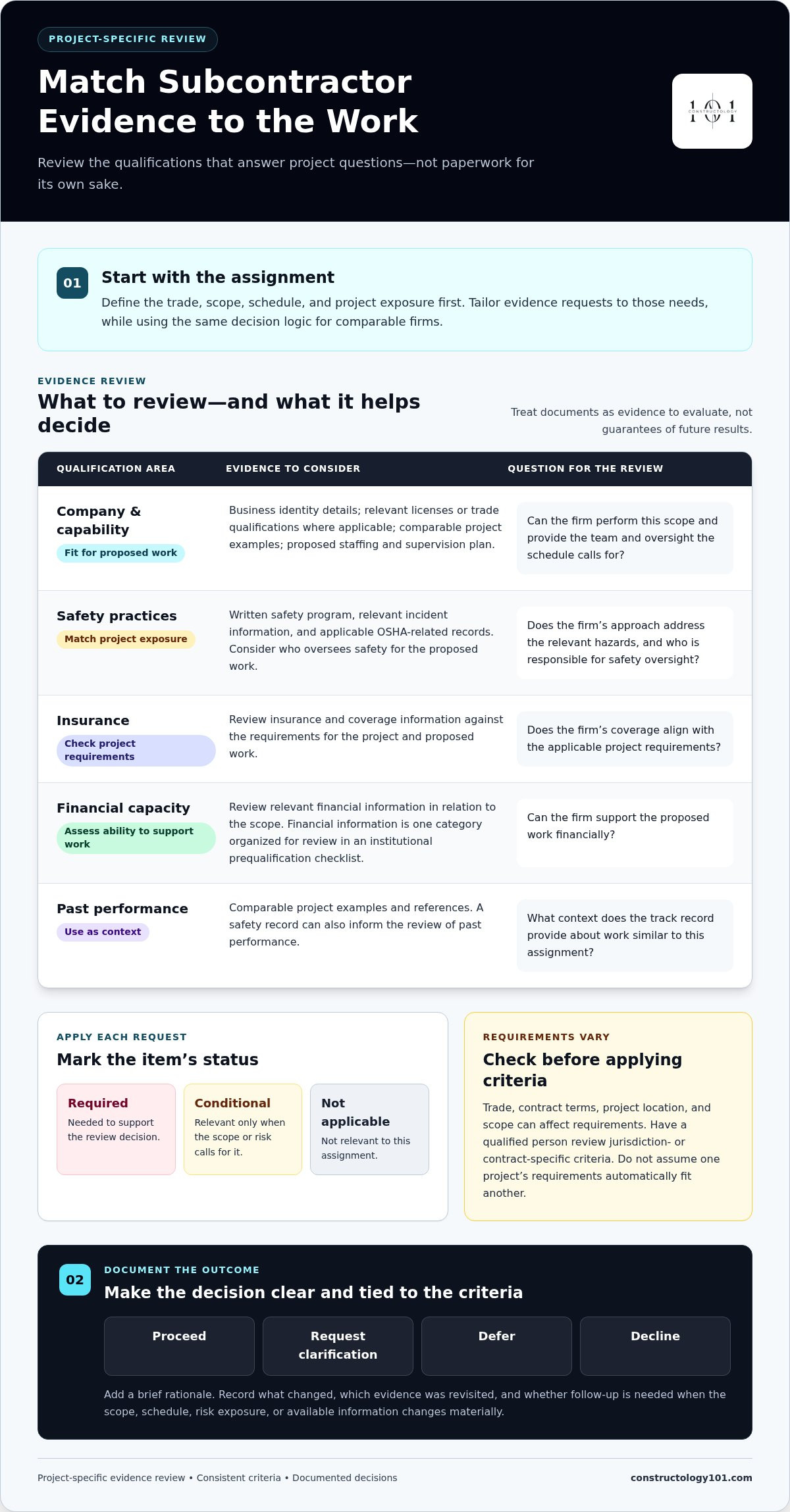
Prequalification commonly examines capability, safety practices, insurance, financial capacity, and past performance. Each category answers a different question: Can the firm perform this scope? Does its approach address relevant hazards? Does its coverage align with project requirements? Can it support the work financially? Does its track record provide useful context?
Supporting documents are evidence to evaluate, not guarantees of future results. A safety record, for example, can inform a review of past performance, but it cannot ensure safe work on a future site. General background on Pre-qualification describes its use in evaluating organizations, including subcontractors. For a project review, turn each evidence item into a decision question rather than treating document collection as the decision itself.
When should a general contractor use a checklist?
Use screening at the decision point it is meant to support. Before a bid invitation, an initial review can help determine whether a firm is an appropriate candidate to pursue. Before award, review current information that relates to the scope and selection decision. Before mobilization, confirm project-specific onboarding and contract requirements separately. These steps have different purposes, so passing an early screen does not automatically satisfy later requirements.
Refresh the review when the proposed work, schedule, risk exposure, or available information changes materially. A firm’s qualifications for one trade package, for example, may not answer questions raised by a different scope or a tighter sequence of work. Record what changed, what evidence you revisited, and whether follow-up is needed. Teams developing a broader approach to assessing potential trade partners can also use this reliable construction partner checklist as a related resource.
Make the outcome clear: proceed, request clarification, defer, or decline. Add a brief rationale tied to the project’s criteria. That record makes the review easier to explain and repeat while leaving room for project-specific judgment.
Subcontractor Prequalification Checklist: Documents and Evidence to Review
A useful subcontractor prequalification checklist connects every request to a decision. Before collecting paperwork, note what you need to determine, which evidence could inform that decision, and whether the item applies to this scope. Mark each request required, conditional, or not applicable. This gives reviewers a consistent starting point and helps avoid blanket requests that add effort without clarifying project risk.
Requirements can depend on trade, contract terms, project location, and scope. Flag licensing, insurance, and other jurisdiction- or contract-specific criteria for review by a qualified person before using them. Do not assume that requirements for one project automatically fit another.
Company, trade, and project-capability evidence
Start with records that identify the business and show its fit for the proposed work. Request business identity details and relevant licenses or trade qualifications where applicable. Then look beyond labels: ask for comparable project examples, references, proposed staffing, and the supervision plan. Each item should answer a practical question, such as whether the firm has handled similar work or can provide the team and oversight the schedule calls for.
Assess capacity against the actual scope and timeline, not company size alone. A smaller firm may have the right experience and available crew for a focused package. A larger firm may still need to show that the people and supervisors proposed for this job are available. References can add context, but they do not replace a review of the proposed team and approach.
Safety, insurance, and financial documentation
Match evidence requests to the project’s exposure, and review similar submissions using the same criteria. The North Carolina State University Contractor Pre-qualification Checklist is one example of an institutional checklist that organizes financial, insurance, and organizational information for review.
- Safety: Review the written safety program, relevant incident information, and applicable OSHA-related records. Use consistent questions to understand how the firm manages hazards and who oversees safety for the proposed work.
- Insurance: Collect current insurance documentation and compare it with the applicable contract requirements. Record any gap or clarification needed rather than treating a certificate as a complete risk review.
- Financial capacity: Request financial or payment-capacity information only to the extent it supports a project decision. Limit access to sensitive records and store them appropriately.
An EMR, certificate of insurance, or W-9 can inform a review, but none alone establishes overall capability or approval. Note what each item supports, what remains unclear, and who should resolve the question. Keep discovery separate from qualification: an interactive directory listing of construction businesses can help teams find firms and learn about their services, while project-specific due diligence remains a separate step.
How to Compare Subcontractor Qualifications Without a One-Size-Fits-All Score
A comparison matrix helps reviewers apply the same process without pretending every project has the same priorities. Build it around the decision the team needs to make. The subcontractor prequalification checklist can supply the criteria, while the matrix records what each firm’s evidence shows, what remains unresolved, and who reviewed it.
Keep the format simple. Include a criterion, the evidence reviewed, reviewer notes, and a status such as meets, follow-up needed, exception approved, or does not meet. Add a weighting or priority field only when it helps explain the project’s decision. Avoid relying on a single total score that could hide a serious concern behind strong results in unrelated categories.
- Safety: Record the project-relevant evidence and whether it addresses the hazards in the proposed work.
- Capability: Note comparable experience, proposed supervision, and whether the firm can staff the defined scope.
- Schedule: Compare availability and sequencing needs against project milestones and work interfaces.
- Financial factors: Document only the information needed to assess the firm’s capacity for this package and the basis for that assessment.
Risk-based prequalification matches the depth and weight of each requirement to the subcontract work’s exposure. Use that principle to set criteria before reviewing submissions, not after seeing which firm is under consideration.
How should teams set project-specific review criteria?
Start with the scope, hazard exposure, schedule, interfaces with other trades, and contract obligations. Then decide which criteria are essential, which deserve greater weight, and which are irrelevant. Routine, limited work may call for a focused review of relevant capability and basic project requirements. Higher-consequence work may justify closer scrutiny of safety practices, supervision, coordination, and financial capacity. Set minimum thresholds only when the project has a clear reason, and document that reason.
For example, if a subcontractor’s work depends on a tightly sequenced handoff, schedule readiness and coordination may matter more than broad company history. If the scope involves specific safety exposures, give relevant safety evidence greater attention. Let the work determine the weighting, rather than relying on a template’s default settings.
How can reviewers interpret gaps and red flags fairly?
Separate an incomplete record from evidence of a substantive concern. A missing attachment may be correctable; conflicting information about available supervision or relevant experience may require closer review. Give firms a consistent chance to clarify gaps, set a clear follow-up date, and record the response. Do not mark “unknown” as “failed” without review, but do not treat an unanswered question as resolved.
For each exception, note the criterion, evidence, rationale, approver, and any condition attached to the decision. If a firm proceeds subject to clarification or another requirement, identify who owns the follow-up and when it must be completed. This creates a transparent decision trail, supports consistent comparisons across reviewers, and makes it easier to revisit the judgment if project conditions change.
A Repeatable Subcontractor Prequalification Workflow, From Request to Review
A clear workflow keeps requests organized and gives each reviewer a defined role. Use the same sequence for every review while tailoring the evidence to the project. A subcontractor prequalification checklist works best when it tracks not only what was requested, but also who reviewed it, what needs follow-up, and who owns the final decision.
- Define the review. Confirm the scope, key project risks, decision point, and contract requirements. Identify which checklist categories apply and set a response window that fits the project schedule.
- Assign ownership. Name a reviewer for each category, such as safety, insurance, or technical capability. Assign one decision owner to consider the full review and resolve conflicts between recommendations.
- Send one organized request. Provide the project-specific checklist, submission instructions, due date, and a contact for clarification. Label conditional items clearly so firms can see what applies to their proposed work.
- Track submissions. Log each request, receipt date, missing item, and follow-up question against its checklist criterion. Use a consistent, secure process for collecting sensitive records and limit access to people who need them.
- Review and clarify. Have category reviewers record findings and distinguish incomplete information from a confirmed concern. Route conflicting or unclear evidence for follow-up before the decision owner reaches an outcome.
- Document the decision. Record the approval status, reviewers, date, rationale, conditions, and any outstanding action. Share the outcome with the people responsible for the next project step.
How to request and review information efficiently
One clear request reduces scattered emails and missed details. Use consistent file labels or submission fields so reviewers can find evidence quickly, and state how firms should raise questions. Keep a dated follow-up log linked to the relevant criterion. This keeps a clarification with the evidence it explains and lets reviewers see whether the response addressed the original question.
How to document decisions and keep qualifications current
Qualification records need a useful review point, not just an approval date. Revisit evidence when the scope or contract conditions change, or when a document’s validity changes. Keep these records distinct from onboarding, site safety orientation, and contract administration, since each serves a separate purpose. If a decision includes conditions, name the owner and track completion before the related work proceeds.
A repeatable workflow moves from defined scope to evidence request, review, clarification, and a documented decision. It improves consistency and records the judgment made, but it cannot eliminate project risk. To discover construction businesses and build professional connections before a formal review, explore construction industry directory listings.
Using a Subcontractor Prequalification Checklist Alongside Professional Discovery
Finding a firm whose trade and services appear relevant is a useful starting point, not a qualification decision. Discovery helps teams identify potential connections and learn what businesses say they do. A subcontractor prequalification checklist serves a different purpose: it helps assess a firm’s fit for defined project work using consistent, documented criteria. Keep these steps distinct so a profile, introduction, or positive conversation does not substitute for project-specific review.
Where industry discovery fits in the hiring process
Use trade and service information to build an initial pool of firms that may suit the scope. Then apply the same project-specific review to each candidate, checking relevant evidence against the work, schedule, and contract needs. Discovery can start a conversation, but it cannot establish that a firm meets project requirements. Teams exploring how directories support business connections can also review this guide to choosing a national construction directory.
Constructology 101 is an interactive construction-industry directory and professional network. Its listings let construction businesses showcase their skills and services. Members can share project information and communicate through integrated messaging. These features support professional discovery and relationship-building; the hiring team remains responsible for its own review and decision.
Turn a checklist into stronger construction connections
Professional communication makes discovery more useful. Be clear about the type of work under consideration, the project context you can share, and the information needed for the next step. Keep requests focused and respect sensitive details. For firms, accurate service information and relevant project sharing can help others understand where a conversation may make sense, but visibility and networking are not qualification guarantees.
- Discover: Use trade and service information to identify firms that may align with the scope.
- Connect: Share relevant project context and communicate clearly about potential fit.
- Review: Apply your documented project-specific process before making a decision.
That separation creates a practical path from an initial connection to a defensible review. A directory can broaden professional awareness and make it easier to start industry conversations; the checklist helps your team evaluate fit for specific work. Neither step should be confused with the other.
Explore Constructology 101’s construction professional network to discover construction businesses, share project information, and build professional connections.
Build Better Connections Into Your Next Project
Make your next step a learning loop. After each project, note which review criteria helped your team make a clear decision and where requests or follow-up could be sharper. Use those lessons to refine the next subcontractor prequalification checklist, keeping requirements tied to the work rather than adding steps by habit.
Strong project relationships also begin before a formal review. Constructology 101 brings construction businesses and workers together through interactive directory listings, project sharing, and integrated member messaging. Pioneer Membership provides access to networking and project-sharing features, creating more ways to build professional connections alongside your qualification process.
Take the next step: explore Constructology 101 and connect with construction professionals. Keep your screening focused, your conversations clear, and your process ready to improve with each project.
Frequently Asked Questions
What documents should a subcontractor include in a prequalification package?
A prequalification package should include the information needed to assess the proposed work, not a fixed bundle for every trade. Depending on the project, a firm might provide a company profile, relevant licenses, comparable project references, staffing and supervision details, safety information, current insurance documents, and financial details. Use a cover sheet to identify the project, submission date, and document versions. This helps reviewers spot outdated or mismatched records.
Is subcontractor prequalification the same as contractor onboarding?
No. Prequalification helps a team decide whether a firm appears suitable for consideration or award; onboarding prepares an approved firm to participate in a specific project. Onboarding may cover site access procedures, orientation scheduling, points of contact, and project-specific communication. Keep these records and decisions distinct. A firm can pass a qualification review but still need to complete onboarding steps before beginning work.
Can a small subcontractor qualify without a long project history?
Yes. A short company history does not automatically show that a firm lacks the ability to perform. Review evidence suited to its experience, such as the proposed crew’s trade background, the supervisor’s relevant work, references from comparable assignments, and capacity for the defined scope. A smaller or less complex package may offer a reasonable way to evaluate fit. Apply the same criteria to each candidate while accepting relevant evidence that reflects the firm’s actual structure.
How often should subcontractor prequalification information be reviewed?
Review information when it matters to a new decision, rather than relying on one approval indefinitely. Revisit the file before a new project if the scope, schedule, contract terms, or risk profile differs from the earlier review. Check time-sensitive documents when they are needed and request updates when details have changed. A review date or reminder tied to specific document validity can help teams avoid relying on stale information.
What happens if a subcontractor’s insurance or safety documents are incomplete?
First, identify exactly what is missing and whether it prevents a decision under the project’s requirements. Ask for the relevant document or clarification, record the request, and leave the item unresolved until the evidence is reviewed. If required information remains incomplete, the decision owner may need to defer approval or determine that the firm cannot proceed under the applicable terms. Do not treat an unanswered requirement as satisfied.
Does an EMR score alone determine whether a subcontractor is qualified?
No. An EMR is one data point, not a complete picture of safety practices or project fit. Review it alongside relevant incident information, written safety procedures, supervision plans, and the hazards associated with the proposed work. If a score appears inconsistent with other evidence, document the question and seek context before drawing a conclusion. A single metric should not replace a review of how the firm plans to manage the specific scope.
Does a directory listing prove that a subcontractor has been prequalified?
No. A directory listing can help construction professionals discover a firm and learn about its stated services, but it does not establish that the firm has passed a project-specific review. Treat directory information as a starting point for professional discovery. If you are considering a firm for a job, assess its qualifications using your own documented criteria and evidence relevant to that project. A listing and a qualification decision serve different purposes.


