

A low bid or trusted referral can open the door, but neither proves a subcontractor is ready to deliver. Knowing how to vet a new subcontractor means checking evidence of qualifications, reliability, and project fit, not relying on first impressions or paperwork alone.
Credentials and insurance documents can be difficult to assess, especially when a rushed decision could affect your schedule, safety, or payment process. A consistent, documented screening process helps you compare candidates against the same criteria and separate verified information from assumptions.
This guide covers the checks to complete before work begins, from reviewing qualifications and insurance to assessing safety practices, capacity, and relevant experience. You’ll also learn how to set expectations and keep useful records. A construction-focused directory can help you discover professionals and start industry connections, but a profile is only a starting point, not proof of credentials or performance. Use the steps ahead to make a considered decision and build a stronger working relationship.
Key Takeaways
- Learn how to vet a new subcontractor with a consistent process that weighs evidence, project risk, and fit.
- Review business details, trade qualifications, insurance documents, and safety records against the needs of the work.
- Compare candidates using the same criteria, and distinguish documented evidence from claims and open questions.
- Use a repeatable workflow to identify gaps, make a reasoned decision, and record your checks.
- Turn your decision into practical onboarding with written scope, milestones, communication routines, and change procedures.
Why vet a new subcontractor before project work begins?
A subcontractor can affect more than the quality of one trade’s work. Availability, coordination, safety practices, and paperwork can all influence the broader project. Vetting before assigning work gives you time to spot gaps and clarify expectations before a missed handoff or incomplete document creates a problem. Screening can’t remove every risk, but it makes your decision more deliberate and better supported.
Subcontractor vetting is the process of reviewing relevant evidence about a trade partner before assigning work, so you can assess their qualifications, reliability, and fit for the project. The word “subcontractor” covers different working relationships and specialties; the Definition of Subcontractor offers a useful starting point for understanding the term.
A referral, directory profile, or polished proposal can help you find a candidate and start a conversation. None establishes performance on its own. Compare each with documents, references, and project-specific details. A directory profile can show how a professional presents their services and skills, but visibility isn’t proof of qualifications or past results.
What does subcontractor vetting include?
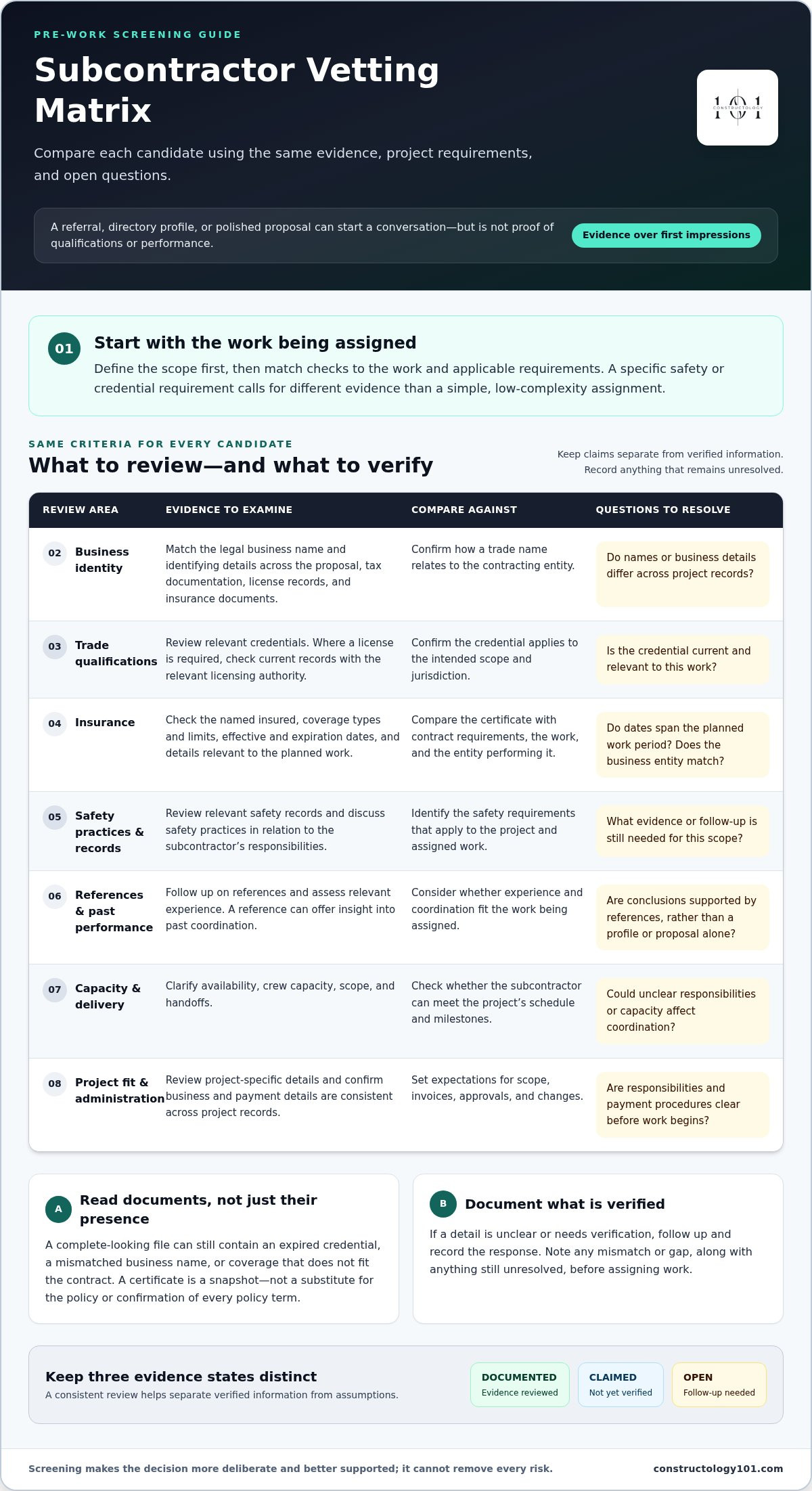
Separate the review into distinct checks: confirm business identity, assess trade qualifications, review insurance, follow up on references, evaluate capacity, and judge project fit. Each addresses a different question. A credential may confirm a qualification, while a reference can offer insight into past coordination. Neither alone shows that the subcontractor can meet this project’s scope and schedule.
Define the scope first, then match your checks to the work and applicable requirements. A task with specific safety or credential requirements calls for different evidence than a simple, low-complexity assignment. Keep claims separate from verified information, and note anything that remains unresolved.
Which risks should the screening process address?
Start with delivery. If the scope, handoffs, or crew capacity are unclear, coordination can falter and milestones may slip. Limited relevant experience can affect workmanship, while weak communication may leave questions about progress, changes, or responsibilities unanswered. Clarifying these areas before work starts gives both sides a stronger basis for planning.
Review insurance details against the assigned work. Expired coverage, a mismatch between the named business and the contracting entity, or coverage that doesn’t align with the project can leave important questions unresolved. Collecting a document isn’t the same as checking its dates, coverage types, limits, and scope. Record what you reviewed and any follow-up needed.
Payment administration deserves attention, too. Confirm that the business and payment details are consistent across project records, and define how invoices, approvals, and changes will be handled. These checks help prevent avoidable confusion after work begins. For a wider view of selecting and building relationships with trade partners, use this reliable construction partners checklist alongside your project-specific screening.
How to verify a subcontractor’s qualifications, insurance, and safety records
Build your document review around the work you’re assigning. Separate proof of business identity from evidence of trade skill, insurance, and safety practices. Each record serves a different purpose, and a complete-looking file can still contain an expired credential, a mismatched business name, or coverage that doesn’t fit the contract. As you decide how to vet a new subcontractor, compare each item with the planned scope and the requirements that apply to the project.
Review business identity, licenses, and trade qualifications
Start by matching the legal business name and identifying details across the proposal, tax documentation, license records, and insurance documents. If the subcontractor uses a trade name, establish how it relates to the contracting entity. Then compare credentials with the actual work. A qualification relevant to one specialty may not establish competence for another task. Where a license is required, check its status in the current records of the relevant licensing authority and confirm that it applies to the intended scope and jurisdiction.
For projects involving federal procurement, the Subcontractor Responsibility Standards provide a reference for assessing responsibility and ability to perform. Use that source in its federal acquisition context, not as a universal checklist for every private project. Licensing, insurance, and safety obligations can vary by project and jurisdiction, so identify the applicable rules before deciding which records to request.
Check insurance and safety documentation
Read the certificate of insurance for the named insured, coverage types, limits, effective and expiration dates, and details relevant to the planned work. Compare those details with the contract requirements and the entity performing the work. A certificate is a snapshot, not a substitute for the policy or confirmation of every policy term. If a detail is unclear or needs verification, follow up with the issuing agent and document the response.
Keep the review tied to the subcontractor’s actual responsibilities. For example, check whether the listed business entity matches the one signing the agreement and whether the coverage dates span the planned work period. Note any mismatch or gap and resolve it before assignment. Don’t assume that the presence of a document means the requirement has been met.
Safety records can help frame a useful conversation, but they don’t predict future performance on their own. Review available records consistently across candidates, then discuss context: the type of work involved, corrective actions taken, and current training and safety practices. Look for clear, specific answers and supporting information, not just a summary metric. A directory listing can help you discover construction professionals and start a connection, while qualification and document checks remain part of your independent review. Explore construction professional listings to find potential trade partners.
How to judge references, past performance, and project fit
A strong record matters most when it matches the work ahead. Compare each candidate against the same scope, schedule, coordination demands, and communication expectations. Consistent criteria help prevent a persuasive proposal or familiar name from outweighing relevant evidence. The goal isn’t to find a perfect match on paper. It’s to understand what the information supports and where questions remain.
Assess relevant project experience and capacity
Look for completed work that resembles the proposed assignment in trade, complexity, sequencing, and coordination. A subcontractor who has completed similar installations may have useful experience, but that similarity doesn’t guarantee results on your project. Ask what their team handled, how the work fit into the wider schedule, and what differed from your scope.
Then check whether that experience is available now. Discuss current workload, crew availability, equipment needs, and possible schedule constraints. A capable team may still be a poor fit if its people or equipment are committed elsewhere during a critical phase. Record examples and stated availability separately, then compare candidates using the same criteria.
Check references and communication habits
Request references connected to comparable scopes and recent working relationships. Use the same prompts for each reference so feedback is easier to compare. Ask how the subcontractor handled schedule coordination, responded to questions, communicated delays, resolved issues, and completed closeout. A reference offers firsthand context, but one positive account is only part of the picture. Consider how closely that project resembles yours and whether the feedback reflects direct experience.
Capture the review in a compact evidence matrix. Keep three categories distinct:
- Documented evidence: Examples of comparable completed work, agreed project dates, or written records that support a claim.
- Candidate claims: Statements about crew capacity, past results, or communication that haven’t been independently corroborated.
- Unresolved questions: Details still to clarify, such as who will lead coordination or how schedule conflicts would be communicated.
This format makes your reasoning visible. If a reference describes reliable communication but the candidate hasn’t explained who will be your day-to-day contact, record both points rather than treating one as an answer to the other. Look for patterns across references, not isolated praise or criticism, and distinguish firsthand feedback from someone else’s impressions.
For specialty-trade discovery, a plumbing subcontractor list and vetting guide can provide trade-specific context as you identify potential candidates. Use an introduction or profile as a starting point, then assess the person’s relevant experience, capacity, and fit against your project’s requirements. This evidence-based comparison is a practical part of how to vet a new subcontractor: it helps you make a decision you can explain, revisit, and document.
How to vet a new subcontractor with a repeatable step-by-step process
A defined workflow helps your team make comparable decisions, even when deadlines are tight. Start with the work and its requirements, then gather and assess evidence in the same order for each candidate. Consistent criteria make comparisons more defensible because each decision is based on the same project needs, not shifting standards or first impressions.
- Define the scope. Write down deliverables, schedule expectations, handoffs, communication needs, and project-specific requirements.
- Screen candidates. Check that each candidate’s stated services and experience appear relevant to the work.
- Collect evidence. Request the records and details needed to assess identity, qualifications, coverage, safety, capacity, and fit.
- Compare consistently. Use the same core criteria for each candidate, noting evidence separately from claims.
- Resolve gaps. Follow up on missing, conflicting, or unclear information before treating a requirement as satisfied.
- Decide. Choose go, pause, or decline based on thresholds set before comparing proposals.
- Document. Record the decision, supporting evidence, and any remaining actions in the project file.
Build a consistent screening checklist
Turn the scope into a checklist before reviewing candidates. Apply the same core items to everyone, adding project-specific checks where the work or applicable requirements call for them. Mark each item verified, pending, not applicable, or requiring follow-up. This status system shows what’s complete and keeps unanswered questions visible during a busy bid process.
When time is limited, prioritize checks by consequence and dependency. Address applicable requirements and any gap that could affect safe performance, authorization, or the ability to start work first. Then schedule remaining follow-ups according to their impact on coordination and delivery. A short timeline is a reason to focus the review, not to assume an unresolved material requirement is acceptable.
Make a documented go, pause, or decline decision
Set decision thresholds before reviewing bids. For example, decide which requirements must be verified and which concerns can be resolved through follow-up. Keep those standards steady across candidates. If a material gap remains, pause the decision, describe its potential impact, and assign someone to obtain or review the missing information. Decline when a candidate doesn’t meet a requirement you’ve established as essential.
Keep a compact decision record with four fields:
- Evidence reviewed: Identify the documents, references, or project details considered.
- Open questions: State what still needs clarification.
- Owner: Name the person responsible for follow-up.
- Next action: Record the action and when the decision should be revisited.
Keep this record with the project documents so the decision remains clear as work moves forward. To discover construction professionals and begin industry connections, explore the construction professional directory, then apply your screening process to each potential fit.
Turn a successful vetting decision into a clear subcontractor onboarding
A sound screening decision is only the start. Put agreed expectations into clear instructions before work begins. A written handoff helps the subcontractor understand the scope, schedule, communication channels, and process for handling changes. It also gives your team a shared reference when questions arise during delivery.
Set expectations before the first day of work
Review the agreement together and confirm where the subcontractor’s responsibilities begin and end. Clarify how the work fits into the project sequence, what site coordination is required, and who will share progress updates. Define how changes, delays, and urgent issues should be communicated, including who has authority to respond or approve next steps.
Put the working routine in writing. Include practical details such as:
- Scope and milestones: State deliverables, key dates, dependencies, and how completion will be recognized.
- Contacts and reporting: Name the day-to-day points of contact and agree on the format and timing of updates.
- Changes and escalation: Explain how proposed changes are documented and how urgent issues are raised.
- Payment and closeout: Align invoice support, approvals, and closeout records with the project’s agreed contract process.
These details reduce the chance that each party is working from a different understanding. Keep the language practical, and make sure everyone knows where to find the current instructions.
Maintain an evidence-based working record
Keep the documents that support the working relationship in one accessible project record. Store the approved scope, schedule versions, decisions, approvals, and follow-up responsibilities together. Label revised documents clearly so the team can distinguish current instructions from superseded copies. As work progresses, log deliverables, schedule updates, and documented changes against the relevant milestone.
If an issue arises, record what happened, when it occurred, who was involved, and what corrective action was agreed. Keep the language factual. For example, note when a delivery milestone changed and record the agreed response, rather than relying on general impressions about performance. This creates a useful reference for closeout and for evaluating future project fit.
A construction-focused directory can help you discover professionals and begin industry connections, but a listing is a starting point, not verification of credentials or performance. Once you’ve defined the trade, scope, and expectations you need, explore the construction professional network to connect across the industry. You can also connect with construction professionals as you build your next project relationship. Keep applying the same documented standards to every candidate. That consistency is central to how to vet a new subcontractor and carry a sound decision into the work itself.
Build stronger project relationships from here
Make each subcontractor relationship part of a stronger professional network. A clear working relationship can support the current project and help you build connections for future work. Keep communication open, document what matters, and carry forward the lessons that help your team collaborate with confidence.
Finding the right people is an ongoing part of construction work. Constructology 101’s interactive directory listings help construction professionals showcase their services and skills. Member messaging and project-sharing features give professionals ways to connect and exchange project context. Use those connections to discover potential partners, then apply your own project-specific screening before making a hiring decision.
Take the next step and Discover construction professionals and build stronger project connections. With a repeatable approach to how to vet a new subcontractor, you can make more deliberate choices and strengthen your network for future projects.
Frequently Asked Questions
How long does it take to vet a new subcontractor?
Timing depends on the project’s requirements, how quickly records are supplied, and whether anything needs follow-up. A straightforward review may move quickly; checking a trade-specific credential, confirming insurance details, or resolving conflicting business information can take longer. Build the review into project planning rather than leaving it until mobilization. If the start date is close, prioritize requirements that must be met before work begins and assign someone to track outstanding items.
What documents should I collect before a subcontractor starts work?
Collect the records required by your contract and project. These may include a signed agreement or work order, business and tax documentation, applicable trade credentials, insurance documentation, and relevant safety or training records. Keep the approved scope, schedule, site rules, and payment-submission instructions accessible to the people coordinating the work. Use a document checklist, note when each item was received, and make sure the project team can identify the current version.
Can a subcontractor’s insurance certificate be verified?
Yes. Treat the certificate as a starting point, then contact the issuing insurance agent or broker to clarify details that matter to the project. Confirm that the named business and coverage dates align with the subcontract, and ask whether the listed coverage reflects the requirements you’re checking. Keep a record of the confirmation and any follow-up. A certificate summarizes information, so don’t assume it answers every question about policy terms or endorsements.
What happens if a subcontractor’s insurance expires during a project?
Don’t assume the prior certificate continues to apply. Contact the subcontractor and request current documentation, then review the gap against the contract and project requirements. Escalate the issue to the person responsible for insurance review, and consult your insurance professional or legal adviser if the implications are unclear. Document the dates, communications, and decision before proceeding with affected work. Set reminders ahead of expiration dates to reduce the chance of a mid-project lapse.
Should I run a background check on a subcontractor?
Consider one only when it serves a clear project-related purpose, such as access to sensitive facilities or information. First decide what information is relevant, who will review it, and how the result could affect the decision. Apply the same approach to comparable candidates, protect personal information, and check applicable laws and consent requirements before starting. A background check is only one input; it doesn’t establish trade skill, reliability, or project capacity.
How many subcontractor references should I check?
There’s no universal required number. As a practical starting point, speak with two or three references tied to comparable work, if available, and look for consistent patterns rather than a perfect score. Ask each person about a different aspect of delivery, such as coordination, schedule communication, or closeout. If accounts conflict, follow up before drawing a conclusion. A reference reflects one person’s experience, so weigh it alongside records and project-specific evidence.
What is the difference between subcontractor prequalification and vetting?
Prequalification typically screens a pool of firms against baseline criteria before a specific opportunity, helping determine who may be considered for future work. Vetting examines a candidate in relation to a particular assignment, including its scope, timing, and project needs. In practice, prequalification can be an early filter, while how to vet a new subcontractor focuses on deciding whether that trade partner fits this job and what must be confirmed before work starts.


