

A finished project doesn’t automatically build a reputation. The work may be solid, the client satisfied, and the team dependable, yet future clients and industry partners may never see that proof. Learning how to build a construction business reputation means making reliable delivery visible and turning good project experiences into lasting trust.
Reputation is earned on the job. The challenge is carrying that trust beyond the site, gathering credible feedback, and staying connected with clients, peers, suppliers, and potential project partners. A polished online presence helps, but it works best when it reflects real performance rather than unsupported claims.
This guide gives you a repeatable plan for building trust before, during, and after each project. You’ll learn how to document your work, request and present client feedback credibly, strengthen professional relationships, and keep your business presence accurate and useful. You’ll also see how an interactive directory listing, project sharing, and professional messaging can support visibility as part of a broader reputation strategy.
Key Takeaways
- Learn how to build a construction business reputation by aligning what clients experience with the evidence they can see.
- Use clear scopes and realistic commitments to reduce avoidable misunderstandings throughout a project.
- Choose proof that fits the purpose: reviews, references, case studies, credentials, and directory profiles each show a different part of your business.
- Build a manageable routine for refreshing project examples, client feedback, and professional profiles.
- Use an accurate directory listing to present your services and stay visible to construction professionals.
How to Build a Construction Business Reputation That Clients Trust
Your construction business reputation is the judgment clients and industry peers form from what they experience and can verify. It reflects how you set expectations, communicate, deliver the work, and handle what comes next. Your brand identity is the impression you choose to present; your website is one place to present it; online ratings are one kind of feedback. None tells the whole story on its own.
The broader practice of reputation management includes shaping and responding to how others perceive an organization. For construction businesses, that work starts with project behavior. A profile or portfolio can make your capabilities easier to understand, but dependable conduct gives those claims substance.
Construction businesses earn reputations through repeated project behavior: what they promise, how they communicate, and whether they follow through.
What does reputation mean in the construction industry?
Different people see your business from different angles. A client may judge whether the scope was clear and progress updates arrived as expected. A subcontractor may value coordinated handoffs and prompt answers. A supplier may notice whether orders and changes are handled clearly, while peers may form impressions through shared projects and professional conversations.
Small actions add up. An accurate scope gives everyone a shared understanding of the work. A useful update explains a delay before it becomes a surprise. A clear closeout records completed work and outstanding items. These moments show how your business operates, beyond a polished website or a handful of ratings.
Why does a strong reputation matter beyond winning one contract?
Trust can make future conversations easier. A satisfied client may consider you for later work or mention their experience to someone looking for a construction professional. A supplier or peer who has seen you communicate reliably may be more comfortable discussing a potential project together. Reputation can support consideration, but it doesn’t decide every project.
That’s why how to build a construction business reputation is a question of consistency, not a one-time marketing task. Each interaction can reinforce credibility or create doubt: the first response to an inquiry, a scope clarification, a change discussion, or a final follow-up. Set realistic expectations, communicate steadily, and make follow-through visible. Over time, these habits give clients and industry contacts a clearer basis for deciding whether they trust your business.
Build Your Construction Reputation Through Reliable Project Delivery
Strong project delivery means more than completing the work. Clients also notice whether the process matches what they were told to expect. Clear scopes, realistic commitments, steady updates, and a thoughtful handoff help prevent small uncertainties from turning into trust gaps. These habits are central to how to build a construction business reputation through everyday work.
How should you set expectations before work begins?
Make the plan easy to understand. Clarify the scope, who is responsible for key decisions, how progress will be shared, and which milestones will guide the work. Use plain language and be specific about what your team can control. Avoid promising outcomes or timing that depend on factors outside your control.
When the scope changes, explain what’s different and how it may affect the schedule or deliverables. Record the revised agreement and next steps so everyone has the same reference point if questions arise later.
How do you protect trust during and after a project?
Keep clients informed as work progresses. Share concise updates that explain what’s complete, what comes next, and whether a decision or adjustment is needed. If an issue arises, raise it early, explain the relevant context, and identify the next step. Reliable communication makes professionalism visible, especially when plans need attention.
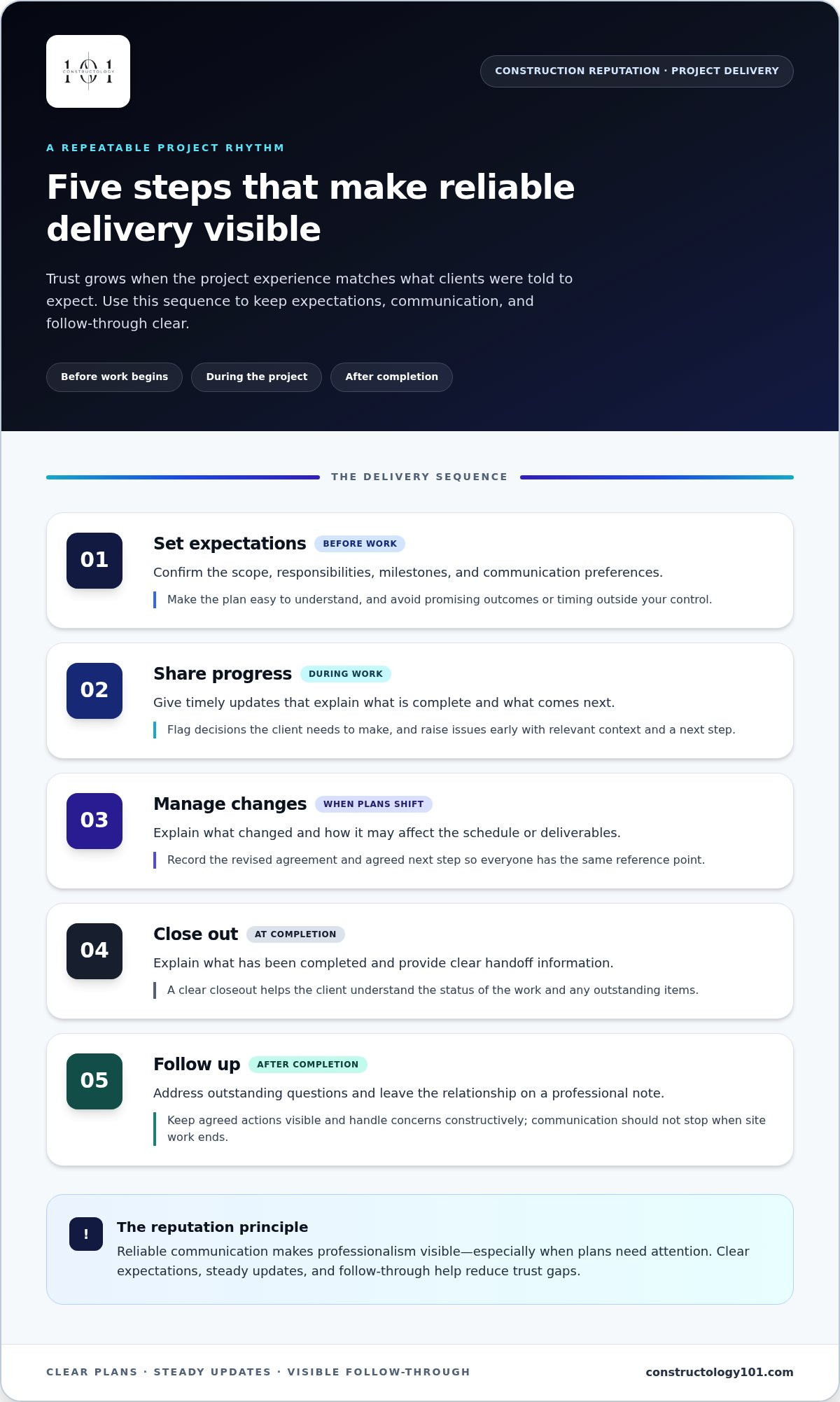
Use a simple sequence to make the experience consistent:
- Set expectations: Confirm scope, responsibilities, milestones, and communication preferences.
- Share progress: Give timely updates and flag decisions the client needs to make.
- Manage changes: Document what changed, its likely effect, and the agreed next step.
- Close out: Explain what has been completed and provide clear handoff information.
- Follow up: Address outstanding questions and leave the relationship on a professional note.
Follow-through matters at the end, too. A clear closeout helps clients understand the status of the work, while a professional follow-up shows that communication doesn’t stop when site work is done. Keep agreed actions visible and address concerns constructively.
Project delivery builds trust through direct experience. To make relevant work and expertise easier for construction professionals to discover, share project examples and maintain connections through Constructology 101’s construction directory.
Compare Construction Reputation Signals: Reviews, References, and Project Proof
A reputation becomes more credible when people can see different kinds of evidence behind it. Reviews, references, project examples, credentials, and directory profiles serve distinct purposes. Together, they can show how your business works and what others have experienced. No single signal represents the whole business, and a polished profile can’t replace evidence from real projects.
Which reputation proof should a construction business prioritize?
Choose proof based on what you want someone to understand. Reviews share public customer feedback. References provide relationship-based validation through a conversation with someone familiar with your work. Project case studies show your role and process in context. Credentials can document specific qualifications, while a professional directory profile helps people discover and understand your services.
- Reviews: Show a client’s stated experience in a public format.
- References: Let a prospective client hear directly about a working relationship.
- Project examples: Describe the scope, your role, key steps, and verifiable outcomes.
- Credentials: Present relevant qualifications accurately and in context.
- Directory profiles: Make specialties, services, and professional information easier to find and review.
For example, a project description can identify the trade package your team handled, explain how coordination worked, and state a result you can document. Be clear about your contribution rather than implying responsibility for work completed by others. For more on how profiles support professional discoverability, see this interactive construction directory guide.
How can you present proof without overstating results?
Separate facts from opinions. A project’s scope, your role, and a completed deliverable are factual details you should be able to support. A client quotation is their feedback, not a measurable result. General statements about your capabilities should match the work you can demonstrate.
Before publishing, check that information is accurate, current, and appropriate to share. Get permission to use client names, testimonials, images, or project details, and consider whether the material reveals private or sensitive information. Add enough context for readers to understand what an example shows, without implying that one project guarantees the same outcome elsewhere.
Review your proof regularly. Update changed services or credentials, remove outdated claims, and correct anything that no longer reflects your work. That discipline is part of how to build a construction business reputation: present evidence people can interpret clearly, and make sure each claim holds up when they look closer.
Create a Repeatable Reputation-Building Plan for Your Construction Business
Reputation work doesn’t require a large marketing budget or a long project portfolio. It does require a routine. Start with the proof you already have, strengthen the habits that create good project experiences, then keep accurate information visible. Small, consistent actions make it easier for others to understand what you do and how you work.
Use this simple cycle:
- Audit your proof: Review existing profiles, project examples, testimonials, credentials, and business contact details. Note what’s missing, outdated, or difficult to verify.
- Improve delivery habits: Choose one practical change, such as documenting decisions or sending more consistent progress updates, and use it on active projects.
- Capture feedback and context: After a meaningful milestone or closeout, invite honest feedback and record project details and outcomes you’re permitted to share.
- Maintain visibility: Refresh professional profiles and share relevant examples where clients and industry peers can find them.
A smaller firm can build credibility before it has an extensive portfolio. Document the work you do have: your role, the scope, the process, and outcomes you can substantiate. A concise, accurate example is more useful than a broad claim without supporting detail. For profile-specific guidance, read this guide to optimizing a construction professional profile.
How can you collect feedback and turn completed work into proof?
Ask for specific, honest feedback at a natural point, such as a completed milestone or project closeout. Keep the request professional and voluntary. Don’t pressure clients to leave positive reviews or suggest wording. Separately, record the project scope, your contribution, and any outcomes you can verify. Before sharing names, quotations, images, or project details, get appropriate permission and protect private information.
How should you maintain a consistent professional presence?
Set a recurring time to review business descriptions, services, contact details, project examples, and testimonials across your channels. Update information when it changes. If someone raises a concern, respond calmly and professionally; correct factual inaccuracies without escalating the exchange. Consistency helps people connect your public profile with the way you work and communicate.
Visibility also grows through relevant industry relationships. Explore this construction business relationship guide for ways to keep professional connections active. To present your services in a construction-focused directory, create an interactive directory listing.
Use Constructology 101 to Boost Your Construction Reputation
A professional directory can make your expertise easier to find and understand. It works best as one part of a broader reputation plan: dependable project delivery provides the experience behind your claims, while accurate profiles and relevant project examples make that experience visible. Constructology 101 brings together a broad construction community, including architects, engineers, specialty trades, and suppliers.
What can a construction directory listing contribute to your reputation?
An interactive listing gives you a focused place to present your services, specialties, and relevant professional information. Be specific about the work you do and the skills you bring. Keep details consistent with your other professional channels, and avoid broad claims you can’t support with examples or experience. A listing supports discoverability and helps peers understand your business, but it doesn’t guarantee endorsements, contracts, or other outcomes.
Make it easy for a potential project partner to see whether your capabilities fit their needs. Instead of relying on a vague description, identify relevant services and specialties, then keep the information current as your business evolves. This creates a useful first impression and gives your proven work context.
How can project sharing and networking support long-term credibility?
Project sharing can demonstrate experience beyond a short service description. Choose relevant examples, explain your role accurately, and share only details you have permission to use. Integrated messaging can support professional conversations and ongoing connections. Use it to exchange useful information and follow up thoughtfully, not just to promote your business once.
This is a practical extension of how to build a construction business reputation: pair credible evidence with visible, respectful industry relationships. Constructology 101’s project-sharing and messaging features support those connections. The Pioneer Membership provides access to the platform’s networking and project-sharing tools at a one-time price, with a lifetime membership.
Use the directory alongside the habits already shaping your reputation: communicate clearly, document work responsibly, and keep professional information current. Explore Constructology 101 to see how an interactive listing and industry connections can fit into your broader reputation-building plan.
Make Your Reputation Visible, One Project at a Time
Knowing how to build a construction business reputation starts with dependable work, clear communication, and evidence that reflects what you’ve delivered. Keep project details accurate, invite honest feedback without pressure, and maintain a professional presence that shows clients and industry peers what you do.
Reputation grows through more than public reviews. Project examples can demonstrate your experience, while professional relationships keep your business connected across the construction industry. A construction-focused interactive directory offers another place to present your services and specialties. Project sharing, professional connections, and integrated messaging can help you maintain relevant industry relationships without promising a particular business outcome.
Take the next step and explore Constructology 101 and build your professional presence. Make your work easier to understand, your expertise easier to discover, and your industry connections stronger. Trust takes consistent effort, and every project gives you another opportunity to earn it.
Frequently Asked Questions
How long does it take to build a construction business reputation?
There’s no fixed timeline for how to build a construction business reputation; it grows through repeated experiences and credible proof over time. Each project, client interaction, and professional relationship can shape how others see your business. Start documenting work and feedback as it happens, rather than waiting for a large portfolio. Consistency helps people build a clearer picture of your reliability, though it can’t guarantee referrals or future projects.
What matters most when building a contractor's reputation?
Reliable project delivery matters most, supported by clear communication and follow-through. Set realistic expectations, explain changes promptly, and make responsibilities and next steps clear. Clients notice the quality of the work, but they also remember whether you kept them informed and handled concerns professionally. Build on that experience with accurate project examples and honest feedback, so the reputation you present reflects the way your business actually operates.
How can a construction company get more online reviews?
Ask clients for honest feedback at a natural point, such as project closeout, and make the request professional and voluntary. You might say, “Would you be willing to share feedback about your experience?” Don’t pressure clients to leave a positive review or suggest what they should write. Follow the review platform’s rules, respond courteously to feedback, and use what you learn to improve communication and project practices.
Do online reviews matter for construction businesses?
Yes. Reviews can help prospective clients understand what past customers say about working with your business. They’re useful, but they’re only one reputation signal. A review may describe communication or the overall experience, while a project case study can clarify your role and scope, and a reference can provide a direct conversation. Present reviews alongside other accurate evidence, and avoid treating ratings alone as a complete picture of your work.
How can a new construction business build credibility without many reviews?
A new business can show credibility with specific, supportable information, even before it has a long review history. Describe your services clearly, document completed work and your role, and share project examples only with appropriate permission. You can also provide relevant credentials you hold and references who agree to speak about their experience. Be transparent about your track record, and avoid claims that your available evidence can’t substantiate.
How should a contractor respond to a negative review?
Respond calmly, acknowledge the reviewer’s concern, and keep your reply professional and factual. Avoid arguing, blaming, or sharing private project details in public. If the review contains an inaccuracy, correct it briefly and respectfully. Where a fuller discussion would help, invite the reviewer to continue through a private channel. Then follow through on any agreed next steps. A measured response shows readers how you handle concerns, not just how you describe your work.
Can a construction directory help build a business reputation?
Yes. A construction directory can help peers discover your business and understand your services, specialties, and relevant professional information. Constructology 101 is an interactive directory and professional network for construction professionals, with project sharing and integrated messaging to support industry connections. Keep your listing accurate and specific, and share project information responsibly. A directory can support discoverability, but it doesn’t guarantee endorsements, reviews, contracts, or revenue.


