

A stack of business cards isn’t a career network. The most useful construction industry career networking happens when a brief conversation becomes a relationship you can build on, whether you meet on a jobsite, at an industry event, or online.
If reaching out feels awkward or self-serving, you’re not alone. Construction brings together people across trades, suppliers, and project roles, so it can be hard to know who to approach or what to say. The answer isn’t to collect more contacts. Start with genuine curiosity, offer value where you can, and follow up with a clear reason.
This guide explains how to find relevant peers, mentors, and industry communities, choose networking channels that fit your goals, and turn conversations into professional connections. You’ll find practical ways to start and maintain relationships across roles, combine in-person and online networking, and make the habit manageable around a busy work schedule. Build connections steadily, and your network can become a meaningful part of your career development.
Key Takeaways
- Set a clear career goal before reaching out so you can focus on people and communities relevant to your next step.
- Ask specific, respectful questions about someone’s role or work to make conversations easier to start and more meaningful.
- Choose between events, associations, online communities, and peer introductions based on the access and time each requires.
- Make construction industry career networking manageable with a repeatable plan built around one goal, one channel, and thoughtful follow-up.
- A construction-focused directory can help professionals discover peers by skills and specialties, then continue relevant conversations online.
What Construction Industry Career Networking Can Do for Your Career
Construction industry career networking means building reciprocal professional relationships across roles, trades, and specialties. It isn’t about collecting business cards or approaching strangers with an immediate request for work. It’s about learning from others, sharing useful knowledge, and staying in touch over time.
The broader idea of Business networking includes both in-person and online relationship-building. In construction, those relationships can help you understand how different parts of the industry work together. They may also provide peer support, mentorship, and greater visibility for your skills. Networking can support career development, but it can’t guarantee a job, project, or promotion.
Who can benefit from construction career networking?
Apprentices and students can meet experienced professionals and learn about possible paths into the industry. Tradespeople can connect with peers in other specialties, while designers and engineers can get a clearer view of how their work fits into project delivery. Experienced professionals may use their networks to exchange knowledge, mentor others, or explore a new direction.
Cross-role relationships offer perspectives you may not get from your own job title. A conversation with someone in another trade, for example, can help you understand how their work affects coordination and project decisions. Set a goal that fits your career stage and priorities. You might want to learn what a role involves, find a mentor, or understand another specialty.
What makes construction networking different from casual socializing?
Construction work provides practical reasons to talk. Shared project timelines, responsibilities, coordination needs, and changing site conditions can open a conversation without a scripted pitch. Ask what someone works on, what their role involves, or what they’ve learned from a recent project. Listen closely, and keep the exchange respectful of their time.
Trust grows through what you do after the conversation. Follow through if you offer to share information, make an introduction, or send a resource. Be reliable in your work and considerate in your communication. These habits matter when people depend on one another to keep responsibilities clear and work moving.
Professional networking is the ongoing exchange of knowledge, support, and opportunities through relationships, not the accumulation of names in a contact list. Approach it with curiosity and a willingness to contribute. Over time, connections can give you new perspectives, strengthen your professional visibility, and help you make informed career choices without treating every conversation as a transaction.
How Construction Professionals Build Trusting Career Relationships
Strong professional relationships start with intention, not a polished pitch. Before an event, site visit, or online introduction, decide what you want to learn or whom you hope to meet. Then look for someone whose role or experience connects to that goal. For instance, if you’re exploring a move toward construction management, you might speak with a professional who coordinates people, schedules, and project responsibilities. The U.S. Bureau of Labor Statistics’ Construction Managers Occupational Outlook can help you understand the role and prepare focused questions.
How should you start a construction networking conversation?
Keep your introduction brief and specific: share your name, role or specialty, and why you wanted to connect. Then ask an open-ended question that invites more than a yes-or-no answer. You could ask how someone entered their specialty, what their responsibilities involve, or which skills they’ve found useful on projects.
Listen before looking for a way to promote yourself. A thoughtful follow-up question shows you’re engaged; an immediate sales pitch or request for a job can make the exchange feel one-sided. Respect the setting, too. If someone is busy or focused on work, keep the conversation short and ask whether another time would suit them.
What should you do after meeting a construction professional?
Follow up while the conversation is still easy to remember. Send a short, personalized note that refers to a detail you discussed, such as a career insight or project challenge. If you offered to share a relevant resource, send it. Make an introduction only when it could genuinely help both people, and check that the connection is welcome.
Keep in touch for a reason, rather than sending a routine message that asks for something. Share a useful article, congratulate them on a professional milestone, or reach out when you have a relevant question. If they don’t respond, give them space instead of sending repeated requests. Reciprocity can be simple: exchange practical knowledge, make considerate introductions, and communicate dependably.
Set a goal, choose a relevant person, start with a genuine question, and follow up with something useful. That sequence makes construction industry career networking easier to practice and helps conversations develop naturally. To present your professional skills and connect with industry peers, explore Constructology 101’s construction directory.
In-Person or Online Construction Career Networking: Which Fits Your Goal?
The best channel depends on what you want from a connection, how much time you have, and how you prefer to communicate. In-person events can make it easier to build rapport quickly. Online communities and directories can help you find people by role or specialty and reconnect between events. Neither approach works for everyone. Combining them can help keep a useful conversation moving.
| Channel | Access | Interaction style | Follow-up potential | Likely time commitment |
|---|---|---|---|---|
| Industry events | Depends on event schedule and registration | Face-to-face introductions and group discussions | Exchange contact details, then continue the conversation | Requires time for the event and travel |
| Professional associations | Depends on membership and available activities | Recurring meetings, learning, and peer interaction | Repeated participation can help build familiarity | Varies with the organization and your involvement |
| Online communities or directories | Can be accessed remotely, subject to platform terms | Messages, profiles, and shared professional information | Digital conversations can continue over time | Can fit into shorter intervals |
| Direct peer introductions | Relies on a mutual contact or existing connection | Personal, focused conversation | Simple to follow up with both people involved | Usually focused on a specific conversation |
When are construction events and professional groups useful?
Choose an event when you want focused introductions, peer learning, or a chance to hear how others approach industry challenges. Before committing time, check the event’s purpose, who is likely to attend, and what participation involves. Associations such as the Associated General Contractors of America (AGC), NAHB, AIA, and CMAA are examples to explore. Review each organization’s current offerings to see which fit your role and goals.
How can online construction networking complement in-person connections?
Online professional networks and construction-focused directories offer another way to discover people by role, skill, or specialty. A clear profile or listing helps others understand your professional focus before they contact you. Where available, project information and messaging can give you a natural way to continue a relevant discussion after meeting someone. For more ideas on building connections through digital channels, read the modern construction professional network guide.
Choose construction industry career networking channels with a purpose: attend an event for direct conversation, join a group for ongoing peer learning, or use online tools to find and reconnect with relevant professionals. Start with the channel that suits your schedule and communication style, then add another if it supports your goal.
A Practical Construction Career Networking Plan You Can Maintain
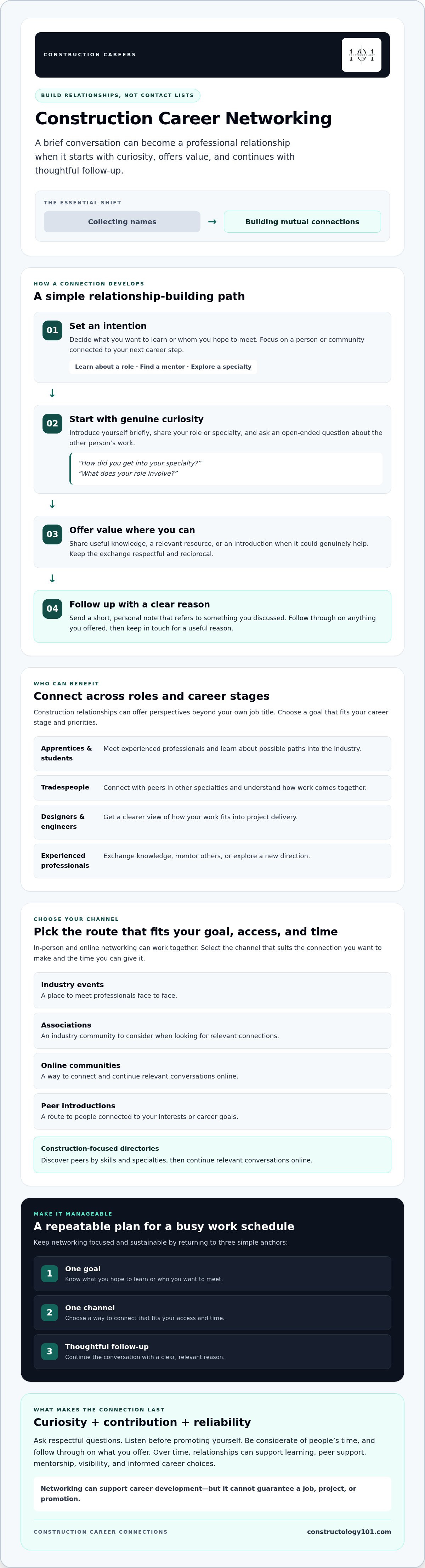
Networking doesn’t need to become another full-time task. A small, repeatable routine can help you build construction industry career networking into your working life without turning every conversation into a transaction. Use this four-step plan:
- Define one goal. Decide what you want to learn, such as how a specialty works or what skills support a career move.
- Choose a channel. Pick an event, professional group, online community, or peer introduction that fits that goal.
- Make focused connections. Reach out to people whose experience or role relates to what you want to understand.
- Follow up with purpose. Refer to your conversation and share a resource, insight, or introduction only if it’s genuinely useful.
Keep a simple record so useful conversations don’t disappear into your inbox. Note who you spoke with, what you discussed, any shared interests, and a sensible next action. That might be sending a resource, checking in after a project milestone, or leaving the door open for future contact. Measure progress by the quality of your learning and relationships, not by an arbitrary contact quota or promised outcome.
How can you network when you are new to construction?
Start close to your current experience: classmates, colleagues, supervisors, project partners, or relevant professional groups. Prepare a short introduction that explains what you’re doing now and which parts of the industry interest you. Then ask for perspective, such as what someone learned early in their career or what they’d recommend you study. Curiosity feels more natural than opening with a request for employment.
How do you make networking fit a busy work schedule?
Choose a pace you can sustain around your workload and career goals. You might use a short break to send a personalized follow-up or set aside time occasionally to reconnect with someone you already know. Keep messages specific and useful instead of sending repeated check-ins without a reason. For more ideas on nurturing professional relationships, read the construction business relationship management guide.
Awkwardness often eases when the aim is mutual value, not self-promotion. Ask thoughtful questions, share what you know, and respect the other person’s time. To make your skills easier for construction peers to discover, explore an interactive construction directory listing.
Use a Construction-Focused Network to Keep Career Connections Moving
Events and introductions can spark a connection. A construction-focused online network gives you another way to keep professional discovery going between conversations. Rather than relying only on who happens to attend the same event, peers can use professional listings to understand one another’s roles, skills, services, and specialties.
That clarity matters across construction, where people in different trades and project roles may need to understand how their experience fits together. A precise profile helps others see what you do and what you’re interested in. It can support relevant conversations, but it doesn’t promise employment, leads, contracts, or career outcomes.
What should a construction professional profile communicate?
Make it easy for someone to understand your professional focus at a glance. State your role, specialty, experience, and areas of interest in plain language. Describe your services accurately, and include relevant project information where appropriate. Avoid broad claims that leave readers guessing about your skills or experience. For more profile tips, see the construction professional profile optimization guide.
How can Constructology 101 support ongoing industry connections?
Constructology 101 is a construction-focused directory and professional social network for construction professionals, specialty trades, and suppliers. Members can create professional listings, share project information, and communicate through integrated messaging. These features provide ways to discover relevant peers and continue a conversation online after an introduction or event.
Use a directory as an additional channel, not a substitute for the trust built through direct, dependable relationships. A listing can help others recognize a relevant specialty; project sharing can provide context for a professional conversation; messaging can help keep that exchange moving. Check that the platform’s current features and access conditions suit your needs.
Keep your profile current and your interactions genuine. Share useful information, communicate clearly, and follow up when there’s a relevant reason. These small actions can help turn online discovery into a more personal professional connection, without treating every interaction as a pitch.
If a construction-specific place to present your professional skills and explore industry connections would support your approach, explore Constructology 101.
Make Your Next Career Connection Count
Strong construction industry career networking grows through steady, genuine exchanges, not one-off introductions. Set a clear goal, choose channels that fit your schedule, and follow up with care. A useful professional profile can also help peers understand your skills and specialties, giving them a starting point for relevant conversations.
Constructology 101 is a construction-focused directory for professionals, specialty trades, and suppliers. Professional listings, project sharing, and integrated messaging provide ways to discover peers and continue conversations online. These tools can complement relationships built through direct conversations and shared work.
Take one practical step today: reconnect with a peer, ask someone about their career path, or make your professional focus easier to find. Explore Constructology 101 and build your construction-industry connections.
Frequently Asked Questions
How do you network in the construction industry?
Start with a clear goal, then choose a channel that fits it, such as an industry event, professional group, online community, or introduction through a peer. Introduce yourself by sharing your role and what you’re interested in learning. Ask specific questions about someone’s work or experience, listen closely, and follow up with a relevant note. Construction industry career networking works best as steady relationship-building, not a one-time request or contact-collecting exercise.
Why is networking important in construction?
Networking helps construction professionals exchange knowledge, learn how other roles contribute to projects, and find peers or mentors who understand the industry. These connections can offer support as you develop skills, explore specialties, or consider a career change. Professional visibility can also make it easier for others to understand your experience and interests. Networking may support career development, but it can’t guarantee a job, project, contract, or promotion.
How can I network in construction if I am new to the industry?
Begin with people already around you, such as classmates, colleagues, supervisors, project partners, or members of a relevant professional group. Prepare a brief introduction that explains your current experience and what parts of construction interest you. Ask for perspective, such as what skills matter in a particular role or how someone built their experience. Focus on learning and respectful conversation rather than opening with a request for employment.
Are construction networking events worth attending?
They can be worthwhile if the event’s purpose and attendees match what you want to learn or whom you hope to meet. Review the agenda, intended audience, participation expectations, and time commitment before attending. A focused meeting can offer introductions and peer learning, while a broad event may be less relevant to a specific career goal. Treat events as one channel among several, and plan to follow up if a conversation is useful.
How do you follow up after meeting someone in construction?
Send a brief, personalized message that refers to something you actually discussed. For example, mention a career insight they shared or a project topic you both found relevant. If you offered to send a resource, include it. Keep future contact purposeful by sharing useful information or checking in when you have a genuine reason. Avoid repeated messages that only ask for help, and give the other person room to respond.
Can online networking help build a construction career?
Yes. Online networks and construction-focused directories can help you discover professionals by role or specialty and keep conversations going beyond an event or introduction. Constructology 101 supports professional listings, project sharing, and integrated messaging for construction professionals, specialty trades, and suppliers. These tools can complement in-person relationships and make professional information easier to find. They don’t guarantee career outcomes, so approach online connections with the same care and follow-through as offline ones.
What should I include in a construction professional networking profile?
State your role, specialty, experience, and professional interests clearly. Describe your skills or services accurately, using specific language that helps peers understand your focus. Add relevant project information where appropriate, and keep it current as your experience changes. Avoid sharing confidential details or making claims you can’t support. A clear profile helps other construction professionals understand who you are and decide whether a conversation or connection is relevant.


