

A subcontractor search that starts when the schedule is at risk is already late. A dependable commercial subcontractor network takes shape before a project needs another trade partner, giving teams time to assess experience, capacity, and communication instead of rushing to fill a gap.
If you’ve struggled to find subcontractors with relevant commercial experience or coordinate trades before schedule conflicts arise, you’re not alone. In 2026, labor pressure and shifting project demand make early preparation especially valuable. A contact list alone won’t show who fits your scope, who may have capacity, or how a business prefers to communicate.
This article lays out a practical process for finding, vetting, and maintaining project-ready connections. You’ll learn what to check, which questions to ask about workforce capacity, qualifications, technology, and procurement, and how to keep scope and schedule conversations clear. The goal is a stronger foundation for matching project needs with informed, well-prepared trade partners.
Key Takeaways
- Build a commercial subcontractor network around upcoming project scopes, timelines, and required capabilities, not just a broad list of contacts.
- Compare potential trade partners on relevant experience, capacity, communication, and verified references to assess project fit.
- Keep connections warm with respectful check-ins and concise, dated updates to your records.
- Use a construction directory to discover specialty trades and review how they present their skills, then vet fit directly.
- Use professional networking, project sharing, and messaging to support ongoing connections, while confirming project details with each contact.
Why a Commercial Subcontractor Network Matters Before Schedule Pressure Builds
A commercial project can require several specialty trades and suppliers, each with a distinct scope and sequence. Searching only after a need becomes urgent leaves less time to compare experience, confirm capacity, and clarify expectations. Building relationships earlier gives teams room to ask better questions before a project is on the line.
A construction subcontractor network is a maintained set of relationships with specialty trade contractors and suppliers who may fit future project needs. It’s a source of potential connections, not a hiring decision or a promise that a firm will be available. A subcontractor generally performs part of a larger project, so identifying a suitable trade partner starts with defining the work that needs to be covered.
What belongs in a commercial subcontractor network?
Include the trades and suppliers relevant to the commercial scopes your team may encounter. Organize contacts by the work they perform, then record practical details that can help you decide whom to approach for a specific project:
- Services: The work or materials they provide, including any scope boundaries discussed.
- Project experience: Commercial project types or scopes they’ve worked on, with notes on what has been verified.
- Coverage: Where they say they operate, which should be confirmed for each opportunity.
- Communication: The preferred contact method and the best person to reach.
Keep records useful, but don’t assume they stay current. Verify services, references, coverage, and capacity directly before relying on any information for project planning. A past introduction or project does not confirm present availability or suitability.
How can a stronger network support delay prevention?
Earlier introductions create time for due diligence before a schedule is under pressure. A team can discuss a potential scope, learn how a trade partner approaches similar work, and identify questions that need answers. If the fit looks promising, the next conversation can focus on the actual project rather than basic discovery.
Discuss the scope, expected timing, dependencies, and information each party needs to coordinate. For example, if one trade’s work depends on another’s completion, raise that relationship early and agree how updates will be shared. This can reduce avoidable misunderstandings, but networking alone can’t prevent delays or guarantee that a subcontractor will be available. Treat the network as a starting point for informed conversations, then verify project-specific details before making commitments.
How to Build a Commercial Subcontractor Network Step by Step
Start with the work, not a search box. A commercial subcontractor network becomes useful when each contact is connected to a trade need, a clear scope, and a record your team can revisit. Construction managers help plan, coordinate, budget, and supervise project work, so organized trade-partner information can support those responsibilities.
How should teams define the subcontractor they need?
Describe the trade, scope boundaries, project type, and conditions that could shape the work. Separate essential qualifications from preferences, then confirm the requirements for each project rather than assuming they stay the same. Note schedule dependencies too: when must this trade be ready, and what work or information needs to come first?
Where can commercial teams discover potential trade partners?
Look across referrals, existing professional relationships, industry groups, and focused construction directories. Treat each as a discovery channel, not proof of fit. Review stated services and relevant project examples, then contact the business to confirm details. For a deeper vetting process, see how to find reliable construction partners.
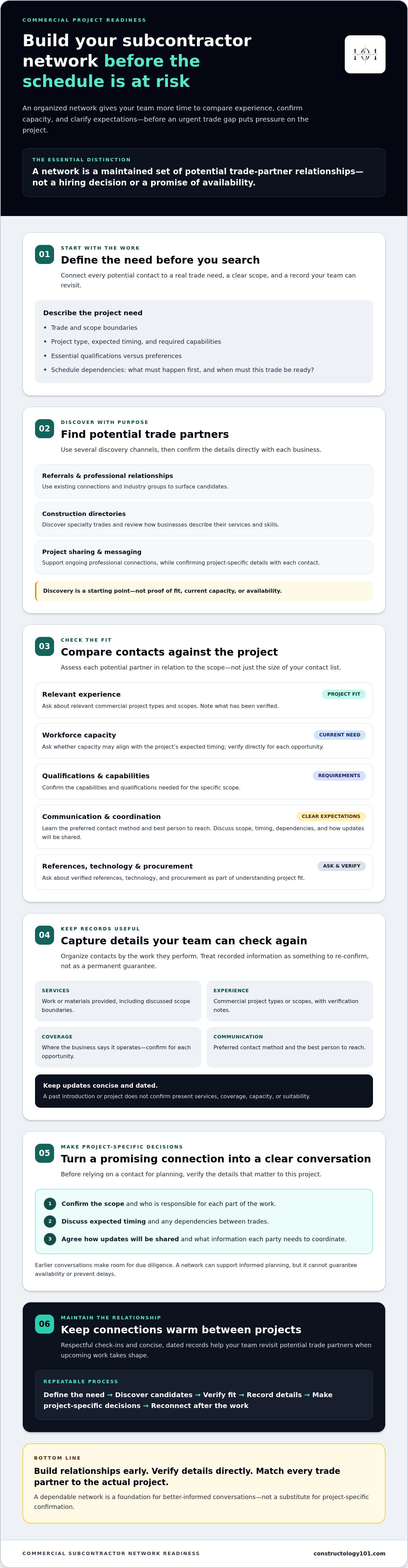
Define the need, discover candidates, verify fit, record key details, make project-specific decisions, and reconnect after the work. This creates a repeatable process, not a guarantee of availability or project results.
- Step 1: Define the need. Record the trade, scope, project type, expected timing, coordination points, and required capabilities.
- Step 2: Find candidates. Gather names from multiple sources and note how each prospect came to your attention.
- Step 3: Check the fit. Ask about relevant commercial experience, references, current capacity, and requirements that matter to the specific project.
- Step 4: Log the details. Track services, project examples, reference-check status, capacity notes, source, preferred communication method, and next follow-up.
- Step 5: Reconfirm before relying on a contact. Check that the scope, timing, and availability still align before making project decisions.
- Step 6: Close the loop. After the project, record useful observations and thank the contact. Keep the relationship active whether or not the team worked together.
Keep the system lightweight enough to maintain. A focused construction directory can help teams discover professionals and review how they present their services. Constructology 101’s construction directory is one option to include in a broader search. Verify information directly before relying on it for a project.
How to Evaluate Network Contacts for Commercial Project Fit
A long contact list can look reassuring, but names alone don’t show whether your team has project-ready coverage. A trade partner may offer the right service and still lack relevant experience, current capacity, or a clear fit for the scope. Evaluate each prospect against the needs of the specific project, then confirm important details directly.
Directory profiles, reviews, and polished project photos can help you decide whom to contact. They aren’t a substitute for a conversation or verification. Treat profile details as starting points, not proof of current qualifications or availability.
Which questions reveal whether a subcontractor fits the project?
Use consistent, project-focused questions. Ask about comparable scope and working conditions, which parts of the work the subcontractor would handle, and how they coordinate with other trades. Discuss project timing and ask what capacity they can currently describe. An earlier estimate of availability isn’t a commitment, so reconfirm it as the opportunity develops.
Request references or supporting documentation when relevant to the work. Follow up with references directly and confirm that the experience described matches the scope you’re evaluating. If a qualification or document matters to your project, verify its relevance and current status rather than relying on an unconfirmed profile claim.
How can teams compare prospects consistently?
Ask each prospect the same core questions, while making room for project-specific follow-ups. In your notes, label information as verified, self-reported, or not yet confirmed. This keeps assumptions from appearing as facts and makes information gaps easier to spot before a decision.
Use a simple comparison table. Leave entries blank or mark them “to confirm” until checked. Don’t invent scores or treat one favorable factor as a substitute for project fit.
| Criteria | What to record | Status |
|---|---|---|
| Scope fit | Services offered and scope boundaries discussed | Verified / to confirm |
| Relevant experience | Comparable project examples and reference checks | Verified / to confirm |
| Capacity | Current capacity and timing discussed for this opportunity | Reconfirm before relying |
| Communication | Contact preference, response expectations, and coordination approach | Discussed / to confirm |
| References | References requested and contacted, where relevant | Complete / pending |
Revisit the comparison when the scope or schedule changes. Details that were accurate during an earlier conversation may no longer apply. A disciplined review helps your commercial subcontractor network support informed decisions, without turning a directory listing or past relationship into an automatic endorsement.
How to Keep a Commercial Subcontractor Network Ready for Upcoming Work
A useful network needs occasional attention between projects. Reach out with a relevant update or brief check-in, not only when a job needs an immediate answer. Respect each contact’s time, keep conversations purposeful, and don’t assume a friendly relationship guarantees future availability.
What information should teams keep current?
Review contact records regularly and after meaningful changes, such as a new project or a contact sharing updated services. Keep notes concise and focused on details that help you start a useful conversation:
- Contact details: The right person and their preferred communication method.
- Services and scope: Work the business says it performs, including any boundaries discussed.
- Experience: Relevant project examples, with notes on what has been verified.
- Capacity notes: What the contact shared and when. Treat this as a snapshot, not a promise of future availability.
- Follow-up context: Date last verified, prior conversation, and a sensible next step.
Store only what helps maintain a professional connection. Avoid collecting unnecessary sensitive information. When a specific opportunity arises, reconfirm the contact’s current scope fit and capacity instead of relying on an old note.
How can teams make coordination conversations more useful?
Share project context early enough for a trade partner to understand the request. Outline the proposed scope, milestone expectations, dependencies on other work, and open questions. For example, identify what needs to be ready before a trade can begin and which details still need confirmation. Early discussion can expose gaps and clarify expectations, but final timing and commitments must be agreed for the specific project.
Use communication channels both parties have agreed on, then document decisions through the project’s established process. This gives the team a clear reference point and helps prevent informal conversations from being mistaken for confirmed commitments. For broader ideas on maintaining professional connections, read construction business relationship management.
Make network upkeep part of the work, not a scramble before it. A brief, respectful check-in and a current record can make the next project conversation more focused. Explore Constructology 101’s construction directory to discover construction professionals and maintain industry connections.
How a Construction Directory Can Support Your Commercial Subcontractor Network
A focused construction directory can add a discovery and visibility channel to your commercial subcontractor network. It helps professionals find and learn about businesses that present relevant trade services, but it doesn’t replace direct conversations, project-specific vetting, or clear coordination. Treat a listing as a starting point for research, not a qualification or availability check.
What can a construction-focused directory help professionals do?
Constructology 101 is a nationwide interactive directory and professional social network for construction-industry participants, including specialty trades and suppliers. Professional listings give businesses a place to showcase their skills and services, helping peers discover professionals whose stated offerings may be relevant. Check those details directly before deciding whether a contact fits a particular scope.
The platform also includes professional networking, project sharing, and integrated messaging. These features can support industry connections and conversations around shared project information where appropriate. They don’t confirm that a listed business is qualified for your work or able to take it on.
A profile, project post, or message should never be treated as a promise of leads, project awards, subcontractor availability, or schedule outcomes. Use the directory for visibility and discovery, then verify experience, references, scope fit, and current capacity through your own process.
What is a practical next step for building your network?
Start with one trade category or service where stronger connections would be useful. Before creating or updating a listing, prepare accurate service descriptions, relevant project experience, and clear details about the work your business performs. Specific, current information makes it easier for peers to understand what you offer and decide whether to start a conversation.
- Choose the trade or service category you want to represent.
- Describe your services and scope clearly, without implying capabilities you can’t verify.
- Share relevant project examples that help explain your experience.
- Review your information periodically and update it when details change.
Then use discovery as the beginning of a professional connection. Ask project-specific questions, confirm information directly, and agree on communication expectations before relying on any contact for upcoming work. A directory can help people find one another; strong working relationships still depend on clear, respectful follow-through.
Explore Constructology 101 to learn about its construction directory and professional networking features.
Build Stronger Trade Connections Before the Next Project
A reliable commercial subcontractor network starts with clear project needs, thoughtful vetting, and relationships maintained before work becomes urgent. Keep records current, compare potential partners against the same project-specific criteria, and confirm scope, capacity, and timing directly when an opportunity arises.
Use discovery tools to widen your view, not replace due diligence. Constructology 101 brings together interactive directory listings designed for construction professionals, along with networking, project sharing, and integrated messaging. These tools can help professionals showcase their services and connect, but they don’t guarantee leads, awards, availability, or project outcomes.
Take one practical step now: identify a trade or service where stronger connections would help, then make time to build and maintain those relationships. Explore Constructology 101’s construction professional network to discover another way to connect with construction peers. Start early, stay clear, and give future project conversations a stronger foundation.
Frequently Asked Questions
What is a commercial subcontractor network?
A commercial subcontractor network is a maintained set of relationships with specialty trade contractors and suppliers who may fit future project needs. It’s more than a contact list: useful records note each business’s services, relevant experience, contact preferences, and information that still needs verification. Teams can use the network to identify potential partners and start project conversations earlier. Membership in a network doesn’t confirm qualifications, availability, or a commitment to take on work.
How do I find reliable commercial subcontractors?
Find potential commercial subcontractors through trusted referrals, existing professional relationships, industry groups, and construction-focused directories. Then check each prospect against the project’s scope, conditions, and timing. Ask about comparable commercial work, current capacity, coordination practices, and references. Verify relevant details directly rather than relying only on a profile or recommendation. A structured comparison helps teams make informed decisions without treating any source as proof of fit.
Can a subcontractor network help prevent construction delays?
A subcontractor network can support delay prevention by giving teams more time to identify potential trade partners, check project fit, and discuss scope and schedule dependencies. Early conversations may surface unanswered questions before they become urgent. But relationships alone can’t prevent delays or guarantee that a subcontractor will be available. Confirm capacity and timing for each opportunity, clarify expectations, and coordinate project-specific commitments with the people involved.
What should I check before adding a subcontractor to my network?
Check what services the subcontractor provides, whether they have relevant experience, and how their stated capabilities align with the commercial scopes you expect. Ask about project conditions they’ve handled, current capacity, communication preferences, and references. Verify important information directly, and note what is self-reported versus confirmed. A contact can be valuable to keep even if they aren’t a fit for one project, but don’t treat an old record as current qualification.
How is a subcontractor network different from a directory?
A directory helps people discover and learn about businesses; a subcontractor network is the set of professional relationships a team maintains over time. A directory can be one source for building that network, but a listing alone doesn’t confirm fit or availability. Constructology 101 combines an interactive construction directory with professional networking, project sharing, and integrated messaging. Use these features to support discovery and connection, then verify details directly for project decisions.
How often should construction teams update subcontractor contact information?
Review contact records regularly and update them whenever a contact shares a change in services, communication preferences, or other relevant details. Record when information was last checked so your team can see what may be outdated. Reconfirm capacity, project fit, and timing as soon as a specific opportunity arises, since availability can change. Keep notes focused on professional information needed for outreach, and avoid storing unnecessary sensitive details.


