

Finding names is only the first step. A concrete subcontractor directory can help you discover businesses and the services they describe, but it can’t establish whether a candidate fits your project.
Listings vary in detail, and matching specialties to a specific scope takes careful review. Use a directory to identify possible partners, then assess their experience, capabilities, schedule fit, and project requirements before moving forward.
Constructology 101’s interactive directory helps construction professionals discover one another through listings that showcase specific skills and services. This guide explains how to define your search, compare directory results, and build a project-specific shortlist. It also shows how concrete professionals can use listings and networking tools to make their services easier for industry peers to find.
Key Takeaways
- Use a concrete subcontractor directory to discover businesses by specialty, then assess qualifications separately.
- Translate drawings, specifications, schedule, and work packages into the concrete services your project needs.
- Compare directories by the relevance of their listings, specialty details, search tools, and contact options.
- Apply the same project-specific criteria to each candidate and document your shortlist decisions.
- Use Constructology 101 listings, project sharing, and integrated messaging to support discovery and professional connections.
What a concrete subcontractor directory can, and cannot, tell you
A concrete subcontractor directory is a discovery tool. It helps you find businesses based on the services or specialties they describe, such as foundations, slab work, forming, or finishing. Industry-specific listings can help you identify potential trade partners whose stated work appears relevant to a commercial project.
A listing is not verification. On its own, it does not prove licensing, insurance, safety performance, relevant experience, or suitability for your scope. Treat it as an initial signal: use it to identify candidates and begin conversations, then conduct a project-specific review.
What does prequalification mean for a concrete subcontractor?
Prequalification means assessing a candidate against the needs and requirements of a particular project. Depending on the scope and contract, a project team might review relevant work, current capacity, safety documentation, references, and required credentials. Criteria vary between projects, so a general checklist is not a universal legal standard.
Begin with the work itself. A subcontractor experienced in flatwork may not be the right fit for a package centered on structural concrete. If a listing mentions reinforced concrete, that can point you toward a relevant specialty. The project team still needs to assess the candidate against its specifications and requirements.
Why a directory listing is a starting point, not a guarantee
A listing presents information a business chooses to share, which may include services, skills, and past work. The project team can review that information alongside documents and other evidence to determine whether it aligns with the job. Keep the steps distinct: directory content supports discovery, while qualification comes from evaluating the candidate for the project.
Use each listing to decide whether a business merits a closer look. Note how its stated specialty relates to the scope, what project-specific credentials or documentation you need to review, and what questions to raise in an initial conversation. Applying the same process to every candidate makes comparisons more consistent.
This distinction helps you use directory results without treating a profile as an endorsement. For a broader selection process, see how to find reliable construction partners.
Match concrete subcontractor specialties to the project's scope
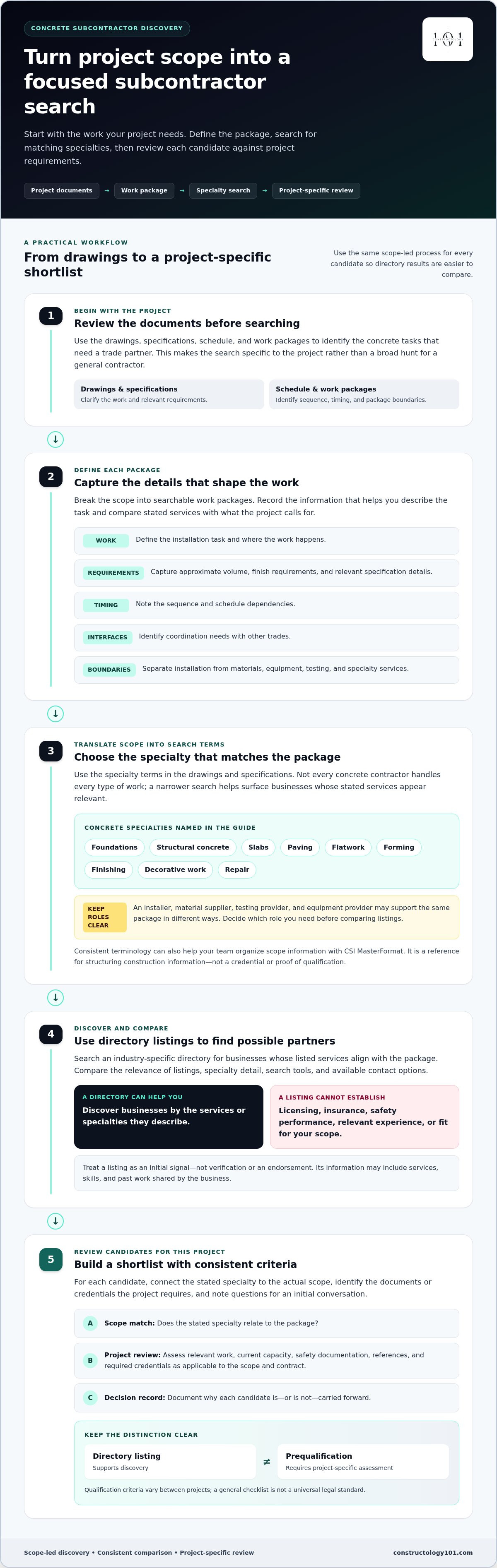
Start with the project documents, not a broad directory search. Review the drawings, specifications, schedule, and work packages. Then identify the concrete tasks that need a trade partner. This turns a general search into a focused one and gives you a clear basis for comparing listed services with the work.
Break the concrete scope into searchable work packages
For each package, note where the work happens, its sequence, approximate volume, finish requirements, and interfaces with other trades. Then define the specialty you need: foundations, structural concrete, slabs, paving, flatwork, forming, finishing, decorative work, or repair. Not every contractor handles every specialty, so let the scope guide your search in a concrete subcontractor directory.
- Work: Define the installation task and location.
- Requirements: Capture volume, finish, and relevant specification details.
- Timing: Note the sequence and schedule dependencies.
- Interfaces: Identify coordination needs with other trades.
- Boundaries: Separate installation from materials, equipment, testing, and specialty services.
This breakdown helps prevent a common mismatch: searching for a general concrete contractor when the package calls for a narrower capability. A paving scope and a structural foundation scope, for example, may involve different work methods and project interfaces. If reinforced concrete is part of the package, the American Concrete Institute offers technical resources that can help orient your review of concrete-related project information.
Use construction classifications to make searches more precise
Consistent terminology helps your team search, compare listings, and describe the package clearly in conversations. Use the specialty terms in the drawings and specifications, and consider organizing scope information with CSI MasterFormat. It is a reference for structuring construction information, not a credential or proof that a subcontractor is qualified.
Keep scope boundaries clear. A concrete installer, material supplier, testing provider, and equipment provider may support the same work package in different ways. Decide which role you need before comparing directory results, then look for stated services that match. For broader criteria on choosing a directory, read the national construction directory buying guide.
Once your search terms and package boundaries are clear, use an industry-specific directory to discover businesses and start relevant conversations. Concrete professionals can use an interactive construction directory listing to showcase their skills and services to industry peers.
Compare concrete subcontractor directories using practical buying criteria
Choose a directory based on how well it supports your search, not just how many names it displays. For a commercial scope, relevant categories, clear specialty descriptions, useful search functions, and a practical way to contact listed professionals can make discovery more focused. A construction-specific directory is organized around industry services rather than a broad range of unrelated businesses.
Which directory features help a buyer narrow the field?
Look for descriptions that help you compare stated services with your work package. Search tools should help surface relevant trades or specialties, and contact options should make it straightforward to move from a promising listing to a professional conversation. These features can improve discovery, but they do not establish whether a business meets your project requirements.
| Criterion | What useful information looks like | Buyer’s next action |
|---|---|---|
| Directory relevance | Construction businesses and trade services are the focus. | Check that the directory serves the professionals you need to reach. |
| Specialty detail | Listings describe concrete services beyond a broad contractor label. | Compare each stated service with your work package. |
| Search functions | Search options help surface relevant trades or specialties. | Try project-relevant terms and review the results for fit. |
| Contact path | You can move from a listing to a direct professional conversation. | Identify candidates for follow-up and project-specific review. |
How to compare a directory with a subcontractor database
A directory generally helps users discover businesses and the services they describe. A database may organize more structured records for a particular workflow. The labels alone do not tell you what information is available, how it is maintained, or whether it answers your project’s needs. Review the actual details and the steps each tool supports.
Do not treat a “prequalified” label or polished search experience as proof that a subcontractor meets your requirements. Qualification still depends on the project team’s review of relevant information and evidence. Directory features support discovery and communication; they do not replace that assessment.
For examples of how interactive listings support visibility and discovery, read about interactive construction directory listings. Construction professionals can also use Constructology 101’s professional network to showcase services and connect with industry peers.
Build a project-specific shortlist from concrete directory results
Turn search results into a shortlist with a repeatable process. A concrete subcontractor directory helps surface possible partners, while the project team decides which candidates merit further review. Set your criteria before comparing businesses, then apply them consistently against the same scope, schedule, and requirements.
- Define the requirements. Summarize the work package, schedule, interfaces, and any project-specific credentials or documentation needed.
- Search by specialty. Use terms that reflect the work, such as foundations, slab installation, forming, paving, or finishing.
- Compare stated services. Check how each listing describes its concrete work and note where the information aligns with the package.
- Request relevant evidence. Identify what the project team needs to review, such as examples of relevant work, capacity information, safety documentation, references, insurance, licenses, or submittals.
- Document the decision. Record what you reviewed, what remains unclear, and why each candidate advances or does not.
What information should the project team evaluate?
Compare relevant concrete project experience, stated capabilities, available capacity, and schedule alignment. A contractor’s described specialty may match the package, but the team still needs to determine whether its experience and resources fit the project’s demands.
Set evidence requirements using the project documents and contract. Licensing, insurance, safety records, references, and submittals may be relevant, but requirements vary by project and applicable rules. A directory profile can guide discovery; it does not replace collecting and reviewing the documents your project requires.
How can buyers document a fair qualification decision?
Use the same scorecard for every candidate, with criteria tied to the scope, schedule, and stated requirements. Record the information reviewed, open questions, decision rationale, and follow-up needed. Consistent notes make comparisons clearer and help the team explain how it reached its shortlist.
For a broader partner-selection framework, see finding reliable construction partners. Once your evaluation criteria are set, use Constructology 101 to discover industry peers and start professional conversations through its directory and networking tools. Explore the construction directory.
Use Constructology 101 to discover and connect with concrete subcontractors
Finding a relevant listing is the start of a professional connection, not the end of your project review. Constructology 101 brings construction businesses and workers together through an interactive, industry-specific directory. Listings showcase skills and services, helping buyers using a concrete subcontractor directory identify businesses whose stated focus may align with a work package.
How an interactive listing supports professional discovery
Clear service information gives industry peers a useful starting point. Concrete subcontractors can describe their areas of work, and buyers can use those details to decide whether to begin a conversation. Project sharing and integrated messaging help members continue connecting after discovery and discuss relevant work directly.
These tools support networking, not independent qualification. Buyers still evaluate candidates against the project’s scope, schedule, and requirements. A listing does not guarantee a project award or business outcome. For broader context on building professional relationships in construction, read the modern construction professional network guide.
Turn directory visibility into a practical next step
For buyers, use a relevant listing to identify a potential trade partner and start a direct conversation. Continue with the project-specific evaluation process, keeping the discussion grounded in the work package and the information your team needs to assess fit.
For concrete professionals, describe services in clear, specific terms so construction peers can understand your areas of focus. A detailed listing helps potential partners recognize the work you do and decide whether to connect. Project sharing and messaging give members additional ways to build professional connections.
Make discovery more purposeful. Explore Constructology 101 and build your interactive directory listing to showcase your concrete services and join the construction network.
Turn directory discovery into your next project connection
A concrete subcontractor directory can help you find potential trade partners, but a listing is only the first step. Start with the project scope, search for matching specialties, and apply the same project-specific criteria to every candidate. Review relevant experience, capacity, schedule fit, and the documentation your project requires before building your shortlist.
Constructology 101 supports discovery with interactive listings that showcase construction skills and services. Project sharing and integrated messaging help professionals continue conversations and build industry connections. For concrete professionals, a clear listing helps peers understand their services and areas of focus. Pioneer Membership offers early participants a lifetime membership option.
Ready to broaden your professional connections? Explore Constructology 101 and build connections across the construction industry.
Frequently Asked Questions
What is a concrete subcontractor directory?
A concrete subcontractor directory is an organized resource for discovering businesses that provide concrete-related services. Categories and listing details can help buyers find potential candidates for work such as foundations, slabs, or finishing. Use the information to identify businesses whose stated services appear relevant, then assess their experience, capabilities, and required documentation separately. A directory supports discovery; a listing alone does not establish that a business meets your project’s requirements.
How do I find a qualified concrete subcontractor for a project?
Start by defining the concrete work packages, schedule, and project requirements. Search for businesses whose stated services match the scope, then compare relevant experience, capacity, references, and required credentials. Apply the same criteria to each candidate and keep notes on your review. A concrete subcontractor directory can help you identify potential partners, but qualification depends on your project team’s evaluation of each candidate against the specific work and requirements.
Does a concrete subcontractor directory prequalify listed companies?
Not necessarily. A directory can help you find businesses and review the services they describe, but a listing alone does not show that a company has been independently screened or meets your project’s requirements. Treat directory information as a starting point. Your team can then review relevant work history, required credentials, insurance, safety information, and references against the project criteria and applicable contract requirements.
What should I look for in a concrete subcontractor listing?
Look for clear descriptions of services and specialties that you can compare with your project scope. Relevant project experience, stated capabilities, capacity information, and a practical way to start a professional conversation can help you decide which businesses merit closer review. Use the listing to identify potential candidates, not as proof of their qualifications. Request and assess the documentation your project requires before making a decision.
How can I compare concrete subcontractor directory platforms?
Compare the relevance of the construction listings, how clearly they describe specialties, which search functions are available, and how easily you can connect with professionals. Consider whether the directory helps you narrow results to the work your project needs. Separate discovery features from qualification: useful search tools may help organize your search, but your team still needs to evaluate each candidate against project-specific requirements.
What information should I verify before hiring a concrete subcontractor?
Base your review on the project scope, contract, and applicable requirements. Areas to assess may include relevant experience, schedule and capacity, required licenses or credentials, insurance, safety documentation, references, and scope alignment. Requirements vary by project, so use the criteria that apply to your work rather than assuming there is one universal checklist. Record what you reviewed and how each candidate meets the stated requirements.
Can a construction directory help concrete subcontractors get discovered?
Yes. A construction-focused directory gives subcontractors a place to present their services and specialties to industry peers looking for relevant capabilities. Clear descriptions help potential partners understand the work a business performs and decide whether to connect. Constructology 101 also supports professional connections through project sharing and integrated messaging. Directory visibility can begin a conversation, but it does not guarantee a project award or a specific business outcome.


