

What good is a new industry introduction if the conversation ends when the event does? A construction business networking platform should help you do more than collect contacts. It should make relevant professionals easier to find, give you a way to share project information, and help you keep communicating after the first connection. Trade shows and association events still matter, but lasting relationships also need a way to continue between gatherings.
If you’ve struggled to find construction-specific contacts on general networks or turn a promising introduction into an ongoing relationship, the right platform can help. Compare networking options by the jobs they do: connecting professionals, supporting project workflows, or bringing people together in person. This guide explains what to look for in a construction-focused directory, project sharing, and messaging, and how to use those features to build useful connections.
Constructology 101 brings those networking steps into one industry-focused environment. Its interactive directory helps construction professionals and businesses present their services for discovery, while project sharing and integrated messaging give connections a place to develop beyond a profile or first hello. You’ll also find practical ways to build your presence and make each introduction count.
Key Takeaways
- Choose a construction business networking platform based on how well it helps you discover relevant professionals and continue conversations beyond a first introduction.
- Compare networking platforms, industry events, and operations software by their purpose. They support different parts of construction business development.
- Look for useful profile and communication features that help you explain your services, share project information, and connect with the right peers.
- Turn connections into working relationships by setting a clear networking goal, starting a focused conversation, and following up with useful details.
- See how Constructology 101’s interactive directory, project sharing, and messaging support construction-focused discovery and follow-up.
What a Construction Business Networking Platform Does Beyond Hosting Events
A construction business networking platform is a digital environment where construction professionals and businesses can discover one another, share relevant information, and build professional relationships over time. Unlike a scheduled event, it can support discovery and communication between gatherings. The point is continuity: make a useful introduction, then have a place to develop the connection.
Business networking is about forming relationships that can support professional goals. In construction, those goals depend on your role. An architect may want to connect with engineers or specialty trades whose expertise fits a project. An engineer may seek design collaborators or suppliers. A specialty contractor may want to build relationships with firms and peers, while a supplier may want to introduce products and services to relevant professionals. A construction-focused network gives people a shared industry context for pursuing these connections.
How online networking differs from construction events
Events create concentrated opportunities to meet people face to face. Trade shows, association gatherings, and industry expos can help professionals start conversations, exchange details, and learn about others’ work. But an event has a set time and place. A digital professional network can help people continue those conversations afterward and discover relevant peers outside the event schedule.
Use both. Meet people in person, then follow up through a professional profile or direct message. Refer to what you discussed, share relevant information, and suggest a clear next step. Online discovery can also help you identify people to connect with before an event, making in-person conversations more purposeful. The tools complement each other; one doesn’t make the other obsolete.
How networking platforms differ from construction software
Not every construction-focused platform is built for networking. Operational software supports work such as estimating, workforce planning, project coordination, or other business workflows. Buildr, for example, is presented as a construction CRM and preconstruction software option for general contractors, with estimating and workforce-planning functions. That serves a different need from discovering a broad range of construction professionals and building peer relationships.
A networking platform can support professional discovery and communication without managing construction projects. It isn’t a substitute for estimating or workforce-planning tools, just as operational software isn’t automatically a cross-role professional directory. When comparing options, ask whether your immediate goal is to manage project workflows or find and connect with industry peers. Some businesses may use both types of tools for different purposes.
Which Features Make a Construction Networking Platform Useful?
Useful features help you move from “Who’s out there?” to “Who should I talk with?” Start with audience fit. A construction business networking platform should make sense for the roles and services you want to connect with, so professionals across the industry can find relevant peers and explain what they do.
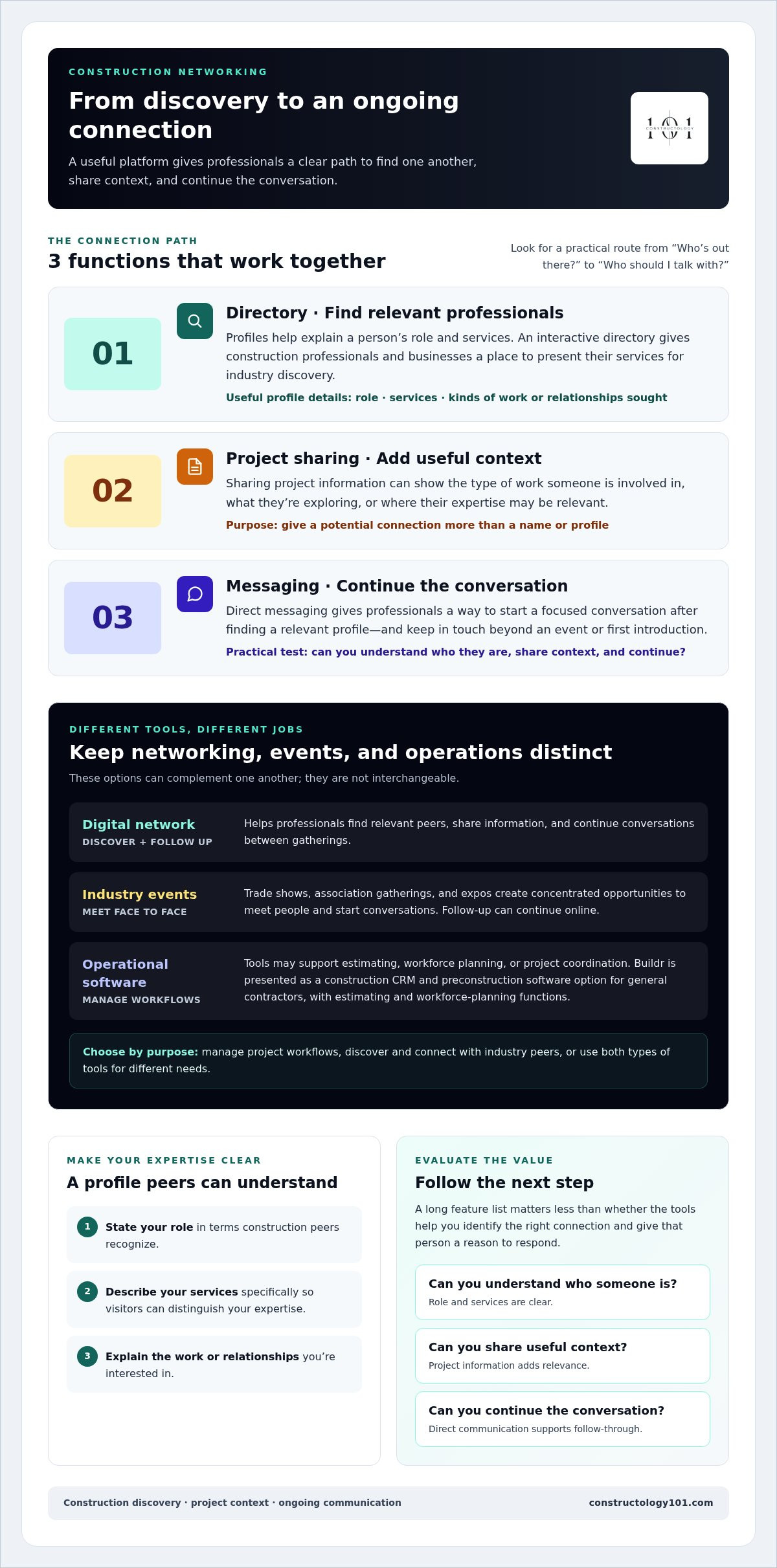
Next, assess whether the tools support a clear path from discovery to follow-up. Look for profiles that explain a person’s role and services, a directory that helps you find relevant professionals, options to share project information, and direct communication. A long feature list matters less than whether these tools help you identify the right connection and give that person a reason to respond.
Does the directory make the right professionals discoverable?
A directory works best when profiles make expertise easy to understand. Specific service descriptions help visitors distinguish, for example, a specialty trade focused on a particular scope from a supplier serving a related need. Architects, engineers, trades, and suppliers should be able to describe their work in terms peers recognize and can use to identify a relevant connection.
Keep profile details concrete: state your role, the services you provide, and the kinds of work or professional relationships you’re interested in. An interactive directory listing gives construction businesses a place to present their services for industry discovery. A clear listing can make your offering easier to understand, but it shouldn’t be treated as a promise of inquiries, contracts, or project awards.
Do communication and project sharing support follow-through?
Discovery is only a starting point. Direct messaging gives professionals a way to begin a focused conversation after finding a relevant profile. Project sharing adds context: it can explain the type of work someone is involved in, what they’re exploring, or where their expertise may be relevant. Together, these features help a connection develop beyond a name in a directory.
Judge each feature by the next step it enables. Can you understand who someone is? Can you share useful context? Can you continue the conversation? Those are practical tests of networking value, not simply a count of available tools.
Keep the purpose clear. Networking communication supports professional discovery and relationship-building; it isn’t the same as formal project-management workflows or a system built to generate and manage leads. For a construction-focused example, explore Constructology 101’s professional network, where directory discovery, project sharing, and messaging work together to support industry connections.
How to Compare Construction Business Networking Platforms
Compare options by the job you need them to do, not by the number of features on a page. A construction business networking platform should make it possible to find relevant professionals and support follow-up. A profile alone doesn’t build a relationship; useful conversations and consistent follow-through do.
Construction-specific role coverage makes discovery more relevant because it helps professionals find peers whose services, expertise, or business needs align with their own. Use these categories to compare the kind of access each option provides:
| Option | Audience fit | Professional discovery | Communication | Project sharing | Intended use |
|---|---|---|---|---|---|
| Industry events | People attending a particular gathering | In-person introductions during the event | Face-to-face, with follow-up arranged afterward | May come up in conversation or presentations | Concentrated introductions and industry learning |
| Online professional network | Construction roles represented in the network | Ongoing discovery through profiles or a directory | Digital communication, depending on platform features | May allow members to share project information | Visibility, continued discovery, and relationship-building |
| CRM or preconstruction software | Users and contacts tied to a company’s workflows | Often centered on internal contacts or pursuits | Supports work-related coordination and records | May organize project or pursuit information | Internal pursuit and project-operation workflows |
Which platform category matches your networking goal?
Choose events for scheduled face-to-face introductions, industry learning, and time with a concentrated group. Choose an online network when you want ongoing professional discovery, visibility, project sharing, and communication beyond a single gathering. Choose CRM or preconstruction tools for internal pursuit and operational workflows. These options can complement each other, but they aren’t interchangeable.
What to check before investing time in a new network
Before building a profile or joining a community, check whether it represents the roles and services relevant to your business. Review whether profiles make people’s expertise easy to understand and whether the platform gives you practical ways to continue a promising connection. Then consider the membership structure and what access or features it provides. Evaluate the fit rather than expecting a particular business outcome.
Once you join, treat your profile as the beginning of the work. Explain what you do clearly, identify the professionals you want to connect with, and follow up when you find a relevant match. That’s how a digital introduction can become a professional relationship.
How to Turn Construction Platform Connections Into Working Relationships
A connection becomes useful through clear intent and thoughtful follow-up. Define the kind of professional relationship you’re looking for, explain your services, find relevant peers, start a focused conversation, and follow up with a useful next step. A construction business networking platform can make discovery and communication easier, but your approach gives the connection momentum.
Build a profile that gives peers a reason to connect
Make your profile specific enough for someone in construction to understand your work at a glance. State your role, specialties, and services in plain industry language. For example, explain the type of engineering or specialty trade you provide rather than relying on broad claims like “quality solutions.” Keep your information current so potential connections aren’t working from an outdated picture of your business.
Project context can help demonstrate experience, but share it with care. Describe your role, scope, or relevant expertise without posting restricted plans, confidential client information, sensitive pricing, or details you don’t have permission to share. A clear, accurate profile helps others decide whether there’s a relevant reason to connect, without promising a particular business outcome.
Start relevant conversations and maintain momentum
Make the first message personal and purposeful. Refer to a shared professional interest, a service that complements your work, or a project topic the other person has chosen to share. Then ask a focused question or suggest a practical next step. Skip generic, high-volume pitches; they give the recipient little reason to continue the conversation.
After the first exchange, follow up with something useful: a brief answer to a question, relevant project context, or a clear suggestion for continuing the discussion. Respect professional boundaries, keep sensitive information private, and avoid treating an introduction as a commitment to work together. Strong relationships grow through relevant exchanges and consistent, considerate communication.
Use a construction professional network to make discovery and follow-up part of the same process. Constructology 101 brings an interactive construction directory together with project sharing and integrated messaging, giving members ways to present their services and continue conversations. Build your construction presence on Constructology 101 and put these relationship-building steps into practice.
Build Your Construction Network With Constructology 101
Constructology 101 brings professional discovery and ongoing communication together in an interactive directory and social network built for the construction community. It’s designed for industry connections, not for managing construction projects. If you’re looking for a construction business networking platform where businesses can present their services and members can continue conversations, its directory, project-sharing, and messaging features create a practical path from discovery to follow-up.
How Constructology 101 supports industry discovery
Construction professionals and businesses can use directory listings to showcase their skills and services for industry discovery. The construction focus supports connections across roles, including architects, engineers, specialty trades, and suppliers. Once professionals find a relevant connection, members can share project information and use integrated messaging to continue the conversation. This gives discovery and follow-up a shared environment without turning the platform into project-management software.
Is Pioneer Membership the right next step?
Pioneer Membership offers early participants a lifetime membership deal at a one-time price. Consider whether the platform’s tools match your goals: presenting your services through a directory listing, sharing project information, and communicating with construction professionals. A good fit starts with what you want to make easier, not with a promise of a particular business result.
Start with one clear next step. Prepare a concise description of your services, decide which construction professionals you want to connect with, and choose project information you can share appropriately. Then explore Constructology 101 and see how its construction-focused directory and communication features fit your approach to building industry relationships.
Make Your Next Construction Connection Count
The right construction business networking platform should help you do more than meet people once. Choose tools that make relevant professionals easier to discover, give you useful ways to share context, and help conversations continue beyond an introduction. A clear profile and thoughtful follow-up turn those features into stronger professional relationships.
Constructology 101 brings those steps together with an interactive directory designed for the construction community, plus project sharing and integrated messaging. Professionals and businesses can present their services, share project information, and continue conversations in one industry-focused environment. Pioneer Membership offers early participants a lifetime membership deal at a one-time price.
Ready to put your network-building goals into action? Explore Constructology 101 and start building your construction network. Take the next step with a clear description of your work and an open mind about the connections you can build. A meaningful relationship can start with one relevant introduction.
Frequently Asked Questions
What is a construction business networking platform?
A construction business networking platform is an online environment where construction professionals and businesses can discover one another and build industry relationships. It may combine professional profiles or directory listings with tools for communication and sharing project information. Unlike an event, it can support discovery and follow-up beyond a scheduled gathering. The aim is to make relevant connections easier to find and continue, not to manage construction work.
How can a construction networking platform help my business?
A construction networking platform can help your business present its services, discover professionals across the industry, and continue conversations after an introduction. For example, a specialty trade might use a directory listing to explain its work, then share relevant project information in a conversation with a potential collaborator. These tools can support visibility and relationship-building, but they don’t guarantee inquiries, contracts, or project awards. Results depend on fit and follow-up.
What features should a construction networking platform have?
Look for professional profiles or listings that make roles, skills, and services easy to understand. Directory discovery can help users find relevant peers, while project sharing and direct messaging give them ways to provide context and follow up. Features matter when they support those steps. A platform designed for construction should make sense for the roles you want to connect with, rather than focusing only on one company type or operational workflow.
Are construction networking platforms different from construction directories?
They can overlap. A construction directory helps professionals and businesses present their services so industry peers can find them. A networking platform may include that directory function along with ways to share project information and communicate. Constructology 101 combines an interactive directory with a professional social network for the construction community. In either case, a listing supports discovery, while clear communication and thoughtful follow-up help develop a connection.
Can an online construction network help me find project partners?
An online construction network can help you discover professionals whose roles or services may fit your project interests, such as architects, engineers, specialty trades, or suppliers. Project sharing can provide context, and messaging can help you explore whether there’s a basis for collaboration. Treat discovery as a starting point, not a promise of a partnership. Be specific about your needs, communicate professionally, and respect confidentiality when discussing project details.
How is a construction networking platform different from a construction CRM?
A construction networking platform focuses on professional discovery and building relationships across the industry. A construction CRM typically supports a company’s management of contacts and business workflows, such as tracking client relationships or pursuits. Some platforms may share communication features, but their purposes differ. Choose based on your goal: finding and connecting with construction peers, organizing internal relationship or pursuit information, or using separate tools for each need.
Is Constructology 101 a construction project-management platform?
No. Constructology 101 is an interactive directory and professional social network built for the construction community. Its directory listings help construction professionals and businesses present their services for industry discovery; members can also share project information and communicate through integrated messaging. These features support networking and professional relationships, rather than construction project-management workflows. Pioneer Membership offers early participants a lifetime membership deal at a one-time price.


