

Static trade directories are officially dead. If you still rely on outdated catalogs and bloated databases to find construction suppliers US builders can rely on, you are risking project margins before ground even breaks. You know the frustration firsthand: unverified credentials, unpredictable lead times, and fragmented data spread across obsolete portals. Sourcing dependable partners across the country shouldn't feel like a shot in the dark.
In 2026, agile teams trade static lists for interactive, community-driven supply networks. This guide helps you master the modern procurement process to locate, vet, and secure reliable construction suppliers across the United States. You will learn how to streamline your sourcing workflow, build direct communication lines with verified vendors, and capture competitive pricing through smarter industry connections. Ahead, we break down actionable vetting frameworks, domestic compliance benchmarks, and collaborative tools designed to safeguard your delivery schedules.
Key Takeaways
- Shift from fragmented regional lists to a unified national strategy to find construction suppliers US projects require for reliable delivery.
- Evaluate prospective trade partners using the Big Three criteria: capacity, compliance, and credibility.
- Ditch static databases that cause procurement friction in favor of interactive networks with real-time portfolio data.
- Implement a structured five-step vetting workflow that sharpens scope definitions and leverages dynamic trade filters.
- Secure a lifetime procurement advantage by engaging directly with verified fabricators through Constructology 101.
Navigating the US Construction Supply Market in 2026
Sourcing construction materials in 2026 is a digital-first operation. Relying on local handshakes and casual word-of-mouth is no longer sufficient for complex commercial builds. In a fast-moving market, an informal recommendation cannot verify real-time plant capacity, confirm delivery schedules, or prove regulatory compliance. Modern builders must look past regional silos and execute a coordinated national procurement approach.
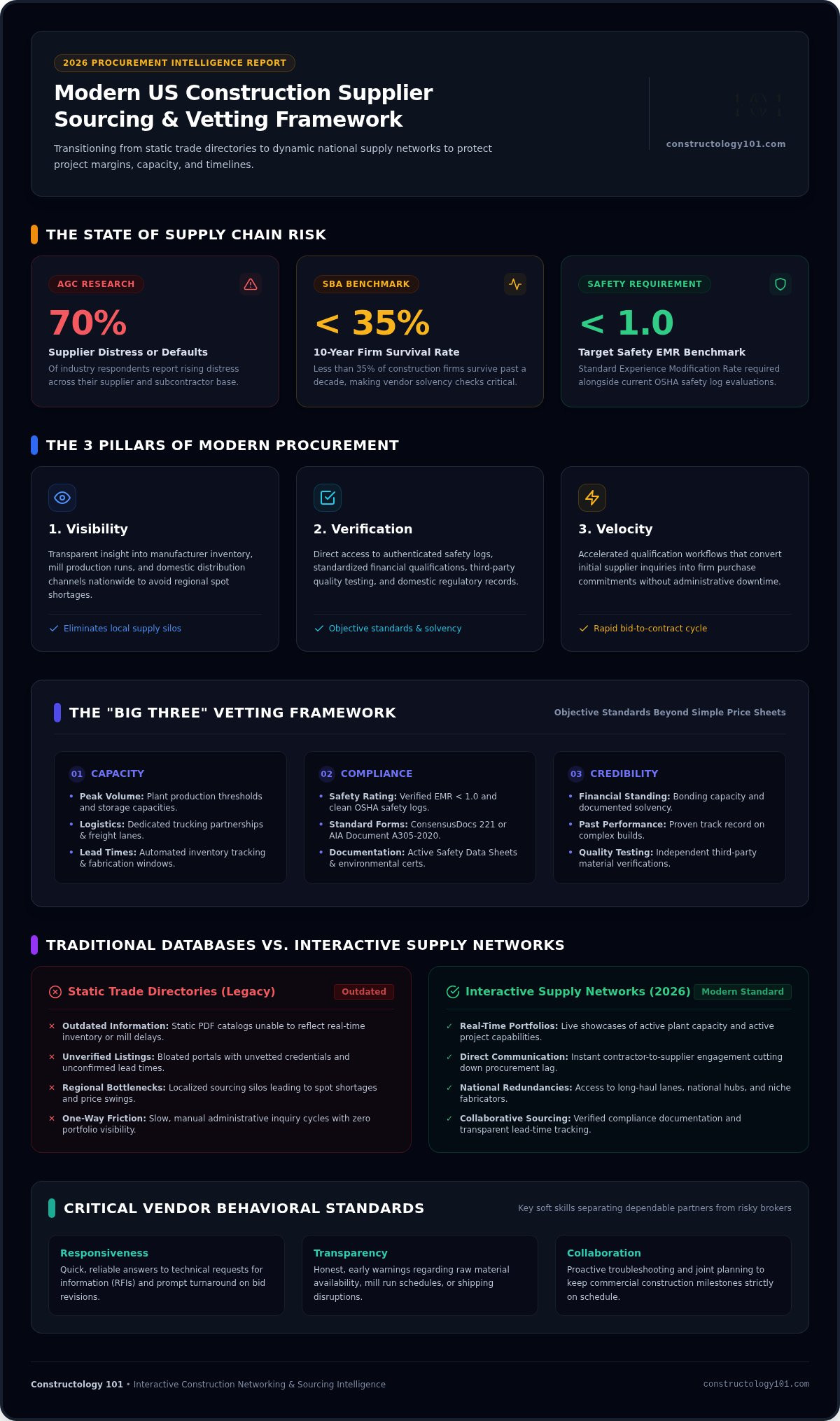
Winning procurement teams base their sourcing on three central pillars:
- Visibility: Transparent insight into manufacturer stock, mill runs, and distribution channels across the country.
- Verification: Instant access to safety ratings, past performance records, and domestic compliance disclosures.
- Velocity: Rapid qualification cycles that turn initial inquiries into firm commitments without administrative lag.
Integrating these operational pillars standardizes your commercial procurement process, protecting job sites from downstream delays and volatile price swings.
The Rise of Digital Procurement Networks
Static PDF catalogs and generic online directories can't keep pace with shifting inventories. When builders need to find construction suppliers US projects require right now, interactive networks provide the answer. Modern platforms replace one-way listings with live communication channels, letting general contractors and specialty trades talk directly to suppliers. Securing an Interactive Directory Listing gives vendors an active showcase for real-time project capabilities, transforming static discovery into active collaboration.
Why National Sourcing Matters for Resilience
Regional supply bottlenecks can halt a job site in days. Accessing a national network of vetted vendors protects your business from local spot shortages. It creates vital supply redundancies. Broadening your reach lets you leverage long-haul freight lanes and national distribution hubs to secure volume pricing. Most importantly, casting a wider net helps general contractors connect with niche fabricators, diverse enterprises, and innovative manufacturers that regional markets simply lack. Expanding your reach ensures you find construction suppliers US jobs demand, keeping timelines firm and project estimates accurate.
Establishing Your Procurement Criteria and Standards
A low bid means nothing if the materials never arrive at the job site. Evaluating trade partners requires a disciplined framework centered on the Big Three: capacity, compliance, and credibility. Research from the Associated General Contractors of America shows that 70% of industry respondents report rising supplier distress or defaults. With the Small Business Administration noting that less than 35% of construction firms survive beyond a decade, financial solvency and operational vetting are non-negotiable. To successfully find construction suppliers US contractors can depend on, you must look past simple price sheets and grade vendors against objective benchmarks.
Technical and Safety Compliance Requirements
Never sign a purchase order without verifying regulatory credentials. Review the supplier's OSHA safety logs and verify an Experience Modification Rate (EMR) below 1.0. Demand standardized qualification forms such as ConsensusDocs 221 or AIA Document A305-2020 to confirm financial standing, active insurance coverages, and bonding capacity. As shown by recent U.S. construction spending data, rising capital investments mean regulatory scrutiny is at an all-time high. Collect updated Safety Data Sheets, third-party quality testing, and environmental certifications before finalizing any contract.
Capacity and Lead Time Evaluation
Can the supplier handle your peak installation volume without stalling deliveries? Assess plant production limits, dedicated storage, and trucking partnerships early. Lead-time transparency separates dependable fabricators from risky brokers. Modern suppliers utilize automated inventory tracking, providing accurate fabrication windows and automated shipping updates. Prioritize vendors that exhibit strong soft skills:
- Responsiveness: Quick answers to requests for information and bid revisions.
- Transparency: Honest early warnings regarding material availability or mill delays.
- Collaboration: Proactive troubleshooting to keep project milestones on schedule.
When you evaluate vendors against these standards, you systematically find construction suppliers US projects need to stay profitable. If you want to connect directly with vetted partners and review active capabilities, join the industry community at Constructology 101.
Comparing Traditional Databases vs. Modern Interactive Networks
Static business lists operate like an outdated phone book. They provide an unverified company name, a generic office phone number, and zero context regarding operational health. When project managers attempt to find construction suppliers US job sites can actually count on, these static lists create crippling procurement friction. You waste days dialing disconnected numbers, chasing unresponsive sales reps, and running blind credit checks. Traditional databases tell you a business exists, but they cannot tell you if that vendor has the bandwidth or equipment to deliver your order next month.
Modern procurement moves away from passive registries and embraces interactive networks. Evaluating prospective vendors against federal contractor qualification and responsibility standards requires transparent, real-time proof of performance. Free databases offer zero social proof, leaving you vulnerable to delivery failures and unvetted partners. Dedicated industry networks eliminate this risk by providing community-verified profiles where past job completions, peer endorsements, and trade specializations are visible upfront.
The Limits of Static Directories
Free portals suffer from rampant data rot. Old phone numbers, abandoned email addresses, and shuttered business entities clutter their search results. They offer no dynamic tools for team collaboration or document exchange. If you want to avoid these dead ends, read our analysis on Choosing the Best National Construction Directory to see how curated platforms outperform legacy databases across every metric.
The Advantages of an Industry Social Network
Interactive networks combine directory discovery with direct messaging tools. General contractors can initiate requests for quotes directly within the platform, cutting days off standard communication loops. Instead of guessing supplier capabilities, you review an active digital portfolio showcasing completed builds, plant capacity, and verified trade certifications. Leveraging purpose-built construction professional networks helps you find construction suppliers US projects require while establishing lasting partnerships built on speed and mutual trust.
How to Find and Vet Construction Suppliers: A 5-Step Process
Procurement teams need a repeatable roadmap to manage risk. When you set out to find construction suppliers US job sites can count on for timely delivery, following a structured vetting workflow protects your margins and schedule. Use this battle-tested five-step sequence:
- Define Scope: Detail exact material grades, required quantities, drop-ship parameters, and non-negotiable delivery dates before reaching out.
- Search and Filter: Run queries across modern interactive directories, filtering by trade specialization, nationwide capacity, and past project history.
- Verify Credentials: Audit safety records, trade licenses, domestic origin disclosures, and audited financial statements.
- Engage and Communicate: Send direct platform inquiries to evaluate responsiveness, technical understanding, and quoting accuracy.
- Finalize and Monitor: Issue purchase orders with clear performance benchmarks covering on-time arrival, material defects, and invoicing accuracy.
Optimizing Your Search for Niche Suppliers
Specialty projects demand certified partners. To find construction suppliers US projects require for specialized scopes, such as minority-owned fabricators or niche timber suppliers, use laser-targeted trade keywords. Never trust an unverified web form. Instead, confirm the supplier's digital footprint using the verification triplet: verified customer reviews, active trade certifications, and documented project portfolios. This three-point check validates real operational capacity before you commit capital.
Leveraging Messaging for Faster RFQs
Ditch cumbersome email chains. Direct messaging tools streamline the bid process by putting all project documents, specifications, and clarifications in a shared thread. When drafting your initial inquiry, provide complete project specs, target lead times, and compliance requirements upfront.
Watch for red flags during early exchanges. Vague production timelines, reluctance to sign lien waivers, or days of silence signal future job site headaches. Spotting these issues early keeps risky vendors off your critical path. Ready to streamline your vendor discovery? Find vetted construction suppliers on Constructology 101 and start connecting directly with responsive fabricators nationwide.
Future-Proofing Your Supply Chain with Constructology 101
Sourcing materials is only half the battle. Maintaining reliable relationships across the country is what keeps jobs on schedule. Constructology 101 bridges the gap between vendor discovery and relationship management, combining an interactive directory with an active industry social network. Rather than juggling fragmented spreadsheets or paying endless subscription fees for closed bidding portals, builders use the platform to connect, collaborate, and exchange project details in one shared workspace.
Interactive profiles transform passive listings into dynamic business hubs. Fabricators showcase completed builds and material capabilities, while general contractors broadcast upcoming project needs to an engaged national audience. This open communication loop eliminates middlemen, simplifies negotiations, and gives procurement teams an efficient way to find construction suppliers US projects require for steady execution.
The Strategic Advantage of Pioneer Membership
Rising software overhead eats into thin construction margins. Many platforms lock basic messaging behind steep recurring monthly fees, increasing administrative friction. The Pioneer Membership offers an alternative model, granting lifetime access to interactive project sharing and direct messaging tools at a single lifetime price. Joining early secures a permanent presence in a dedicated trade community, establishing your team as an industry fixture before directory tiers fill up. Explore our Construction Industry Lifetime Membership ROI Guide to see how lifetime procurement tools cut technology costs while expanding your professional circle.
Maximizing Your National Visibility
Modern procurement runs on mutual trust. Top-tier suppliers want to partner with organized, communicative general contractors just as much as builders seek reliable deliveries. An Interactive Directory Listing puts your capabilities directly in front of verified partners nationwide. Follow our framework to find reliable construction partners, present your portfolio, and attract competitive bids from specialty fabricators. Securing your spot on the ground floor ensures your business is positioned to find construction suppliers US operations depend on for years to come.
Build a Resilient Supply Network Today
Reliable projects require dependable partners. Moving past static directories, applying a disciplined vetting framework, and engaging through interactive networks protect your bottom line against material delays. When you take a modern approach to find construction suppliers US builds run smoother, bid leveling happens faster, and delivery schedules hold firm.
Constructology 101 provides the collaborative platform your team needs to connect directly with verified fabricators, manufacturers, and trade specialists nationwide. Use our integrated messaging system to cut RFQ turnaround, showcase your project track record, and build lasting industry relationships. Don't waste money on recurring monthly software fees for closed databases. Secure Your Lifetime Pioneer Membership and Start Sourcing Today to gain permanent access at a single Pioneer price. Take the lead and elevate your supply chain now.
Frequently Asked Questions
What are the best ways to find minority-owned construction suppliers in the US?
Filter digital directories by specific certifications such as DBE, MBE, or SBA 8(a). Modern interactive platforms let trade partners tag their profiles with verified ownership credentials, making niche sourcing direct and verifiable. Reviewing digital portfolios on nationwide industry networks ensures certified vendors possess the commercial capacity to meet project milestones.
How do I verify a construction supplier's safety record nationally?
Request their official Experience Modification Rate (EMR) documentation and examine OSHA Form 300A summary logs from the past three years. An EMR under 1.0 reflects safer job site and manufacturing performance. Cross-check these records through standard prequalification instruments to verify consistent safety compliance across state lines.
Are digital construction directories more reliable than traditional trade shows?
Yes, because digital networks provide dynamic, year-round operational data rather than annual marketing pitches. Trade shows offer strong in-person introductions, but interactive platforms let you review active fabrication backlogs, inspect past build galleries, and verify compliance certifications instantly. Digital tools significantly accelerate the timeline to find construction suppliers US general contractors can trust.
What certifications should I look for in a US construction supplier in 2026?
Prioritize ISO 9001 for quality control, third-party domestic content audit trails, and product-specific Type III Environmental Product Declarations (EPDs). If bidding on federally funded work, confirm compliance with the 55% domestic manufacturing cost threshold under BABA standards. Always inspect current bonding papers and commercial liability insurance certificates before finalizing contracts.
How can I find suppliers that offer sustainable or green building materials?
Search for vendors that provide published, verified Environmental Product Declarations detailing Global Warming Potential limits. Many interactive directories allow users to filter specifically for low-embodied carbon products across concrete, steel, glass, and asphalt. Inspecting material batch reports early ensures compliance with modern green building standards.
What happens if a supplier in a different state fails to meet a deadline?
Remedies depend strictly on the purchase agreement terms. Robust procurement contracts include dynamic escalation clauses, clear liquidated damages provisions, and detailed delay-notification rules. Centralized platform messaging keeps a complete, auditable record of order confirmations, specifications, and delivery commitments to simplify dispute resolution.
Is it worth paying for a premium construction directory membership?
Yes, especially when platforms offer lifetime access models instead of draining monthly software fees. A one-time Pioneer Membership provides perpetual access to interactive project-sharing features and integrated messaging systems. That permanent presence creates sustained networking value, helping procurement teams find construction suppliers US projects require without recurring overhead.
How do I use an interactive directory to find niche specialty trades?
Apply granular keyword filters targeting specific trade codes, proprietary fabrication capabilities, or unique material finishes. Review digital company showcases rather than basic text listings. Interactive directories allow you to message specialty fabricators directly, confirm production capacity, and review high-resolution project samples in minutes.


