

Contact depth matters as much as company count. The US commercial roofing contractor list averaged 7.8 contacts per company as of Sep 16, 2026, and included 3,658 companies with 1-10 employees and 3,083 with 11-50 employees. Those figures offer a starting point for assessing a database of commercial roofing contractors in the US by reach and company size.
A broad list can help you map the market, but useful targeting depends on the details attached to each business. This guide explains how to assess company and contact information, narrow contractors by location and business attributes, and interpret differences in counts across metro areas. It also explains why a company’s headquarters and operating footprint may differ. Use these distinctions to plan focused outreach and understand what a database can, and cannot, tell you about the contractors you want to reach.
Key Takeaways
- Assess a contractor database by contact depth and company-size coverage, not just its total number of businesses.
- Narrow your outreach by location and business attributes to build a list that fits your market goals.
- Compare metro counts carefully: headquarters location and the areas a contractor serves can tell different stories.
- Use directory listings to strengthen industry visibility and make it easier for construction professionals to discover your business.
Roofing contractor email and contact database coverage
A useful database of commercial roofing contractors in the US separates company records from individual contacts. As of Sep 16, 2026, the list averaged 7.8 contacts per company. It included 3,658 companies with 1-10 employees and 3,083 with 11-50 employees. Those figures show why contact depth and company size matter alongside total coverage. For outreach, distinguish owners, operations staff, and other business contacts when the records identify them.
Which commercial roofing contractor directories cover all 50 states? A nationwide directory is intended to cover contractors across the country, but its state-level depth depends on its sources and inclusion criteria. Compare state filters and sample listings to see whether the places you target have usable records.
What are the best free and paid databases of commercial roofers? Free directories can help identify businesses and basic contact routes; paid databases may organize additional contact and business fields. Choose by checking whether records match your target states, company sizes, and outreach needs, rather than relying on a “best” label.
What information do commercial roofing contractor databases include? Common fields include company name, location, website, phone, work email, employee range, and service categories such as repair. Mailing-list coverage may provide business addresses for postal campaigns, while email records support digital outreach. Verified work-email coverage depends on how each dataset labels and updates its records. Treat a verification label as a screening signal, not proof that an address still reaches the intended contact.
How can I verify a commercial roofing contractor’s license, insurance, and certifications? Match the company’s legal name and location against relevant licensing records, then review current insurance documents and certification details. Confirm that each record refers to the same business and service scope. How current and accurate are U.S. listings? Accuracy depends on update frequency and source quality. Check a sample for working contact channels, consistent company details, and weather-related service descriptions before building a mailing or email list.
Targeting contractors by location and business attributes
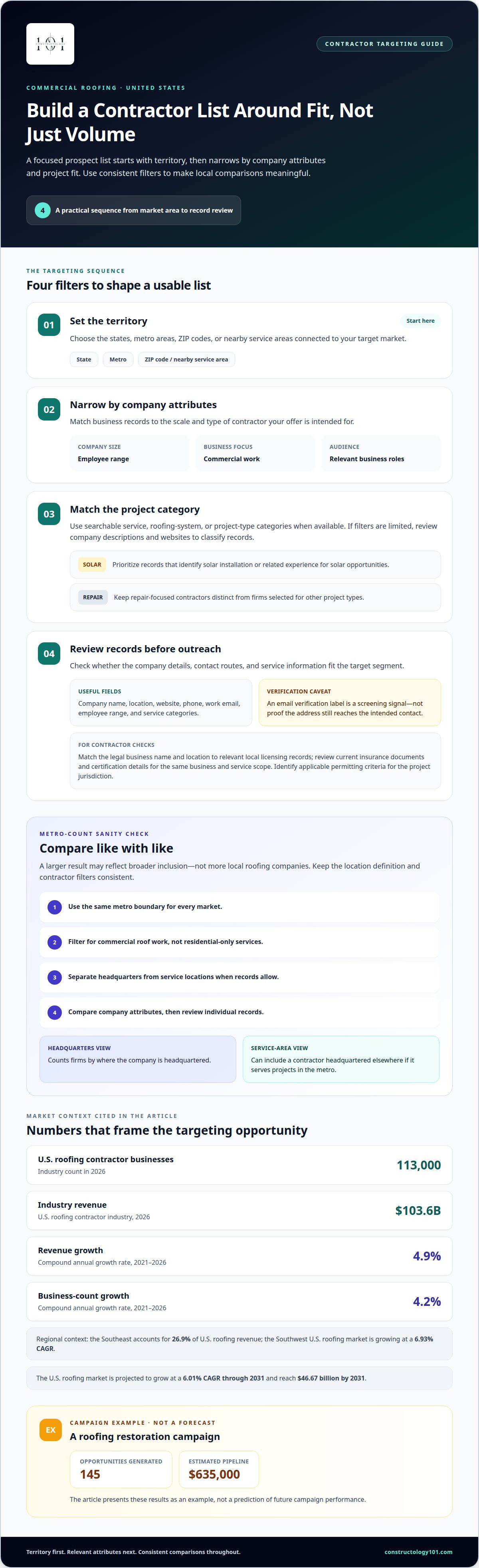
Build a target segment around service territory, company size, and project fit. The United States had 113,000 roofing contractor businesses in 2026, with industry revenue projected at $103.6 billion. From 2021 through 2026, revenue grew at a 4.9% compound annual growth rate. Business counts grew at a 4.2% compound annual growth rate. Together, these trends describe a broad, expanding market.
Start with geography, then narrow by business attributes. Select states or metro areas, employee range, commercial focus, and project categories. For solar roofing opportunities, prioritize records identifying solar installation or related experience. Separate those firms from contractors focused on repair or other work. A database of commercial roofing contractors in the US is more useful when its filters match your offer and territory.
Which databases identify commercial roofers by roofing system or project type? Look for searchable categories that name systems, services, or project types. If filters are limited, use company descriptions and websites to classify records before outreach.
What state and local rules apply when hiring a commercial roofing contractor? Requirements depend on the project location and jurisdiction. Identify the applicable licensing, insurance, and permitting criteria before comparing contractors.
How can I find licensed and insured commercial roofers by ZIP code? Filter a directory by ZIP code or nearby service area, then match businesses against relevant local records. This focuses your search on contractors connected to your target market.
Email results also show why segmentation matters. A roofing restoration campaign generated 145 opportunities and an estimated $635,000 pipeline. Treat this as an example, not a forecast. Tailor messages to professionals by region, project type, and business role. In a united campaign plan, align sales and marketing around one audience. Global reach still starts with relevant local targeting.
Strengthen visibility among construction professionals with a construction industry directory.
The Southeast accounts for 26.9% of US roofing revenue, while the Southwest US roofing market is growing at a 6.93% CAGR. These regional differences can help teams prioritize territories and tailor outreach to local opportunity.
The US roofing market is projected to grow at a 6.01% CAGR through 2031 and reach $46.67 billion by 2031. There are 113k businesses in the US roofing contractors industry in 2026, making territory and business-attribute filters useful for organizing prospect lists.
Commercial roofing contractor counts by metro
A metro count depends on how a database defines location and contractor. One directory may group companies by headquarters; another may include businesses serving the area. Before comparing metro areas, apply the same filters for commercial work, company status, and geographic boundaries. Otherwise, a larger result may reflect broader inclusion, not more local roofing companies.
Use a consistent four-step comparison:
- Choose the same metro boundary for each market.
- Filter for commercial roof work, not residential-only services.
- Separate headquarters from service locations when records allow.
- Compare company attributes, then review individual records.
This process turns a national list into a useful local view. For example, a contractor headquartered outside a metro may still serve projects there. Counting it as local makes sense for outreach focused on service territory, but not for a headquarters analysis. Keep those questions separate to avoid blending different types of market coverage.
Market trends can provide context, but they don’t replace metro counts. A revenue share describes economic activity, while a growth rate describes change over time. Neither figure tells you how many commercial roofing businesses operate in a particular metro. Use market indicators to frame the opportunity, then assess local company records directly.
For a commercial roofing campaign, compare relevant metros using the same criteria and period. Track eligible companies, listed service areas, and contact coverage. A rating or directory category can help organize records, but it shouldn’t substitute for a clear definition of commercial focus. If counts differ, inspect boundary rules and business classifications first. This reveals whether a market has more target firms or simply broader listing coverage.
Use metro counts to prioritize, not to assume demand. A shorter list may still contain more suitable businesses if its records match your project type and territory. Consistent filters make comparisons actionable across the United States.
Contractor headquarters and geographic reach
A headquarters address identifies a company’s base, not its full service territory. For example, a contractor headquartered in one state may serve projects across nearby metros. Separate headquarters, branch locations, and stated service areas when mapping geographic reach. This distinction helps explain why a metro search may include companies based elsewhere.
Use these steps to interpret location records:
- Record the listed headquarters city and state.
- Identify any separate branches or additional offices.
- Compare service-area details with your target project locations.
- Keep headquarters counts separate from regional coverage totals.
Employee ranges can also signal how a company is structured, though they don’t establish its territory. As of Sep 16, 2026, the list included 26 commercial roofing companies with 501-1,000 employees and 9 with 1,001-5,000 employees. It also included 1 company with 5,001-10,000 employees and 3 with more than 10,000 employees. These larger businesses may warrant a different outreach approach than a locally focused firm.
Geography matters alongside market conditions. US roofing contractors industry revenue is expected to decline by 1.3% in 2026. That national trend doesn’t show how demand differs between individual metros or states. Compare local business locations with the project areas you serve, and treat residential and commercial coverage as distinct attributes. A headquarters in a growing market alone doesn’t prove the company works on commercial projects there.
For a practical territory map, group records by headquarters, branch presence, and service area. Then compare those groups against your target market and project type. Use the NAICS classification carefully: code 23816 identifies the US roofing contractors industry, but does not by itself distinguish commercial from residential work. Pair it with business descriptions and location details to refine your segment.
Build professional connections across construction markets by exploring industry directory connections.
Constructology 101: Interactive Directory Listing
Constructology 101’s Interactive Directory Listing gives construction professionals a place to present their business and connect with others across the industry. For commercial roofing contractors, a directory presence can help make their business easier to discover, while an industry-focused network supports professional connections and communication.
Use the listing when you want to build visibility beyond a static contact record and share business information in a construction community. The platform also offers Pioneer membership at a lifetime price for professionals looking to participate in the network. These options support discovery and industry connection; they don’t replace the location, company-size, and project-fit filters used to build a focused market list.
If you’re ready to strengthen your industry presence, visit constructology101.com.
Turn Market Research Into Your Next Move
A useful contractor list is only a starting point. Put your market definition to work by choosing locations, project types, and business attributes that match your goals. Then apply those criteria consistently, so your outreach stays focused as your target markets change.
For businesses looking to build stronger connections across construction, a database of commercial roofing contractors in the US can inform both outreach and professional visibility. Make the next step practical: decide which relationships you want to develop, and choose a platform that supports discovery within the industry.
Connect with Constructology 101 to explore ways to build your presence among construction professionals. Contact Constructology 101 and take the next step toward stronger industry connections.
Frequently Asked Questions
What databases list commercial roofing contractors in the United States?
Commercial roofers can be found through construction-industry directories and business databases with searchable company profiles. Constructology 101’s Interactive Directory Listing is designed for construction businesses and professionals to present their services and be discovered. For a prospecting list, compare whether a database identifies commercial work, provides company-level records, and distinguishes roofing firms from broader construction businesses.
How many commercial roofing contractors operate in the United States?
The United States had 113,000 businesses in the roofing contractors industry in 2026, a broader count than commercial-only contractors. A commercial tally depends on whether it includes firms serving both residential and commercial clients, and whether it counts headquarters or service coverage. Define those boundaries first, then filter records for commercial roofing activity instead of treating every roofing business as a commercial contractor.
Which commercial roofing contractor directories cover all 50 states?
Nationwide directories are intended to cover contractors across the country, but state-level depth varies with their sources and inclusion criteria. Compare state filters and sample listings to assess coverage in your target areas.
How much do contractor directory subscriptions or lead lists cost?
The material gives no subscription price.


