

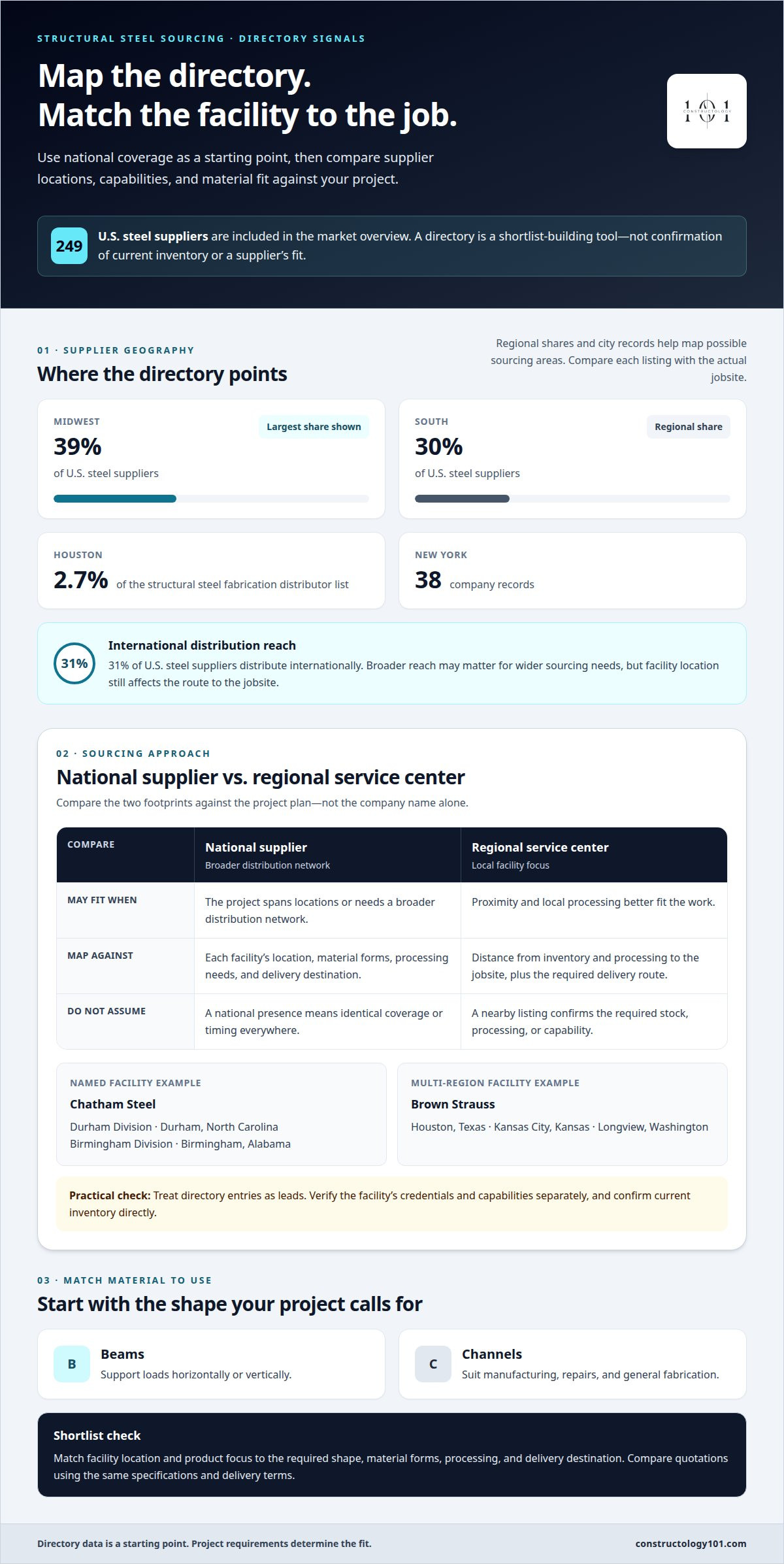
A nationwide directory is a useful starting point, but its value depends on how current its entries are. The U.S. market includes 249 steel suppliers, and a structural steel fabrication distributor list was dated September 18, 2026. To find structural steel suppliers nationwide, use directory details as a starting point, then assess each supplier against your project’s requirements.
When you need to find structural steel suppliers nationwide, a company name alone is not enough. You need to know whether a supplier’s certifications, material availability, delivery capabilities, and quality records suit the job. This guide explains how to assess those details and use an online directory to build a focused shortlist.
Learn what to look for in certification records, inventory, logistics, and mill test reports, and how to distinguish a useful listing from a verified fit. These steps create a clearer path from a broad search to informed next steps.
Key Takeaways
- Use directory records to build a shortlist, then assess whether each supplier’s locations and capabilities align with your project.
- Distinguish certifications by what they indicate, and match the evidence to the work and quality requirements involved.
- Compare material availability and delivery logistics together to see how well a supplier can support your schedule.
- Use quality documentation, including mill test reports, to connect material requirements with verifiable records.
Nationwide directory of structural steel fabrication distributors
Use nationwide directories to build a shortlist, then compare facility locations and capabilities. A supplier’s footprint can affect access to materials, processing services, and delivery routes.
Regional and Specialized Distributors
Regional distributors and steel service centers serve nearby construction and fabrication needs, while specialized suppliers focus on particular products or processing services. Match each listing to the required shape and use: beams support loads horizontally or vertically, while channels suit manufacturing, repairs, and general fabrication. Check product focus and facility locations before narrowing your shortlist.
Supplier Geographic Distribution
Supplier locations are unevenly spread across the country. The Midwest accounts for 39% of U.S. steel suppliers, while the South accounts for 30%. Houston represented 2.7% of the U.S. structural steel fabrication distributor list on September 18, 2026, and New York had 38 company records. Use these regional signals to map potential sourcing areas, then compare individual listings.
Some suppliers also serve international distribution networks: 31% of U.S. steel suppliers distribute internationally. That reach may matter for projects with broader sourcing needs, but location still affects the practical route from supplier to jobsite. Compare listed facilities with project destinations, and note whether a directory entry identifies a distributor, service center, or processing operation.
National Suppliers and Regional Service Centers
Choose a national supplier when a project spans locations or requires a broader distribution network. Compare regional service centers when proximity and local processing better fit the job. Weigh facility locations, material forms, processing needs, and delivery destinations against the project plan.
Structural steel pricing per ton depends on material grade and shape, order quantity, processing, and delivery distance. Compare quotations using the same specifications and delivery terms to understand what drives the total.
What Certifications Should I Look for in a Structural Steel Supplier?
Supplier directories help you compare facilities, contact details, and certification claims across the country. Start with the materials and fabrication your project requires, then match each candidate’s location and credentials to those needs. A directory entry is a useful lead, not proof of certification or current inventory.
AISC certification indicates that a structural steel supplier meets industry standards for fabrication and erection. Consider it alongside the facility’s location and stated capabilities. Certification can matter in construction, energy, and other industries where steel components must meet specific project requirements. Check the supplier’s credentials separately from the qualifications of an individual facility.
Use named facilities and direct contact details to make a practical shortlist. Chatham Steel lists its Durham Division in Durham, North Carolina, at 800-869-2762, and its Birmingham Division in Birmingham, Alabama, at 800-800-2319. Those Southeastern locations give buyers concrete starting points for checking the facility’s relevance to a project and its material needs.
For a broader distribution footprint, Brown Strauss lists facilities in several regions. Its Houston facility is at 2440 FM 1405, Baytown, Texas 77523, while its Kansas City facility is at 802 Kindelberger Road, Kansas City, Kansas 66115. The company also lists a Pacific Northwest facility at 150 Panel Way, Longview, Washington 98632. Compare locations with project destinations and required processing services.
Geography can help shape an efficient sourcing plan. A strategically located service center may reduce the distance between inventory, processing, and the jobsite. For Southeastern U.S. projects, compare the listed Durham and Birmingham divisions with the delivery destination. For work across multiple regions, map each facility to the relevant construction sites instead of relying on a company’s national presence alone.
Build a clear comparison: facility, phone, location, certification, and relevant capabilities. Use a construction supplier directory listing to organize industry connections, then assess the records against your project’s needs. A concise shortlist makes the next supplier discussion more focused.
Steel inventory, logistics, and digital sourcing
Compare inventory, processing options, and delivery routes as part of one sourcing decision. A directory helps organize candidates, but project specifications determine which ones belong on your shortlist.
Inventory and Material Availability
Start with the exact shapes, dimensions, and grades in your project documents. Ask how the supplier’s inventory matches those requirements and whether processing is needed before shipment. A broad range of stock can simplify sourcing, while a specialized order may require more coordination. Plan just-in-time stocking around confirmed quantities, processing steps, and the delivery sequence for each project phase.
Use digital listings to compare material categories and facility locations, then note any gaps between required and listed stock. A sourcing network can help you identify potential partners across regions, but a listing alone does not confirm current inventory. The supplier with the largest footprint may not be the closest match for a particular section or delivery schedule.
Nationwide Delivery and Lead Times
Which suppliers offer nationwide delivery, and what are their shipping areas and lead times? Delivery areas depend on facility locations and transportation routes; lead times depend on stock, processing, order details, and distance. Compare these factors for the actual jobsite instead of assuming a national network offers identical coverage or timing everywhere.
What minimum order quantities and freight charges do structural steel suppliers require? Minimums and freight depend on order size, material dimensions, processing requirements, shipment distance, and delivery arrangements. Compare quotes using the same quantities, specifications, and destination to make the cost components clear.
What structural steel products and grades do major U.S. suppliers offer? Product ranges vary by supplier and facility. Common structural forms include beams, channels, and split tees, which are made by cutting larger wide-flange beams into two T-sections for trusses and support systems. Match the required grade to the project documents and compare listed products with the specifications before planning procurement.
Supplier certifications and steel quality verification
Evaluate a supplier’s credentials alongside the material records for your order. AISC certification indicates that a structural steel supplier meets industry standards for fabrication and erection. It can be relevant when your project involves structural fabrication, but it doesn’t replace checks on the steel itself. Compare the credential with the specific work, facility, and products involved in your United States project.
For quality management, structural steel buyers are advised to look for ISO 9001 certification, according to the International Organization for Standardization. Treat it as a quality-management credential, not as evidence that each carbon steel item meets a particular material requirement. Connect the supplier’s management information to the project specifications and the documentation for the actual shipment.
Check material quality against the applicable ASTM standards for the required steel. Structural steel suppliers should comply with ASTM standards for material quality. Match the standard named in the project documents to the product description and supporting records. For example, do not assume two beams are interchangeable simply because both are listed as structural steel. Their specified material requirements and intended uses matter.
Request mill test reports to check whether the steel meets the required standards. Before accepting a shipment, compare the report’s material identification and recorded results with the order documents. This creates a clearer verification trail from manufacturing records to the jobsite.
Use a simple review sequence: compare the supplier’s certifications, match the order to the required ASTM standards, and examine the mill test reports. Keep copies with the project’s steel records so the team can trace the material later. A trusted sourcing relationship starts with clear, consistent evidence, not a credential name alone. Connect with construction industry suppliers as you build your sourcing network.
Constructology 101: Interactive Directory Listing
Constructology 101 offers an Interactive Directory Listing for construction professionals looking to build industry connections. After narrowing your steel supplier shortlist by location, inventory, and quality records, use the directory to discover businesses and connect with professionals across the construction community.
A directory listing supports the next step: organize your search, find relevant industry contacts, and continue conversations that may build business relationships. It complements supplier evaluation, but does not replace project-specific checks of certifications, material documentation, and logistics.
For professionals who want an ongoing presence in the network, Pioneer membership is available at a lifetime price. Choose the option that fits how you want to participate and be discovered within the construction community.
Visit Constructology 101 to explore the Interactive Directory Listing and take your next step in building industry connections.
Move Your Supplier Search Forward
Turn your shortlist into a focused sourcing plan. Match each candidate to the project’s material requirements, destination, and documentation needs. Keep decisions and supplier conversations organized so your team can move from research to procurement with clarity.
A practical way to find structural steel suppliers nationwide is to build connections across the construction industry while you refine your requirements. Constructology 101’s Interactive Directory Listing can support discovery and professional networking. Pioneer membership is another option for those looking to participate in the community.
Use the directory to continue building relevant industry connections, then apply your project criteria to each sourcing decision. Contact Constructology 101 to explore your next step. Keep the process focused, and move your project forward with confidence.
Frequently Asked Questions
How current is this list?
The structural steel fabrication distributor list was dated September 18, 2026. Treat that date as a snapshot of company records, not proof that a facility’s inventory, certifications, or delivery options remain unchanged. To find structural steel suppliers nationwide, use the dated records as a starting point, then compare each listing with your current project specifications and sourcing needs.
Which structural steel suppliers serve customers nationwide in the United States?
To find structural steel suppliers nationwide, compare facility networks with every project destination. Brown Strauss has facilities across multiple regions, making its footprint relevant to a multi-state shortlist, but location alone does not establish delivery coverage. Map listed branches against job locations and assess each destination separately. For projects concentrated in the Southeast, Chatham Steel’s Durham and Birmingham divisions are regional examples.
Which nationwide steel service centers supply structural beams, channels, angles, and tubing?
Compare service centers by the exact shape categories each facility handles instead of assuming one network stocks every item. Beams provide load-bearing support, while channels are used in manufacturing, repairs, and general fabrication. If a project needs beams, channels, angles, and tubing, organize the specifications by shape, dimensions, and intended use. Then match each requirement to facility product information and processing capabilities.
How do nationwide structural steel suppliers compare on inventory, fabrication, and delivery services?
Compare suppliers against consistent project requirements: material shapes and grades, fabrication or processing needs, delivery destinations, and shipment sequence. A supplier with broad distribution may suit work across several sites, while a nearby service center may better meet local processing needs. Record requirements in a comparison sheet to make differences in material scope, routing, and service capabilities easy to evaluate.
What certifications and quality standards should structural steel suppliers meet, such as AISC or ASTM requirements?
Match credentials and material records to project documents. AISC certification indicates that a structural steel supplier meets industry standards for fabrication and erection. Buyers are advised to look for ISO 9001 certification when evaluating quality management, according to the International Organization for Standardization. Check that supplied material follows applicable ASTM standards, and use mill test reports to verify it against the required specifications.


