

Your LinkedIn profile is a digital business card, but it isn't a project-winning engine. While LinkedIn for construction professionals remains a cornerstone for broad networking, many experts find themselves buried under irrelevant sales pitches and generic content. You likely feel the frustration of searching for a specific specialty trade only to be met with a wall of noise. Sifting through pitches, hunting for trades, and managing profiles shouldn't be this hard.
You know that quality connections drive growth, yet finding reliable partners often feels like a full-time job. This guide shows you how to balance general networking with niche platforms to maximize your visibility and win more construction contracts. Discover how to build a high-value network, find reliable subcontractors quickly, and present your work to the right audience. We'll explore how specialized interactive directory listings bridge the gap between simple connections and real project growth.
Key Takeaways
- Establish your professional baseline on LinkedIn while identifying the specific gaps that generalist platforms leave in your business development.
- Discover how trade-specific filters and project galleries outperform general keyword searches when looking for reliable, verified subcontractors.
- Optimize your profile for LinkedIn for construction professionals using a project-first approach that captures the attention of architects and owners.
- Reduce recruiter fatigue and irrelevant sales pitches by shifting your high-value networking to platforms designed specifically for the construction industry.
- Build a future-proof network and gain lifetime visibility through specialized interactive directory listings that prioritize your project portfolio.
The Evolving Role of LinkedIn for Construction Professionals in 2026
The construction industry has undergone a massive digital transformation over the last decade. Ten years ago, your reputation lived in word-of-mouth referrals and physical handshakes. Today, your digital profile serves as the primary verification tool for general contractors and project owners. LinkedIn for construction professionals has become the industry baseline; if you aren't visible there, you effectively don't exist in the eyes of modern procurement teams.
Active project procurement has replaced simple social interaction. Decision-makers now use digital tools to vet the financial health and operational capacity of potential partners. Modern business networking allows you to look past the surface and see who a firm actually works with. You can verify a supplier's reliability or a subcontractor's crew size by examining their digital interactions and shared project updates. While a handshake still seals the deal, the digital footprint starts the conversation.
Why Every Contractor Needs a Digital Presence
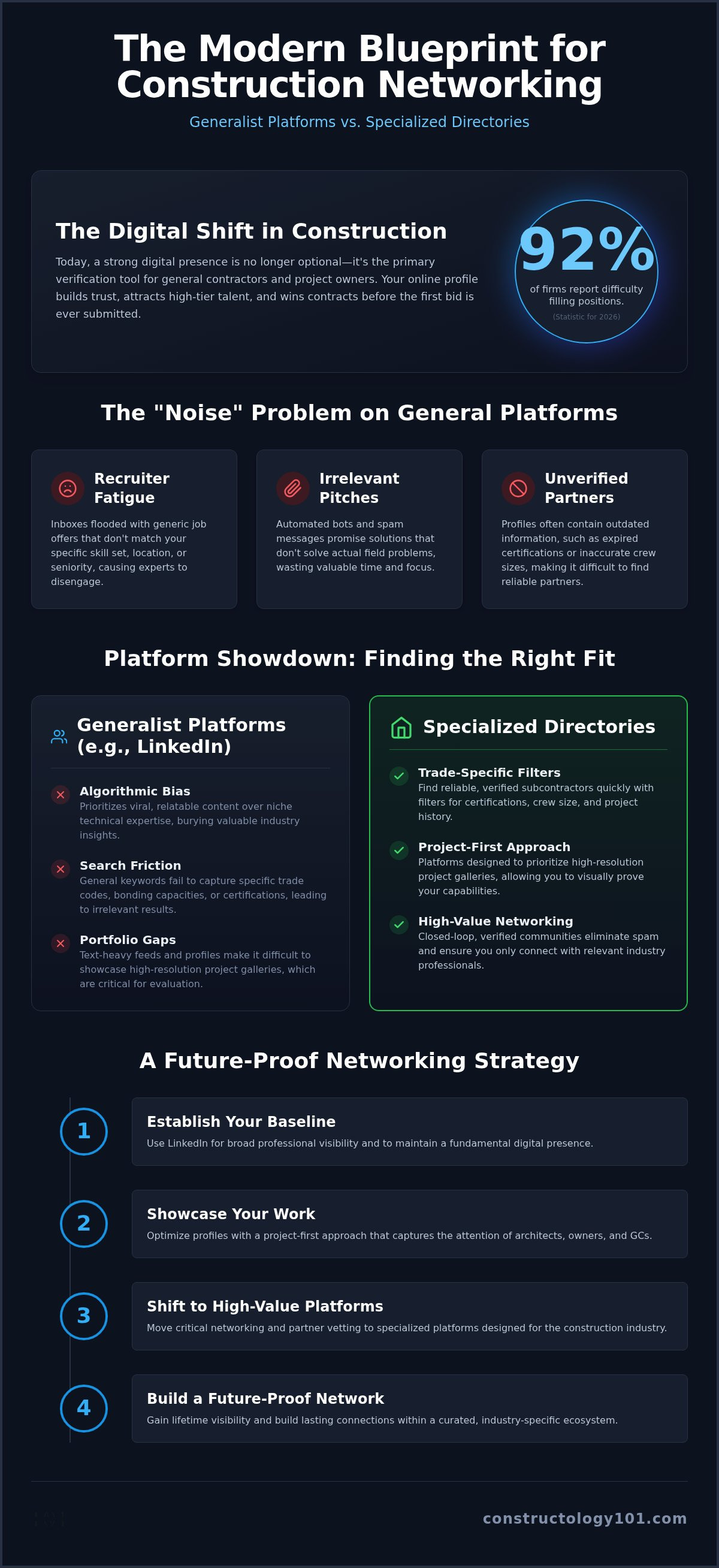
Trust is built before the first bid is even submitted. A strong online presence signals that your firm is professional, modern, and reliable. This visibility does more than just win jobs; it attracts high-tier talent. With 92% of construction firms reporting difficulty filling positions in 2026, your digital reputation is a critical recruiting tool. Commercial contract awards are increasingly influenced by how well a firm presents its safety record, team expertise, and past performance online. Build trust, attract talent, and win contracts by maintaining a sharp digital edge.
The Limitations of Generalist Networking
Generalist platforms struggle to handle the specific data needs of the trades. Search for a "Project Manager" on a general site, and you'll often sift through thousands of irrelevant results from the tech and finance sectors. LinkedIn for construction professionals can feel overly text-heavy, which limits your ability to showcase a complex physical project portfolio. You need to present visual proof of your work, not just a list of former employers.
- Algorithmic Bias: General platforms prioritize viral, relatable content over technical trade expertise.
- Search Friction: General keywords fail to capture specific trade codes, bonding capacities, or certifications.
- Portfolio Gaps: Text-heavy feeds bury the high-resolution project galleries that GCs need to see.
Generalist sites are designed for the masses, not the specialized requirements of a job site. This creates a friction point for professionals who need to find verified partners quickly without wading through unrelated sales pitches. You need a way to highlight project galleries and trade-specific experience that generalist filters simply cannot categorize.
The Noise Problem: Why General Platforms Often Fail Specialty Trades
LinkedIn for construction professionals has become a double-edged sword. While it connects millions, it also opens the door to relentless noise. Trade professionals are increasingly reporting recruiter fatigue. This happens when your inbox is flooded with generic job offers that don't match your specific skill set, location, or seniority. Many specialists are quietly stepping away from general social media because the time spent sifting through junk outweighs the value of the connections. They need a tool that respects their time and expertise.
Finding verified, niche-specific partners is another major hurdle. Generalist platforms often host unmanaged profiles with outdated information. You might find a great-looking electrical contractor only to realize their certifications expired two years ago or their crew size has shrunk. High-stakes projects require real-time data. Effective B2B networking in the construction industry requires more than just a list of names; it needs verified credentials, active project history, and current availability. Without these, you are just guessing.
Sifting Through Irrelevant Sales Pitches
Spam has evolved. Automated bots now target construction business owners with relentless precision. These pitches often promise lead generation or software solutions that don't solve your actual field problems. Protect your time. Focus on high-value interactions. A closed-loop industry community eliminates this clutter by requiring professional verification. It ensures you only talk to people who understand the difference between a change order and a site plan. This focus allows you to build a network that actually supports your bottom line.
The Difficulty of Finding Verified Subcontractors
Popularity does not equal skill. On general platforms, a subcontractor might have thousands of followers but zero recent project completions. This makes LinkedIn a poor choice for a commercial subcontractor database. You risk hiring based on social presence rather than trade proficiency. Specialized networks solve this by verifying industry credentials, safety records, and bonding capacity before you ever reach out. This layer of verification reduces risk and speeds up the procurement process.
General contractors also struggle with diversity requirements on general sites. LinkedIn simply isn't built to filter for minority-owned, veteran-owned, or specific specialty certifications. You can't just click a button to find a WOSB-certified masonry contractor in your region. Specialized directories offer these granular filters as a standard feature. If you're tired of the noise, consider moving your profile to an Interactive Directory Listing where your trade expertise is the priority.
LinkedIn vs. Specialized Construction Directories: A Direct Comparison
LinkedIn connects you with the world, but specialized directories connect you with the work. While LinkedIn for construction professionals provides a broad stage, it often lacks the surgical precision required for high-stakes procurement. You need more than a social connection; you need a verified partner with the right capacity. Generalist platforms prioritize engagement metrics, whereas specialized directories prioritize project readiness. The difference lies in the depth of the data and the quality of the interactions.
Communication efficiency is another major differentiator. InMail has become synonymous with automated spam. Direct industry messaging within a specialized network feels like a site-office conversation. It's fast, relevant, and professional. You don't have to worry about your message getting lost between a newsletter and a marketing bot. This efficiency moves projects forward faster. By limiting access to verified industry pros, these directories ensure that every connection has potential value. You aren't just adding a number to your follower count; you're adding a potential partner to your supply chain.
Searchability and Trade-Specific Filters
General search engines rely on keywords that often miss the mark. A search for "concrete" might return a supplier, a finisher, or even a blogger. Specialized platforms allow for finding construction subcontractors by specific CSI trade codes. This level of detail is vital for the U.S. design and construction sector where time is literally money. Using a national construction directory ensures you filter by project size, bonding capacity, and current certifications. Get the right data. Save your time. Win the bid.
Project Sharing and Portfolio Visualization
Visual proof is the currency of the construction world. LinkedIn's "Featured" section is cluttered and limited. It doesn't handle multi-image project walkthroughs or technical specifications well. You need a dedicated space to present your firm's capabilities without the distraction of a social feed. Interactive Directory Listings create a dynamic portfolio that acts as a living resume. Showcase your craftsmanship. Highlight your safety record. Prove your capability with high-resolution galleries that decision-makers actually want to see. This project-first approach ensures your best work stays front and center for the audience that matters most.
How to Optimize Your Construction Professional Profile for Maximum Reach
Your digital profile is more than a resume; it is a live bidding tool. Decision-makers in the construction industry don't have time to read between the lines. They need to know your trade, your capacity, and your reliability within seconds. Optimizing LinkedIn for construction professionals requires a shift from personal branding to project-focused data. If your profile doesn't immediately answer what you do and who you've done it for, you are losing contracts to competitors who are more visible.
Procurement teams use specific search patterns to find partners. They look for keywords like pre-construction, BIM coordination, or LEED certification. Audit your current bio to ensure these terms appear naturally. Use recommendations to build social proof. Ask previous general contractors to highlight your ability to meet deadlines, maintain safety standards, and manage budgets. These testimonials act as high-value references that speak directly to the needs of future partners. Build trust, demonstrate expertise, and secure your next big award.
Crafting a Headline That Wins Projects
Stop using generic titles like "Owner" or "President." These terms tell a GC nothing about your actual capabilities. Your headline should state your specialty and capacity immediately. A results-oriented header captures attention. Consider a structure that highlights your trade, your certifications, and your primary benefit. For example: "Commercial HVAC Specialist | MBE Certified | Delivering 15% Faster Turnaround on Large-Scale Retail Projects."
Include your most valuable certifications like MBE, WBE, or LEED in the visible profile header. This allows procurement officers to identify you as a qualified candidate before they even click your profile. Use a results-oriented summary that employs rhythmic triplets to define your value. Explain how you help partners ensure safety, drive efficiency, and maximize profit. This directness respects the reader's time and positions you as a proactive professional who understands the bottom line.
Leveraging Project Galleries and Interactive Listings
Visual evidence is non-negotiable. Select high-resolution images that represent your firm's technical capability. Showcase complex job sites, finished high-tier projects, and your team in action. To truly stand out, you must optimize your construction professional profile for search by tagging images with relevant trade keywords. This ensures your work appears in both general and niche searches.
LinkedIn is a great starting point, but it shouldn't be the finish line. Link your social presence back to a specialized directory to drive conversions. A specialized listing allows you to host a dynamic portfolio that generalist sites can't match. It provides a dedicated space for technical specs and project walkthroughs that decision-makers need to see. Take control of your professional growth today by securing an Interactive Directory Listing that puts your best work front and center.
Constructology 101: The Specialized Alternative for Industry Growth
LinkedIn for construction professionals is a solid foundation, but it isn't a complete solution for project procurement. We built a dedicated construction professional network to solve the noise problem once and for all. This platform focuses on project data, trade-specific filters, and direct communication. It acts as a streamlined bridge between your current capacity and your future potential. Stop sifting through irrelevant pitches and start engaging with the people who actually build. Our directory is designed for those who value speed, accuracy, and professional growth.
The integrated messaging system fosters real business relationships by removing the barriers found on generalist sites. It facilitates direct, professional dialogue between trades and decision-makers. You can share documents, verify credentials, and confirm site requirements instantly. This efficiency mirrors the speed of the job site itself. We prioritize results over likes. Our platform is built for professionals who need a reliable way to expand their reach, verify their partners, and win more work. The future of networking is interactive, niche, and highly efficient.
Benefits of the Pioneer Membership
Secure your spot at the ground floor while the platform scales nationally. Our Pioneer Membership offers lifetime access at a one-time price, ensuring you never have to worry about rising subscription costs. Position your business as a leader in this new digital industry hub. You get early access to advanced project sharing tools and networking features that keep you ahead of the competition. Lock in your deal, grow your visibility, and dominate your niche. This is a proactive step toward securing your firm's digital future.
Joining a Dedicated Construction Industry Community
Finding reliable construction partners shouldn't be a gamble. A niche platform accelerates growing construction business networking by removing the general public from the equation. You only connect with verified architects, engineers, and trades who understand your language. This high-value network allows you to showcase your project portfolio to the exact audience looking to hire. Eliminate the spam, target your audience, and build a network that actually supports your bottom line.
Niche communities provide the clarity that generalist sites often lack. By joining a dedicated industry hub, you eliminate the risk of outdated information and unverified claims. You gain access to specialized filters for minority-owned and specialty trades, making it easier to meet complex project requirements. This targeted approach ensures your profile is seen by those who need your specific expertise. Claim your Interactive Directory Listing today and start building the relationships that drive real project success.
Secure Your Competitive Edge in the Modern Marketplace
LinkedIn for construction professionals remains a vital baseline, but generalist networking alone won't secure your firm's future. You've seen how noise and irrelevant pitches can drain your productivity. Success in 2026 depends on your ability to showcase technical expertise, find verified partners quickly, and leverage trade-specific data. Transitioning to a specialized environment allows you to present your project portfolio to the exact decision-makers looking to hire.
Stop sifting through the clutter and start building meaningful connections. Join a specialized community of architects, engineers, and trades today. Build high-value industry relationships without the noise that stalls progress. Claim Your Pioneer Membership and Build Your Construction Network to secure lifetime access with our Pioneer Member program. This is your opportunity to lead the digital shift in the trades. Take action, showcase your craftsmanship, and watch your network drive real project success.
Frequently Asked Questions
Is LinkedIn enough for construction business networking?
LinkedIn is a baseline for credibility, but it isn't enough for specialized procurement. It lacks the trade-specific filters and verified data required for high-stakes projects. While LinkedIn for construction professionals helps with broad reach, it often results in recruiter fatigue and irrelevant sales pitches. You need a niche platform to supplement your efforts. This allows you to connect with verified partners and showcase project portfolios without the general social noise.
What should a construction professional's LinkedIn headline look like?
Your headline must be specific, results-oriented, and capacity-driven. Move beyond generic titles like "Owner" or "Manager." State your specialty trade, highlight key certifications like MBE or LEED, and include a clear value proposition. A strong example is: "Specialty Electrical Contractor | WBE Certified | Reducing Site Downtime by 20% on Commercial Projects." This directness captures the attention of GCs and project owners searching for specific expertise immediately.
How do I find specialty subcontractors on professional networks?
Finding reliable partners requires looking past social popularity. Use search filters for specific trade codes and certifications rather than general keywords. On specialized networks, you can filter for minority-owned or specialty trades directly. Verify their recent project history and safety records before reaching out. This targeted approach ensures you find subcontractors with the actual capacity and skill set needed for your project, saving you hours of manual vetting.
What are the best alternatives to LinkedIn for contractors?
Specialized industry directories and niche social networks offer the best alternatives to generalist platforms. Constructology 101 provides a dedicated environment for architects, engineers, and trades. These platforms offer integrated messaging, project galleries, and trade-specific filters that LinkedIn lacks. By joining a dedicated hub, you eliminate the distractions of general social media. You focus entirely on building high-value industry relationships that lead to real contract awards and project growth.
How can I showcase my construction projects online effectively?
Use high-resolution project galleries that highlight technical complexity and craftsmanship. Static text descriptions are rarely enough for procurement teams. Implement a project-first approach by tagging images with relevant trade keywords and technical specifications. Interactive directory listings allow you to create dynamic portfolios that act as a living resume. This visual proof builds trust quickly. It allows general contractors to verify your firm's capabilities and safety standards before the first meeting.
What is a construction interactive directory listing?
An interactive directory listing is a professional profile within a specialized industry hub. Unlike a static phone book entry, it allows you to showcase project galleries, share technical certifications, and communicate through integrated messaging. It helps your business be discovered by peers searching for exact skills or services. These listings prioritize trade-specific data. They make it easy for architects and general contractors to find, vet, and contact you for upcoming projects.
How do I network with architects and engineers online?
Engage with them in dedicated industry communities where technical expertise is the primary focus. Share detailed project updates that highlight how you solved specific engineering or design challenges. Use integrated messaging systems to ask direct questions or offer collaboration on upcoming bids. By positioning yourself as a proactive problem-solver rather than just another vendor, you build the professional trust required for long-term partnerships. This approach fosters growth, builds credibility, and expands your reach.
Is a specialized construction network worth the investment?
Yes, because it provides targeted visibility that generalist platforms cannot match. A specialized network reduces the cost of business development by putting your profile in front of a pre-verified audience. Programs like the Pioneer Membership offer lifetime access at a one-time price. This ensures long-term value as the platform grows. You gain a competitive advantage by securing your spot in a noise-free environment. Every connection has the potential to become a project-winning partnership.


